

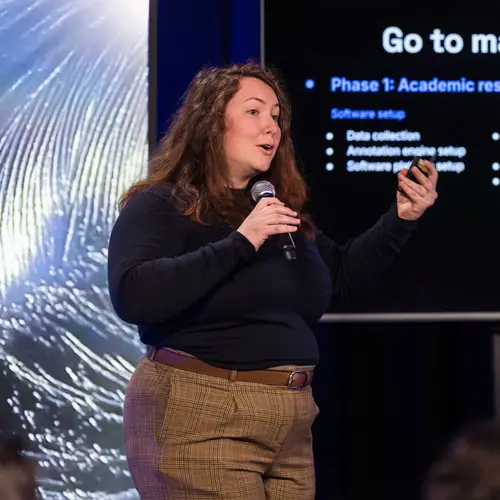

Portrait de Smita Krishnaswamy

Smita Krishnaswamy

Membre affilié
Professeure associée, Yale University
Université de Montréal
Yale
Sujets de recherche
Apprentissage de représentations
Apprentissage profond
Apprentissage profond géométrique
Apprentissage spectral
Apprentissage sur variétés
Biologie computationnelle
Géométrie des données
IA en santé
Interfaces cerveau-ordinateur
Modèles génératifs
Modélisation moléculaire
Neurosciences computationnelles
Parcimonie des données
Réseaux de neurones en graphes
Science cognitive
Science des données
Systèmes dynamiques
Théorie de l'information

Biographie

Notre laboratoire travaille sur le développement de méthodes mathématiques fondamentales d'apprentissage automatique et d'apprentissage profond qui intègrent l'apprentissage basé sur les graphes, le traitement du signal, la théorie de l'information, la géométrie et la topologie des données, le transport optimal et la modélisation dynamique qui sont capables d'effectuer une analyse exploratoire, une inférence scientifique, une interprétation et une génération d'hypothèses de grands ensembles de données biomédicales allant des données de cellules uniques, à l'imagerie cérébrale, aux ensembles de données structurelles moléculaires provenant des neurosciences, de la psychologie, de la biologie des cellules souches, de la biologie du cancer, des soins de santé, et de la biochimie. Nos travaux ont été déterminants pour l'apprentissage de trajectoires dynamiques à partir de données instantanées statiques, le débruitage des données, la visualisation, l'inférence de réseaux, la modélisation de structures moléculaires et bien d'autres choses encore.

Étudiants actuels

Collaborateur·rice de recherche - Yale University
Superviseur⋅e principal⋅e :

Publications

HSV-2 triggers upregulation of MALAT1 in CD4+ T cells and promotes HIV latency reversal
Carl A. Pierce
Lip Nam Loh
Holly Steach
Natalia Cheshenko
Paula Preston-Hurlburt
Fengrui Zhang
Stephanie Stransky
Leah Kravets
Simone Sidoli
William Philbrick
Michel Nassar
Kevan C. Herold
Betsy C. Herold
Herpes simplex virus type 2 (HSV-2) coinfection is associated with increased HIV-1 viral loads and expanded tissue reservoirs, but the mecha… (voir plus)nisms are not well defined. HSV-2 recurrences result in an influx of activated CD4+ T cells to sites of viral replication and an increase in activated CD4+ T cells in peripheral blood. We hypothesized that HSV-2 induces changes in these cells that facilitate HIV-1 reactivation and replication and tested this hypothesis in human CD4+ T cells and 2D10 cells, a model of HIV-1 latency. HSV-2 promoted latency reversal in HSV-2–infected and bystander 2D10 cells. Bulk and single-cell RNA-Seq studies of activated primary human CD4+ T cells identified decreased expression of HIV-1 restriction factors and increased expression of transcripts including MALAT1 that could drive HIV replication in both the HSV-2–infected and bystander cells. Transfection of 2D10 cells with VP16, an HSV-2 protein that regulates transcription, significantly upregulated MALAT1 expression, decreased trimethylation of lysine 27 on histone H3 protein, and triggered HIV latency reversal. Knockout of MALAT1 from 2D10 cells abrogated the response to VP16 and reduced the response to HSV-2 infection. These results demonstrate that HSV-2 contributes to HIV-1 reactivation through diverse mechanisms, including upregulation of MALAT1 to release epigenetic silencing.
Graph Fourier MMD for Signals on Graphs
While numerous methods have been proposed for computing distances between probability distributions in Euclidean space, relatively little at… (voir plus)tention has been given to computing such distances for distributions on graphs. However, there has been a marked increase in data that either lies on graph (such as protein interaction networks) or can be modeled as a graph (single cell data), particularly in the biomedical sciences. Thus, it becomes important to find ways to compare signals defined on such graphs. Here, we propose Graph Fourier MMD (GFMMD), a novel distance between distributions and signals on graphs. GFMMD is defined via an optimal witness function that is both smooth on the graph and maximizes difference in expectation between the pair of distributions on the graph. We find an analytical solution to this optimization problem as well as an embedding of distributions that results from this method. We also prove several properties of this method including scale invariance and applicability to disconnected graphs. We showcase it on graph benchmark datasets as well on single cell RNA-sequencing data analysis. In the latter, we use the GFMMD-based gene embeddings to find meaningful gene clusters. We also propose a novel type of score for gene selection called "gene localization score" which helps select genes for cellular state space characterization.
Single-cell analysis reveals inflammatory interactions driving macular degeneration
Manik Kuchroo
Marcello DiStasio
Eric Song
Eda Calapkulu
Maryam Ige
Amar H. Sheth
Abdelilah Majdoubi
Madhvi Menon
Abhinav Godavarthi
Yu Xing
Scott Gigante
Holly R. Steach
Janhavi Narain
Kisung You
George Mourgkos
Rahul M. Dhodapkar … (voir 5 de plus)
Matthew Hirn
Bastian Rieck
Brian P. Hafler
Due to commonalities in pathophysiology, age-related macular degeneration (AMD) represents a uniquely accessible model to investigate thera… (voir plus)pies for neurodegenerative diseases, leading us to examine whether pathways of disease progression are shared across neurodegenerative conditions. Here we use single-nucleus RNA sequencing to profile lesions from 11 postmortem human retinas with age-related macular degeneration and 6 control retinas with no history of retinal disease. We create a machine-learning pipeline based on recent advances in data geometry and topology and identify activated glial populations enriched in the early phase of disease. Examining single-cell data from Alzheimer’s disease and progressive multiple sclerosis with our pipeline, we find a similar glial activation profile enriched in the early phase of these neurodegenerative diseases. In late-stage age-related macular degeneration, we identify a microglia-to-astrocyte signaling axis mediated by interleukin-1β which drives angiogenesis characteristic of disease pathogenesis. We validated this mechanism using in vitro and in vivo assays in mouse, identifying a possible new therapeutic target for AMD and possibly other neurodegenerative conditions. Thus, due to shared glial states, the retina provides a potential system for investigating therapeutic approaches in neurodegenerative diseases.
Geodesic Sinkhorn for Fast and Accurate Optimal Transport on Manifolds
María Ramos Zapatero
Christopher J. Tape
Efficient computation of optimal transport distance between distributions is of growing importance in data science. Sinkhorn-based methods a… (voir plus)re currently the state-of-the-art for such computations, but require
A Heat Diffusion Perspective on Geodesic Preserving Dimensionality Reduction
Edward De Brouwer
Yanlei Zhang
Ian Adelstein
Diffusion-based manifold learning methods have proven useful in representation learning and dimensionality reduction of modern high dimensio… (voir plus)nal, high throughput, noisy datasets. Such datasets are especially present in fields like biology and physics. While it is thought that these methods preserve underlying manifold structure of data by learning a proxy for geodesic distances, no specific theoretical links have been established. Here, we establish such a link via results in Riemannian geometry explicitly connecting heat diffusion to manifold distances. In this process, we also formulate a more general heat kernel based manifold embedding method that we call heat geodesic embeddings. This novel perspective makes clearer the choices available in manifold learning and denoising. Results show that our method outperforms existing state of the art in preserving ground truth manifold distances, and preserving cluster structure in toy datasets. We also showcase our method on single cell RNA-sequencing datasets with both continuum and cluster structure, where our method enables interpolation of withheld timepoints of data. Finally, we show that parameters of our more general method can be configured to give results similar to PHATE (a state-of-the-art diffusion based manifold learning method) as well as SNE (an attraction/repulsion neighborhood based method that forms the basis of t-SNE).
Inferring dynamic regulatory interaction graphs from time series data with perturbations
Dhananjay Bhaskar
Sumner Magruder
Edward De Brouwer
Matheo Morales
Aarthi Venkat
Complex systems are characterized by intricate interactions between entities that evolve dynamically over time. Accurate inference of these … (voir plus)dynamic relationships is crucial for understanding and predicting system behavior. In this paper, we propose Regulatory Temporal Interaction Network Inference (RiTINI) for inferring time-varying interaction graphs in complex systems using a novel combination of space-and-time graph attentions and graph neural ordinary differential equations (ODEs). RiTINI leverages time-lapse signals on a graph prior, as well as perturbations of signals at various nodes in order to effectively capture the dynamics of the underlying system. This approach is distinct from traditional causal inference networks, which are limited to inferring acyclic and static graphs. In contrast, RiTINI can infer cyclic, directed, and time-varying graphs, providing a more comprehensive and accurate representation of complex systems. The graph attention mechanism in RiTINI allows the model to adaptively focus on the most relevant interactions in time and space, while the graph neural ODEs enable continuous-time modeling of the system's dynamics. We evaluate RiTINI's performance on various simulated and real-world datasets, demonstrating its state-of-the-art capability in inferring interaction graphs compared to previous methods.
Multi-view manifold learning of human brain-state trajectories.
Erica L. Busch
Andrew Benz
Tom Wallenstein
Nicholas B. Turk-Browne
The complexity of the human brain gives the illusion that brain activity is intrinsically high-dimensional. Nonlinear dimensionality-reducti… (voir plus)on methods such as uniform manifold approximation and t-distributed stochastic neighbor embedding have been used for high-throughput biomedical data. However, they have not been used extensively for brain activity data such as those from functional magnetic resonance imaging (fMRI), primarily due to their inability to maintain dynamic structure. Here we introduce a nonlinear manifold learning method for time-series data—including those from fMRI—called temporal potential of heat-diffusion for affinity-based transition embedding (T-PHATE). In addition to recovering a low-dimensional intrinsic manifold geometry from time-series data, T-PHATE exploits the data’s autocorrelative structure to faithfully denoise and unveil dynamic trajectories. We empirically validate T-PHATE on three fMRI datasets, showing that it greatly improves data visualization, classification, and segmentation of the data relative to several other state-of-the-art dimensionality-reduction benchmarks. These improvements suggest many potential applications of T-PHATE to other high-dimensional datasets of temporally diffuse processes.
Time-inhomogeneous diffusion geometry and topology
Bastian Rieck
Manik Kuchroo
Matthew Hirn
Diffusion condensation is a dynamic process that yields a sequence of multiscale data representations that aim to encode meaningful abstract… (voir plus)ions. It has proven effective for manifold learning, denoising, clustering, and visualization of high-dimensional data. Diffusion condensation is constructed as a time-inhomogeneous process where each step first computes and then applies a diffusion operator to the data. We theoretically analyze the convergence and evolution of this process from geometric, spectral, and topological perspectives. From a geometric perspective, we obtain convergence bounds based on the smallest transition probability and the radius of the data, whereas from a spectral perspective, our bounds are based on the eigenspectrum of the diffusion kernel. Our spectral results are of particular interest since most of the literature on data diffusion is focused on homogeneous processes. From a topological perspective, we show diffusion condensation generalizes centroid-based hierarchical clustering. We use this perspective to obtain a bound based on the number of data points, independent of their location. To understand the evolution of the data geometry beyond convergence, we use topological data analysis. We show that the condensation process itself defines an intrinsic condensation homology. We use this intrinsic topology as well as the ambient persistent homology of the condensation process to study how the data changes over diffusion time. We demonstrate both types of topological information in well-understood toy examples. Our work gives theoretical insights into the convergence of diffusion condensation, and shows that it provides a link between topological and geometric data analysis.
Manifold Interpolating Optimal-Transport Flows for Trajectory Inference
D.S. Magruder
Oluwadamilola Fasina
Manik Kuchroo
We present a method called Manifold Interpolating Optimal-Transport Flow (MIOFlow) that learns stochastic, continuous population dynamics fr… (voir plus)om static snapshot samples taken at sporadic timepoints. MIOFlow combines dynamic models, manifold learning, and optimal transport by training neural ordinary differential equations (Neural ODE) to interpolate between static population snapshots as penalized by optimal transport with manifold ground distance. Further, we ensure that the flow follows the geometry by operating in the latent space of an autoencoder that we call a geodesic autoencoder (GAE). In GAE the latent space distance between points is regularized to match a novel multiscale geodesic distance on the data manifold that we define. We show that this method is superior to normalizing flows, Schrödinger bridges and other generative models that are designed to flow from noise to data in terms of interpolating between populations. Theoretically, we link these trajectories with dynamic optimal transport. We evaluate our method on simulated data with bifurcations and merges, as well as scRNA-seq data from embryoid body differentiation, and acute myeloid leukemia treatment.
Learning Shared Neural Manifolds from Multi-Subject fMRI Data
Erica Busch
Tom Wallenstein
Michal Gerasimiuk
Andrew Benz
Nicholas Turk-Browne
Functional magnetic resonance imaging (fMRI) is a notoriously noisy measurement of brain activity because of the large variations between in… (voir plus)dividuals, signals marred by environmental differences during collection, and spatiotemporal averaging required by the measurement resolution. In addition, the data is extremely high dimensional, with the space of the activity typically having much lower intrinsic dimension. In order to understand the connection between stimuli of interest and brain activity, and analyze differences and commonalities between subjects, it becomes important to learn a meaningful embedding of the data that denoises, and reveals its intrinsic structure. Specifically, we assume that while noise varies significantly between individuals, true responses to stimuli will share common, low-dimensional features between subjects which are jointly discoverable. Similar approaches have been exploited previously but they have mainly used linear methods such as PCA and shared response modeling (SRM). In contrast, we propose a neural network called MRMD-AE (manifold-regularized multiple decoder, autoencoder), that learns a common embedding from multiple subjects in an experiment while retaining the ability to decode to individual raw fMRI signals. We show that our learned common space represents an extensible manifold (where new points not seen during training can be mapped), improves the classification accuracy of stimulus features of unseen timepoints, as well as improves cross-subject translation of fMRI signals. We believe this framework can be used for many downstream applications such as guided brain-computer interface (BCI) training in the future.
Embedding Signals on Graphs with Unbalanced Diffusion Earth Mover’s Distance
In modern relational machine learning it is common to encounter large graphs that arise via interactions or similarities between observation… (voir plus)s in many domains. Further, in many cases the target entities for analysis are actually signals on such graphs. We propose to compare and organize such datasets of graph signals by using an earth mover’s distance (EMD) with a geodesic cost over the underlying graph. Typically, EMD is computed by optimizing over the cost of transporting one probability distribution to another over an underlying metric space. However, this is inefficient when computing the EMD between many signals. Here, we propose an unbalanced graph EMD that efficiently embeds the unbalanced EMD on an underlying graph into an L(1) space, whose metric we call unbalanced diffusion earth mover’s distance (UDEMD). Next, we show how this gives distances between graph signals that are robust to noise. Finally, we apply this to organizing patients based on clinical notes, embedding cells modeled as signals on a gene graph, and organizing genes modeled as signals over a large cell graph. In each case, we show that UDEMD-based embeddings find accurate distances that are highly efficient compared to other methods.
Population Genomics Approaches for Genetic Characterization of SARS-CoV-2 Lineages
Isabel Gamache
Arnaud N'Guessan
Justin Pelletier
Carmen Lia Murall
Vanda Gaonac’h-Lovejoy
David J. Hamelin
Raphaël Poujol
Jean-Christophe Grenier
Martin Smith
Etienne Caron
Morgan Craig
B. Jesse Shapiro
Julie G. Hussin
The genome of the Severe Acute Respiratory Syndrome coronavirus 2 (SARS-CoV-2), the pathogen that causes coronavirus disease 2019 (COVID-19)… (voir plus), has been sequenced at an unprecedented scale leading to a tremendous amount of viral genome sequencing data. To assist in tracing infection pathways and design preventive strategies, a deep understanding of the viral genetic diversity landscape is needed. We present here a set of genomic surveillance tools from population genetics which can be used to better understand the evolution of this virus in humans. To illustrate the utility of this toolbox, we detail an in depth analysis of the genetic diversity of SARS-CoV-2 in first year of the COVID-19 pandemic. We analyzed 329,854 high-quality consensus sequences published in the GISAID database during the pre-vaccination phase. We demonstrate that, compared to standard phylogenetic approaches, haplotype networks can be computed efficiently on much larger datasets. This approach enables real-time lineage identification, a clear description of the relationship between variants of concern, and efficient detection of recurrent mutations. Furthermore, time series change of Tajima's D by haplotype provides a powerful metric of lineage expansion. Finally, principal component analysis (PCA) highlights key steps in variant emergence and facilitates the visualization of genomic variation in the context of SARS-CoV-2 diversity. The computational framework presented here is simple to implement and insightful for real-time genomic surveillance of SARS-CoV-2 and could be applied to any pathogen that threatens the health of populations of humans and other organisms.