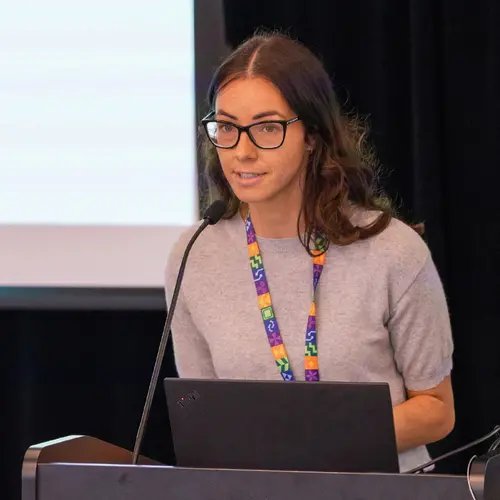
Rejoignez-nous le 19 novembre pour la troisième édition du concours de vulgarisation scientifique de Mila, où les étudiant·e·s présenteront leurs recherches complexes en trois minutes devant un jury.
Nous utilisons des témoins pour analyser le trafic et l’utilisation de notre site web, afin de personnaliser votre expérience. Vous pouvez désactiver ces technologies à tout moment, mais cela peut restreindre certaines fonctionnalités du site. Consultez notre Politique de protection de la vie privée pour en savoir plus.
Paramètre des cookies
Vous pouvez activer et désactiver les types de cookies que vous souhaitez accepter. Cependant certains choix que vous ferez pourraient affecter les services proposés sur nos sites (ex : suggestions, annonces personnalisées, etc.).
Cookies essentiels
Ces cookies sont nécessaires au fonctionnement du site et ne peuvent être désactivés. (Toujours actif)
Cookies analyse
Acceptez-vous l'utilisation de cookies pour mesurer l'audience de nos sites ?
Lecteur Multimédia
Acceptez-vous l'utilisation de cookies pour afficher et vous permettre de regarder les contenus vidéo hébergés par nos partenaires (YouTube, etc.) ?
There is increasing adoption of artificial intelligence in drug discovery. However, existing studies use machine learning to mainly utilize … (voir plus)the chemical structures of molecules but ignore the vast textual knowledge available in chemistry. Incorporating textual knowledge enables us to realize new drug design objectives, adapt to text-based instructions and predict complex biological activities. Here we present a multi-modal molecule structure-text model, MoleculeSTM, by jointly learning molecules' chemical structures and textual descriptions via a contrastive learning strategy. To train MoleculeSTM, we construct a large multi-modal dataset, namely, PubChemSTM, with over 280,000 chemical structure-text pairs. To demonstrate the effectiveness and utility of MoleculeSTM, we design two challenging zero-shot tasks based on text instructions, including structure-text retrieval and molecule editing. MoleculeSTM has two main properties: open vocabulary and compositionality via natural language. In experiments, MoleculeSTM obtains the state-of-the-art generalization ability to novel biochemical concepts across various benchmarks.
The dynamic nature of proteins is crucial for determining their biological functions and properties, and molecular dynamics (MD) simulations… (voir plus) stand as a predominant tool to study such phenomena. By utilizing empirically derived force fields, MD simulations explore the conformational space through numerically evolving the system along MD trajectories. However, the high-energy barrier of the force fields can hamper the exploration of MD, resulting in inadequately sampled ensemble. In this paper, we propose leveraging score-based generative models (SGMs) trained on large-scale general protein structures to perform protein con- formational sampling to complement traditional MD simulations. Experimental results demonstrate the effectiveness of our approach on several benchmark systems by comparing the results with long MD trajectories and state-of-the-art generative structure prediction models.
Proteins are macromolecules that perform essential functions in all living organisms. Designing novel proteins with specific structures and … (voir plus)desired functions has been a long-standing challenge in the field of bioengineering. Existing approaches generate both protein sequence and structure using either autoregressive models or diffusion models, both of which suffer from high inference costs. In this paper, we propose a new approach capable of protein sequence and structure co-design, which iteratively translates both protein sequence and structure into the desired state from random initialization, based on context features given a priori. Our model consists of a trigonometry-aware encoder that reasons geometrical constraints and interactions from context features, and a roto-translation equivariant decoder that translates protein sequence and structure interdependently. Notably, all protein amino acids are updated in one shot in each translation step, which significantly accelerates the inference process. Experimental results across multiple tasks show that our model outperforms previous state-of-the-art baselines by a large margin, and is able to design proteins of high fidelity as regards both sequence and structure, with running time orders of magnitude less than sampling-based methods.
Deep generative models have been extensively explored recently, especially for the graph data such as molecular graphs and point clouds. Yet… (voir plus), much less investigation has been carried out on understanding the learned latent space of deep graph generative models. Such understandings can open up a unified perspective and provide guidelines for essential tasks like controllable generation. In this paper, we first examine the representation space of the recent deep generative model trained for graph data, observing that the learned representation space is not perfectly disentangled. Based on this observation, we then propose an unsupervised method called GraphCG, which is model-agnostic and task-agnostic for discovering steerable factors in graph data. Specifically, GraphCG learns the semantic-rich directions via maximizing the corresponding mutual information, where the edited graph along the same direction will possess certain steerable factors. We conduct experiments on two types of graph data, molecular graphs and point clouds. Both the quantitative and qualitative results show the effectiveness of GraphCG for discovering steerable factors. The code will be public in the near future.
We are now witnessing significant progress of deep learning methods in a variety of tasks (or datasets) of proteins. However, there is a lac… (voir plus)k of a standard benchmark to evaluate the performance of different methods, which hinders the progress of deep learning in this field. In this paper, we propose such a benchmark called PEER, a comprehensive and multi-task benchmark for Protein sEquence undERstanding. PEER provides a set of diverse protein understanding tasks including protein function prediction, protein localization prediction, protein structure prediction, protein-protein interaction prediction, and protein-ligand interaction prediction. We evaluate different types of sequence-based methods for each task including traditional feature engineering approaches, different sequence encoding methods as well as large-scale pre-trained protein language models. In addition, we also investigate the performance of these methods under the multi-task learning setting. Experimental results show that large-scale pre-trained protein language models achieve the best performance for most individual tasks, and jointly training multiple tasks further boosts the performance. The datasets and source codes of this benchmark are all available at https://github.com/DeepGraphLearning/PEER_Benchmark