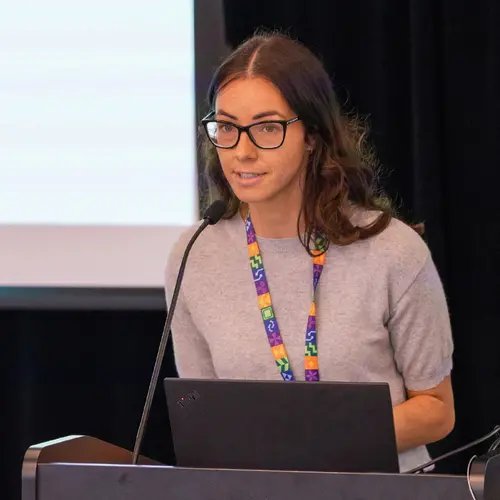
Portrait de Jessica Ojo

Jessica Ojo

Maîtrise recherche - McGill
Superviseur⋅e principal⋅e
Sujets de recherche
Apprentissage automatique pour la parole et l'audio
Évaluation linguistique des modèles de langage
Grands modèles de langage (LLM)
Mise à l'échelle des infrastructures d'ingénierie pour l'entraînement de grands modèles
Traduction automatique

Publications

AfriMTE and AfriCOMET: Empowering COMET to Embrace Under-resourced African Languages
Jiayi Wang
Sweta Agrawal
Ricardo Rei
Eleftheria Briakou
Marine Carpuat
Marek Masiak
Xuanli He
Sofia Bourhim
Andiswa Bukula
Muhidin A. Mohamed
Temitayo Olatoye
Hamam Mokayede
Christine Mwase
Wangui Kimotho
Foutse Yuehgoh
Anuoluwapo Aremu
Shamsuddeen Hassan Muhammad
Salomey Osei … (voir 37 de plus)
Abdul-Hakeem Omotayo
Chiamaka Chukwuneke
Perez Ogayo
Oumaima Hourrane
Salma El Anigri
Lolwethu Ndolela
Thabiso Mangwana
Shafie Abdi Mohamed
Ayinde Hassan
Oluwabusayo Olufunke Awoyomi
Lama Alkhaled
sana Sabah al-azzawi
Naome A. Etori
Millicent A. Ochieng
Clemencia Siro
Samuel Njoroge
Eric Muchiri
Wangari Kimotho
Lyse Naomi Wamba Momo
Daud Abolade
Simbiat Ajao
Tosin P. Adewumi
Iyanuoluwa Shode
Ricky Macharm
Ruqayya Nasir Iro
Saheed Salahudeen Abdullahi
Stephen E. Moore
Bernard Opoku
Zainab Akinjobi
Abeeb Afolabi
Nnaemeka Casmir Obiefuna
Onyekachi Ogbu
Sam Brian
V. Otiende
CHINEDU EMMANUEL MBONU
Toadoum Sari Sakayo
Pontus Stenetorp
Despite the progress we have recorded in scaling multilingual machine translation (MT) models and evaluation data to several under-resourced… (voir plus) African languages, it is difficult to measure accurately the progress we have made on these languages because evaluation is often performed on n -gram matching metrics like BLEU that often have worse correlation with human judgments. Embedding-based metrics such as COMET correlate better; however, lack of evaluation data with human ratings for under-resourced languages, complexity of annotation guidelines like Multidimensional Quality Metrics (MQM), and limited language coverage of multilingual encoders have hampered their applicability to African languages. In this paper, we address these challenges by creating high-quality human evaluation data with a simplified MQM guideline for error-span annotation and direct assessment (DA) scoring for 13 typologi-cally diverse African languages. Furthermore, we develop A FRI COMET—a COMET evaluation metric for African languages by leveraging DA training data from high-resource languages and African-centric multilingual encoder (AfroXLM-Roberta) to create the state-of-the-art evaluation metric for African languages MT with respect to Spearman-rank correlation with human judgments ( +0 . 406 ).
MasakhaNEWS: News Topic Classification for African languages
Marek Masiak
Israel Abebe Azime
Jesujoba Oluwadara Alabi
Atnafu Lambebo Tonja
Christine Mwase
Odunayo Ogundepo
Bonaventure F. P. Dossou
Akintunde Oladipo
Doreen Nixdorf
sana Sabah al-azzawi
Blessing Kudzaishe Sibanda
Davis David
Lolwethu Ndolela
Jonathan Mukiibi
Tunde Oluwaseyi Ajayi
Tatiana Moteu Ngoli
Brian Odhiambo
Abraham Toluwase Owodunni … (voir 42 de plus)
Nnaemeka Casmir Obiefuna
Shamsuddeen Hassan Muhammad
Saheed Salahudeen Abdullahi
Mesay Gemeda Yigezu
Tajuddeen Gwadabe
Idris Abdulmumin
Mahlet Taye Bame
Oluwabusayo Olufunke Awoyomi
Iyanuoluwa Shode
Tolulope Anu Adelani
Habiba Abdulganiy Kailani
Abdul-Hakeem Omotayo
Adetola Adeeko
Afolabi Abeeb
Aremu Anuoluwapo
Olanrewaju Samuel
Clemencia Siro
Wangari Kimotho
Onyekachi Ogbu
CHINEDU EMMANUEL MBONU
Chiamaka Ijeoma Chukwuneke
Samuel Fanijo
Oyinkansola Fiyinfoluwa Awosan
Tadesse Kebede Guge
Toadoum Sari Sakayo
Pamela Nyatsine
Freedmore Sidume
Oreen Yousuf
Mardiyyah Oduwole
USSEN ABRE KIMANUKA
Kanda Patrick Tshinu
Thina Diko
Siyanda Nxakama
Abdulmejid Tuni Johar
Sinodos Gebre
Muhidin A. Mohamed
Shafie Abdi Mohamed
Fuad Mire Hassan
Moges Ahmed Mehamed
Evrard Ngabire
Pontus Stenetorp

African languages are severely under-represented in NLP research due to lack of datasets covering several NLP tasks. While there are individ… (voir plus)ual language specific datasets that are being expanded to different tasks, only a handful of NLP tasks (e.g. named entity recognition and machine translation) have standardized benchmark datasets covering several geographical and typologically-diverse African languages. In this paper, we develop MasakhaNEWS -- a new benchmark dataset for news topic classification covering 16 languages widely spoken in Africa. We provide an evaluation of baseline models by training classical machine learning models and fine-tuning several language models. Furthermore, we explore several alternatives to full fine-tuning of language models that are better suited for zero-shot and few-shot learning such as cross-lingual parameter-efficient fine-tuning (like MAD-X), pattern exploiting training (PET), prompting language models (like ChatGPT), and prompt-free sentence transformer fine-tuning (SetFit and Cohere Embedding API). Our evaluation in zero-shot setting shows the potential of prompting ChatGPT for news topic classification in low-resource African languages, achieving an average performance of 70 F1 points without leveraging additional supervision like MAD-X. In few-shot setting, we show that with as little as 10 examples per label, we achieved more than 90\% (i.e. 86.0 F1 points) of the performance of full supervised training (92.6 F1 points) leveraging the PET approach.