

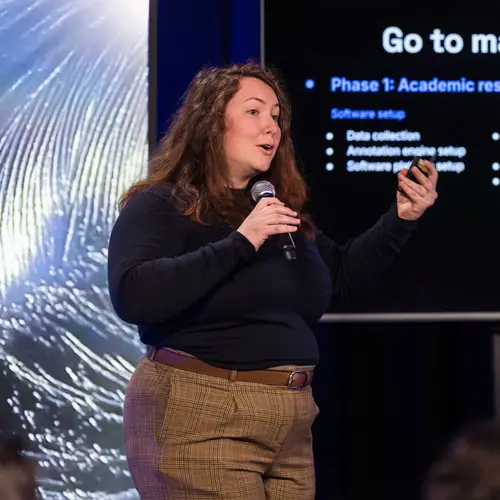

Portrait de Dhanya Sridhar

Dhanya Sridhar

Membre académique principal
Chaire en IA Canada-CIFAR
Professeure adjointe, Université de Montréal, Département d'informatique et de recherche opérationnelle
Sujets de recherche
Apprentissage de représentations
Apprentissage profond
Causalité
Modèles probabilistes
Raisonnement

Biographie

Dhanya Sridhar est professeure adjointe au Département d'informatique et de recherche opérationnelle (DIRO) de l'Université de Montréal, membre académique principale de Mila – Institut québécois d'intelligence artificielle et titulaire d'une chaire en IA Canada-CIFAR. Auparavant, elle a été chercheuse postdoctorale à l’Université Columbia. Elle a obtenu un doctorat de l’Université de la Californie à Santa Cruz. Ses recherches portent sur la combinaison de la causalité et de l'apprentissage automatique au service de systèmes d'IA qui sont résistants aux changements de distribution, s'adaptent efficacement à de nouvelles tâches et découvrent de nouvelles connaissances en même temps que nous.

Étudiants actuels

Doctorat - UdeM
Co-superviseur⋅e :
Collaborateur·rice de recherche - Helmholtz AI
Visiteur de recherche indépendant - University of Maryland College Park
Doctorat - UdeM
Maîtrise recherche - UdeM
Superviseur⋅e principal⋅e :
Doctorat - UdeM
Superviseur⋅e principal⋅e :
Doctorat - UdeM
Superviseur⋅e principal⋅e :
Doctorat - UdeM
Superviseur⋅e principal⋅e :

Publications

Heterogeneous Supervised Topic Models
Hal Daumé III
David Blei
Researchers in the social sciences are often interested in the relationship between text and an outcome of interest, where the goal is to bo… (voir plus)th uncover latent patterns in the text and predict outcomes for unseen texts. To this end, this paper develops the heterogeneous supervised topic model (HSTM), a probabilistic approach to text analysis and prediction. HSTMs posit a joint model of text and outcomes to find heterogeneous patterns that help with both text analysis and prediction. The main benefit of HSTMs is that they capture heterogeneity in the relationship between text and the outcome across latent topics. To fit HSTMs, we develop a variational inference algorithm based on the auto-encoding variational Bayes framework. We study the performance of HSTMs on eight datasets and find that they consistently outperform related methods, including fine-tuned black-box models. Finally, we apply HSTMs to analyze news articles labeled with pro- or anti-tone. We find evidence of differing language used to signal a pro- and anti-tone.