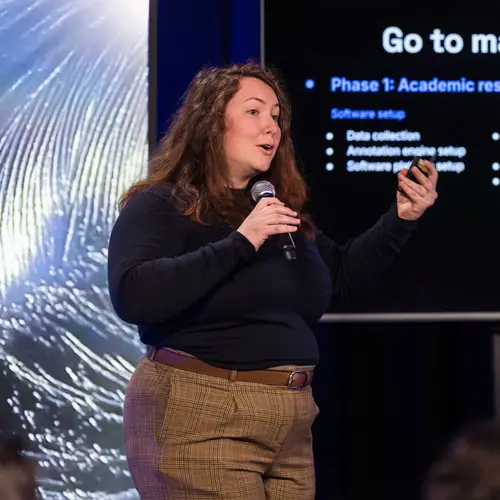
La prochaine rencontre, qui aura lieu le 10 novembre à Mila, permettra d'explorer comment pouvons-nous collectivement développer, encadrer et déployer des systèmes agentiques performants, fiables et sécuritaires en connectant chercheur·euse·s académiques, expert·e·s industriel·le·s et praticien·ne·s.
Ce programme à temps partiel offre aux scientifiques l'opportunité de tester leur intérêt pour l'entrepreneuriat. Vous avez jusqu'au 5 octobre pour postuler.
Avantage IA : productivité dans la fonction publique
Apprenez à tirer parti de l’IA générative pour soutenir et améliorer votre productivité au travail. La prochaine cohorte se déroulera en ligne les 6 et 8 octobre 2026, en anglais.
Nous utilisons des témoins pour analyser le trafic et l’utilisation de notre site web, afin de personnaliser votre expérience. Vous pouvez désactiver ces technologies à tout moment, mais cela peut restreindre certaines fonctionnalités du site. Consultez notre Politique de protection de la vie privée pour en savoir plus.
Paramètre des cookies
Vous pouvez activer et désactiver les types de cookies que vous souhaitez accepter. Cependant certains choix que vous ferez pourraient affecter les services proposés sur nos sites (ex : suggestions, annonces personnalisées, etc.).
Cookies essentiels
Ces cookies sont nécessaires au fonctionnement du site et ne peuvent être désactivés. (Toujours actif)
Cookies analyse
Acceptez-vous l'utilisation de cookies pour mesurer l'audience de nos sites ?
Lecteur Multimédia
Acceptez-vous l'utilisation de cookies pour afficher et vous permettre de regarder les contenus vidéo hébergés par nos partenaires (YouTube, etc.) ?
Knowledge-Intensive Visual Question Answering (KI-VQA) benchmarks evaluate Vision-Language Models (VLMs) as multimodal knowledge assistants … (voir plus)by requiring external information beyond a provided image to answer questions. KI-VQA involves multiple sub-problems -referring expression understanding, visual grounding, object recognition, knowledge retrieval, and reasoning-yet existing benchmarks typically report only end-task accuracy, obscuring where failures arise. To analyze the full KI-VQA pipeline, we introduce CRAG-MM-Diagnostics, a diagnostic benchmark with stage-wise data annotations that isolate 1) language-based visual grounding, 2) object identification, and 3) knowledge retrieval and reasoning. We evaluate fully parametric and retrieval-augmented VLMs, providing fine-grained analyses using newly collected metadata, such as target ROIs, entity names, and visual complexity scores. Our results point to
knowledge retrieval and reasoning as the primary bottleneck, but also highlight issues in the other parts of the KI-VQA pipeline, such as the fact that VLMs struggle with target object identification or that image retrievers struggle to integrate textual cues. These findings expose fundamental limitations in current KI-VQA systems and motivate stage-aware evaluation. We, lastly, leverage these findings to propose a grounded bimodal RAG pipeline that integrates a visual grounding module to crop targets before image retrieval, boosting GPT-5 and Qwen's respective accuracies by 13.3 and 8.5 percentage points.
2026-08-31
WearableAI @ European Conference on Computer Vision (publié)
Human language is driven by unspoken beliefs and belief updates, making these critical to model for successful communication between large l… (voir plus)anguage models (LLMs) and their users. In this paper, we evaluate the ability of LLMs to recognize unspoken beliefs made through implicatures and to understand their updates through implicature cancellation: the pragmatic phenomenon whereby an utterance's implied meaning is weakened or negated. We create the first expert-annotated implicature cancellation dataset, ImplicatureX, crowdsourced for human judgements of implicatures and their corresponding cancellations. We find that LLM belief update understanding lags behind that of humans, especially in more naturally-occurring scenarios. Additional control experiments suggest that successes in LLM belief updates may stem in part from a reliance on prior beliefs, and that failures in belief updates may depend on their type and on their form. Overall, our study suggests that current LLMs have not yet reached human-level understanding of unspoken beliefs and belief updates. Code and data are available at https://github.com/cesare-spinoso/ImplicatureX.
LLMs memorize sensitive training data, including personally identifiable information (PII), creating a pressing need for reliable post hoc r… (voir plus)emoval methods. Unlearning has emerged as a promising solution, with state-of-the-art(SOTA) methods often following a localize-first, unlearn-second paradigm that targets specific model parameters. However, existing benchmarks evaluate unlearning solely at the output level, leaving open the question of whether unlearning truly erases knowledge from a model's parameters or merely obfuscates it, a concern reinforced by the success of resurfacing attacks. To bridge this gap, we introduce LACUNA: the first unlearning testbed with ground-truth parameter-level localization. LACUNA injects PII of synthetic individuals into predefined parameters of 1B and 7B OLMo-based models via masked continual pretraining, enabling direct evaluation of whether unlearning targets the weights responsible for knowledge storage. We use LACUNA to benchmark current SOTA unlearning methods and find that, despite strong output-level performance, existing methods are highly imprecise and susceptible to resurfacing attacks. We further show that when localization is successful, even a simple gradient-based unlearning method achieves strong erasure and robustness to resurfacing attacks, highlighting the importance of precise unlearning. We release LACUNA to complement behavioral evaluations and drive further advances in robust, localization-based unlearning.
Mixture-of-Experts (MoE) models are widely used to scale language models, yet their expert routing behavior and adaptation in a multilingual… (voir plus) setting remain underexplored. In this work, we study multilingual routing dynamics during continual pre-training of an English-centric MoE model on a multilingual corpus, analyzing how expert usage varies across languages. We find that continual multilingual pre-training leads to diffused, language-agnostic routing in early and middle layers, with language specialization primarily emerging in the final layers. We also show that token-level vocabulary overlap between languages plays an important role in how languages are routed. Motivated by these findings, we propose a parameter-efficient adaptation strategy that updates language-specific and shared experts in the final MoE layers. Experiments on MultiBLiMP and Belebele show that our method achieves a strong performance-efficiency trade-off, attaining competitive performance relative to fine-tuning complete final layers, while updating less than 2% of the parameters. Overall, our findings provide insights into where and how language specialization emerges in MoEs during continual pre-training and provide practical insights for low-resource multilingual adaptation. Our code is available at https://github.com/aditi184/moe-routing-adaptation.