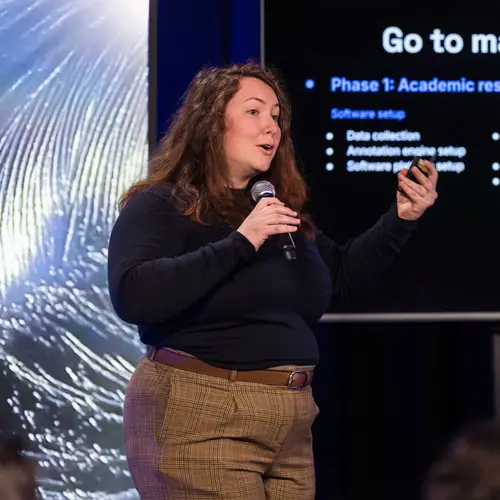
La prochaine rencontre, qui aura lieu le 10 novembre à Mila, permettra d'explorer comment pouvons-nous collectivement développer, encadrer et déployer des systèmes agentiques performants, fiables et sécuritaires en connectant chercheur·euse·s académiques, expert·e·s industriel·le·s et praticien·ne·s.
Ce programme à temps partiel offre aux scientifiques l'opportunité de tester leur intérêt pour l'entrepreneuriat. Vous avez jusqu'au 5 octobre pour postuler.
Avantage IA : productivité dans la fonction publique
Apprenez à tirer parti de l’IA générative pour soutenir et améliorer votre productivité au travail. La prochaine cohorte se déroulera en ligne les 6 et 8 octobre 2026, en anglais.
Nous utilisons des témoins pour analyser le trafic et l’utilisation de notre site web, afin de personnaliser votre expérience. Vous pouvez désactiver ces technologies à tout moment, mais cela peut restreindre certaines fonctionnalités du site. Consultez notre Politique de protection de la vie privée pour en savoir plus.
Paramètre des cookies
Vous pouvez activer et désactiver les types de cookies que vous souhaitez accepter. Cependant certains choix que vous ferez pourraient affecter les services proposés sur nos sites (ex : suggestions, annonces personnalisées, etc.).
Cookies essentiels
Ces cookies sont nécessaires au fonctionnement du site et ne peuvent être désactivés. (Toujours actif)
Cookies analyse
Acceptez-vous l'utilisation de cookies pour mesurer l'audience de nos sites ?
Lecteur Multimédia
Acceptez-vous l'utilisation de cookies pour afficher et vous permettre de regarder les contenus vidéo hébergés par nos partenaires (YouTube, etc.) ?
Large language models (LLMs) show an innate skill for solving language based tasks. But insights have suggested an inability to adjust for i… (voir plus)nformation or task-solving skills becoming outdated, as their knowledge, stored directly within their parameters, remains static in time. Tool use helps by offloading work to systems that the LLM can access through an interface, but LLMs that use them still must adapt to nonstationary environments for prolonged use, as new tools can emerge and existing tools can change. Nevertheless, tools require less specialized knowledge, therefore we hypothesize they are better suited for continual learning (CL) as they rely less on parametric memory for solving tasks and instead focus on learning when to apply pre-defined tools. To verify this, we develop a synthetic benchmark and follow this by aggregating existing NLP tasks to form a more realistic testing scenario. While we demonstrate scaling model size is not a solution, regardless of tool usage, continual learning techniques can enable tool LLMs to both adapt faster while forgetting less, highlighting their potential as continual learners.
In the age of artificial intelligence, the role of large language models (LLMs) is becoming increasingly central. Despite their growing prev… (voir plus)alence, their capacity to consolidate knowledge from different training documents—a crucial ability in numerous applications—remains unexplored. This paper presents the first study examining the capability of LLMs to effectively combine such information within their parameter space. We introduce EpiK-Eval, a novel question-answering benchmark tailored to evaluate LLMs' proficiency in formulating a coherent and consistent knowledge representation from segmented narratives. Evaluations across various LLMs reveal significant weaknesses in this domain. We contend that these shortcomings stem from the intrinsic nature of prevailing training objectives. Consequently, we advocate for refining the approach towards knowledge consolidation, as it harbors the potential to dramatically improve their overall effectiveness and performance. The findings from this study offer insights for developing more robust and reliable LLMs. Our code and benchmark are available at https://github.com/chandar-lab/EpiK-Eval
2023-11-30
Proceedings of the 2023 Conference on Empirical Methods in Natural Language Processing (publié)