


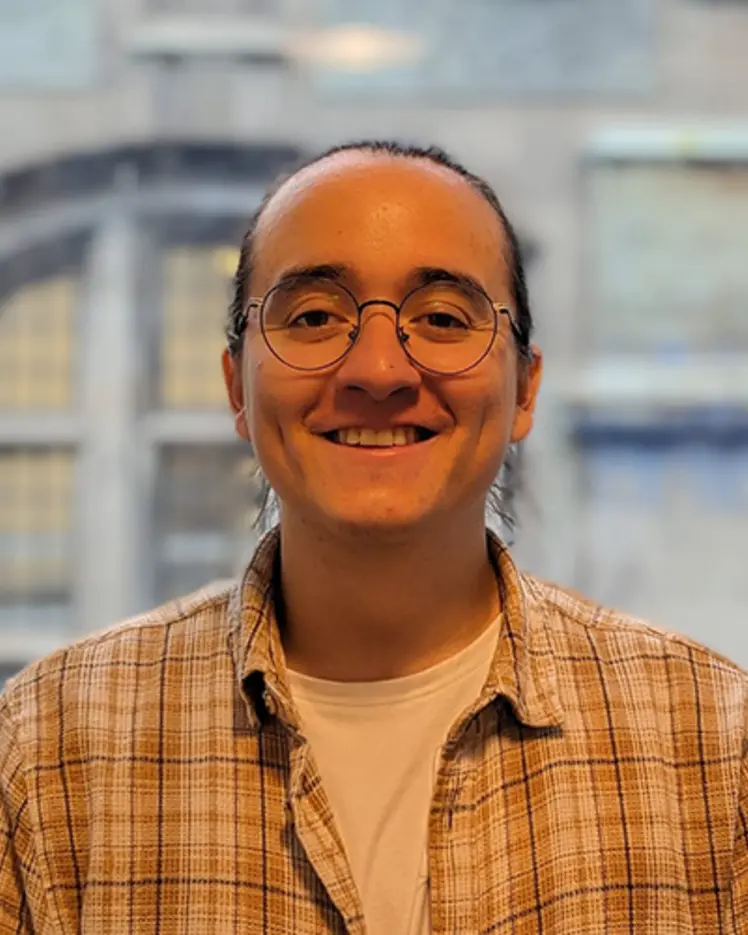
Portrait de César Miguel Valdez Cordova

César Miguel Valdez Cordova

Représentant du laboratoire
Doctorat - McGill University
Superviseur⋅e principal⋅e
Sujets de recherche
Apprentissage profond
Biologie computationnelle

Biographie

Je suis enthousiaste à l’idée de tirer des leçons de ce que je considère comme notre plus grand enseignant, la nature, pour faire progresser le domaine de l’apprentissage automatique. En tant que tel, je cherche à développer des algorithmes inspirés par les défis complexes de la compréhension des phénomènes naturels à différentes échelles, des molécules aux populations, dans le but de repousser les limites des méthodes computationnelles et des connaissances scientifiques fondamentales. Originaire de Mexicali, la capitale animée de la magnifique péninsule de Basse-Californie, au Mexique, mon parcours scientifique a été marqué par des perspectives diverses : du travail pratique en laboratoire pendant mes études d’ingénierie en nanotechnologie et chimie au Tec de Monterrey, à mon rôle actuel de recherche à l’interface entre les sciences computationnelles et naturelles, grâce à une maîtrise en informatique au Centre de recherche scientifique et d’enseignement supérieur d’Ensenada, au Mexique, et une maîtrise ultérieure en intelligence artificielle à l’Université Johannes Kepler de Linz, en Autriche. Convaincu du potentiel de l’IA équitable pour bénéficier à tous, je cherche à être un pont entre les personnes et les machines. Lorsque je ne suis pas en train d’essayer de faire fonctionner des modèles, vous pourriez me trouver en train d’explorer l’art de la cuisine mexicaine, plongé dans la littérature postmoderne, m’essayant à la production musicale ou m’émerveillant et maîtrisant la magie de la fermentation sous toutes ses formes et à toutes les échelles.

Publications

scShapeBench: Discovering geometry from high dimensional scRNAseq data
Andrew J. Steindl
João Felipe Rocha
Brian Tshilengi Di Bassinga
Zachary Warren
Shabarni Gupta
Leire Torices
Daniel Neumann
Timothy J. Mann
Ihuan Gunawan
Dhananjay Bhaskar
John G. Lock
Christine L. Chaffer
High-dimensional point cloud data arise across many scientific domains, especially single-cell biology. The shapes or topologies of these da… (voir plus)tasets determine the types of information that can be extracted. For example, clustered data supports cell-type identification, trajectory structures support transition analysis, and archetypal structures capture continua of cellular behaviors. Existing analysis pipelines often assume a specific shape. The standard Seurat pipeline combines UMAP visualization with Louvain clustering and therefore assumes clustered data, while tools such as Monocle and SPADE assume tree-like structures, and flow-based models such as MIOFlow and Conditional Flow Matching target trajectories. Choosing which pipeline to apply is therefore often left to bioinformaticians who visually inspect datasets before selecting an analysis strategy. With the rise of agentic AI scientists, automating shape detection is increasingly important for selecting downstream analysis pipelines. To address this problem, we introduce scShapeBench, a benchmark dataset for shape detection containing both synthetic and expert-annotated single-cell datasets. Synthetic datasets are sampled from ground-truth skeleton graphs with controlled variance. Real single-cell datasets are curated from diverse sources and annotated by experts into four categories: clusters, single trajectory, multi-branching, and archetypal. We additionally introduce scReebTower, a baseline method that uses diffusion geometry to extract Reeb graphs and connect visualization with pipeline selection. We provide topology-aware evaluation metrics and compare scReebTower against PAGA and Mapper on synthetic and real data. Our results indicate that scReebTower outperforms existing baselines. Overall, our contributions span benchmarks, evaluation metrics, and a baseline for automated shape detection in single-cell data.
Measure Before You Look: Grounding Embeddings Through Manifold Metrics