

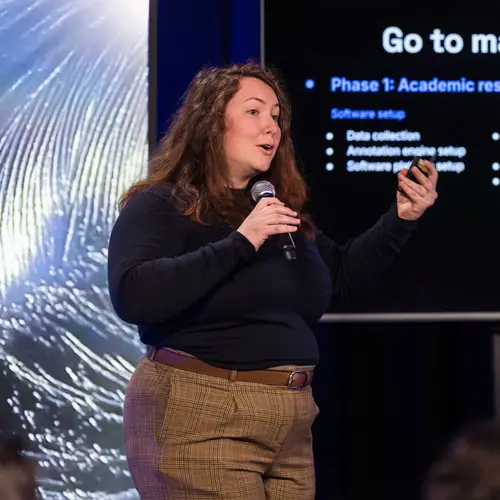

Portrait of Joelle Pineau

Joelle Pineau

Core Academic Member
Canada CIFAR AI Chair
Associate Professor, McGill University, School of Computer Science
Co-Manager Director, Meta AI (FAIR - Facebook AI Research)
Research Topics
Medical Machine Learning
Natural Language Processing
Reinforcement Learning

Biography

Joelle Pineau is a professor and William Dawson Scholar at the School of Computer Science, McGill University, where she co-directs the Reasoning and Learning Lab. She is a core academic member of Mila – Quebec Artificial Intelligence Institute, a Canada CIFAR AI Chair, and VP of AI research at Meta (previously Facebook), where she leads the Fundamental AI Research (FAIR) team. Pineau holds a BSc in systems design engineering from the University of Waterloo, and an MSc and PhD in robotics from Carnegie Mellon University.

Her research focuses on developing new models and algorithms for planning and learning in complex partially observable domains. She also works on applying these algorithms to complex problems in robotics, health care, games and conversational agents. In addition to being on the editorial board of the Journal of Machine Learning Research and past president of the International Machine Learning Society, Pineau is the recipient of numerous awards and honours: NSERC’s E.W.R. Steacie Memorial Fellowship (2018), Governor General Innovation Award (2019), Fellow of the Association for the Advancement of Artificial Intelligence (AAAI), Senior Fellow of the Canadian Institute for Advanced Research (CIFAR), and Fellow of the Royal Society of Canada.

Current Students

Master's Research - Université de Montréal
Principal supervisor :
PhD - Université de Montréal
Principal supervisor :
Collaborating Alumni - McGill University

Publications

Piecewise Latent Variables for Neural Variational Text Processing
Iulian V. Serban
Alexander G. Ororbia II
Advances in neural variational inference have facilitated the learning of powerful directed graphical models with continuous latent variable… (see more)s, such as variational autoencoders. The hope is that such models will learn to represent rich, multi-modal latent factors in real-world data, such as natural language text. However, current models often assume simplistic priors on the latent variables - such as the uni-modal Gaussian distribution - which are incapable of representing complex latent factors efficiently. To overcome this restriction, we propose the simple, but highly flexible, piecewise constant distribution. This distribution has the capacity to represent an exponential number of modes of a latent target distribution, while remaining mathematically tractable. Our results demonstrate that incorporating this new latent distribution into different models yields substantial improvements in natural language processing tasks such as document modeling and natural language generation for dialogue.
Towards an Automatic Turing Test: Learning to Evaluate Dialogue Responses
Michael Noseworthy
Iulian V. Serban
Nicolas A.-Gontier
Automatically evaluating the quality of dialogue responses for unstructured domains is a challenging problem. Unfortunately, existing automa… (see more)tic evaluation metrics are biased and correlate very poorly with human judgements of response quality. Yet having an accurate automatic evaluation procedure is crucial for dialogue research, as it allows rapid prototyping and testing of new models with fewer expensive human evaluations. In response to this challenge, we formulate automatic dialogue evaluation as a learning problem. We present an evaluation model (ADEM) that learns to predict human-like scores to input responses, using a new dataset of human response scores. We show that the ADEM model's predictions correlate significantly, and at a level much higher than word-overlap metrics such as BLEU, with human judgements at both the utterance and system-level. We also show that ADEM can generalize to evaluating dialogue models unseen during training, an important step for automatic dialogue evaluation.
Building End-To-End Dialogue Systems Using Generative Hierarchical Neural Network Models
We investigate the task of building open domain, conversational dialogue systems based on large dialogue corpora using generative models. Ge… (see more)nerative models produce system responses that are autonomously generated word-by-word, opening up the possibility for realistic, flexible interactions. In support of this goal, we extend the recently proposed hierarchical recurrent encoder-decoder neural network to the dialogue domain, and demonstrate that this model is competitive with state-of-the-art neural language models and back-off n-gram models. We investigate the limitations of this and similar approaches, and show how its performance can be improved by bootstrapping the learning from a larger question-answer pair corpus and from pretrained word embeddings.
Recent Advances in Reinforcement Learning