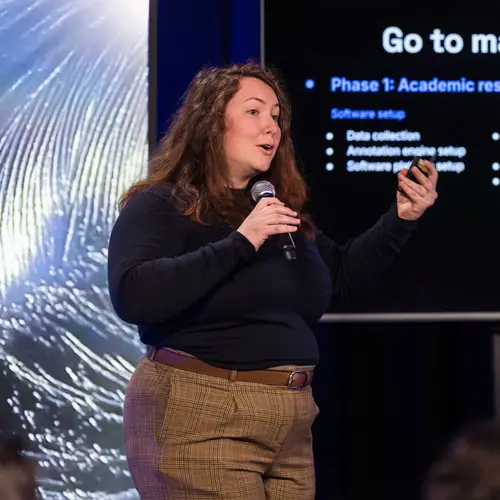
Conférence d'ouverture | Créer une IA plus sécuritaire pour la santé mentale des jeunes
Le 16 mars prochain à 9h, prenez part à cet événement qui réunira des chercheur·euse·s de premier plan en IA, des expert·e·s cliniques, et des voix du terrain pour discuter des cadres nécessaires à la conception d’une IA qui soit performante et sécuritaire en santé mentale.
TRAIL : IA responsable pour les professionnels et les leaders
Apprenez à intégrer des pratique d'IA responsable dans votre organisation avec le programme TRAIL. Inscrivez-vous à la séance d'information le 12 mars prochain pour en apprendre plus sur le programme.
Nous utilisons des témoins pour analyser le trafic et l’utilisation de notre site web, afin de personnaliser votre expérience. Vous pouvez désactiver ces technologies à tout moment, mais cela peut restreindre certaines fonctionnalités du site. Consultez notre Politique de protection de la vie privée pour en savoir plus.
Paramètre des cookies
Vous pouvez activer et désactiver les types de cookies que vous souhaitez accepter. Cependant certains choix que vous ferez pourraient affecter les services proposés sur nos sites (ex : suggestions, annonces personnalisées, etc.).
Cookies essentiels
Ces cookies sont nécessaires au fonctionnement du site et ne peuvent être désactivés. (Toujours actif)
Cookies analyse
Acceptez-vous l'utilisation de cookies pour mesurer l'audience de nos sites ?
Lecteur Multimédia
Acceptez-vous l'utilisation de cookies pour afficher et vous permettre de regarder les contenus vidéo hébergés par nos partenaires (YouTube, etc.) ?
Nicolas Ballas
Alumni

Publications
Inference-time Physics Alignment of Video Generative Models with Latent World Models
State-of-the-art video generative models produce promising visual content yet often violate basic physics principles, limiting their utility… (voir plus). While some attribute this deficiency to insufficient physics understanding from pre-training, we find that the shortfall in physics plausibility also stems from suboptimal inference strategies. We therefore introduce WMReward and treat improving physics plausibility of video generation as an inference-time alignment problem. In particular, we leverage the strong physics prior of a latent world model (here, VJEPA-2) as a reward to search and steer multiple candidate denoising trajectories, enabling scaling test-time compute for better generation performance. Empirically, our approach substantially improves physics plausibility across image-conditioned, multiframe-conditioned, and text-conditioned generation settings, with validation from human preference study. Notably, in the ICCV 2025 Perception Test PhysicsIQ Challenge, we achieve a final score of 62.64%, winning first place and outperforming the previous state of the art by 7.42%. Our work demonstrates the viability of using latent world models to improve physics plausibility of video generation, beyond this specific instantiation or parameterization.
Agents capable of reasoning and planning in the real world require the ability of predicting the consequences of their actions. While world … (voir plus)models possess this capability, they most often require action labels, that can be complex to obtain at scale. This motivates the learning of latent action models, that can learn an action space from videos alone. Our work addresses the problem of learning latent actions world models on in-the-wild videos, expanding the scope of existing works that focus on simple robotics simulations, video games, or manipulation data. While this allows us to capture richer actions, it also introduces challenges stemming from the video diversity, such as environmental noise, or the lack of a common embodiment across videos. To address some of the challenges, we discuss properties that actions should follow as well as relevant architectural choices and evaluations. We find that continuous, but constrained, latent actions are able to capture the complexity of actions from in-the-wild videos, something that the common vector quantization does not. We for example find that changes in the environment coming from agents, such as humans entering the room, can be transferred across videos. This highlights the capability of learning actions that are specific to in-the-wild videos. In the absence of a common embodiment across videos, we are mainly able to learn latent actions that become localized in space, relative to the camera. Nonetheless, we are able to train a controller that maps known actions to latent ones, allowing us to use latent actions as a universal interface and solve planning tasks with our world model with similar performance as action-conditioned baselines. Our analyses and experiments provide a step towards scaling latent action models to the real world.
We present LOCATE 3D, a model for localizing objects in 3D scenes from referring expressions like "the small coffee table between the sofa a… (voir plus)nd the lamp." LOCATE 3D sets a new state-of-the-art on standard referential grounding benchmarks and showcases robust generalization capabilities. Notably, LOCATE 3D operates directly on sensor observation streams (posed RGB-D frames), enabling real-world deployment on robots and AR devices. Key to our approach is 3D-JEPA, a novel self-supervised learning (SSL) algorithm applicable to sensor point clouds. It takes as input a 3D pointcloud featurized using 2D foundation models (CLIP, DINO). Subsequently, masked prediction in latent space is employed as a pretext task to aid the self-supervised learning of contextualized pointcloud features. Once trained, the 3D-JEPA encoder is finetuned alongside a language-conditioned decoder to jointly predict 3D masks and bounding boxes. Additionally, we introduce LOCATE 3D DATASET, a new dataset for 3D referential grounding, spanning multiple capture setups with over 130K annotations. This enables a systematic study of generalization capabilities as well as a stronger model. Code, models and dataset can be found at the project website: locate3d.atmeta.com
2025-10-06
Proceedings of the 42nd International Conference on Machine Learning (publié)
A major challenge for modern AI is to learn to understand the world and learn to act largely by observation. This paper explores a self-supe… (voir plus)rvised approach that combines internet-scale video data with a small amount of interaction data (robot trajectories), to develop models capable of understanding, predicting, and planning in the physical world. We first pre-train an action-free joint-embedding-predictive architecture, V-JEPA 2, on a video and image dataset comprising over 1 million hours of internet video. V-JEPA 2 achieves strong performance on motion understanding (77.3 top-1 accuracy on Something-Something v2) and state-of-the-art performance on human action anticipation (39.7 recall-at-5 on Epic-Kitchens-100) surpassing previous task-specific models. Additionally, after aligning V-JEPA 2 with a large language model, we demonstrate state-of-the-art performance on multiple video question-answering tasks at the 8 billion parameter scale (e.g., 84.0 on PerceptionTest, 76.9 on TempCompass). Finally, we show how self-supervised learning can be applied to robotic planning tasks by post-training a latent action-conditioned world model, V-JEPA 2-AC, using less than 62 hours of unlabeled robot videos from the Droid dataset. We deploy V-JEPA 2-AC zero-shot on Franka arms in two different labs and enable picking and placing of objects using planning with image goals. Notably, this is achieved without collecting any data from the robots in these environments, and without any task-specific training or reward. This work demonstrates how self-supervised learning from web-scale data and a small amount of robot interaction data can yield a world model capable of planning in the physical world.
We investigate the emergence of intuitive physics understanding in general-purpose deep neural network models trained to predict masked regi… (voir plus)ons in natural videos. Leveraging the violation-of-expectation framework, we find that video prediction models trained to predict outcomes in a learned representation space demonstrate an understanding of various intuitive physics properties, such as object permanence and shape consistency. In contrast, video prediction in pixel space and multimodal large language models, which reason through text, achieve performance closer to chance. Our comparisons of these architectures reveal that jointly learning an abstract representation space while predicting missing parts of sensory input, akin to predictive coding, is sufficient to acquire an understanding of intuitive physics, and that even models trained on one week of unique video achieve above chance performance. This challenges the idea that core knowledge -- a set of innate systems to help understand the world -- needs to be hardwired to develop an understanding of intuitive physics.