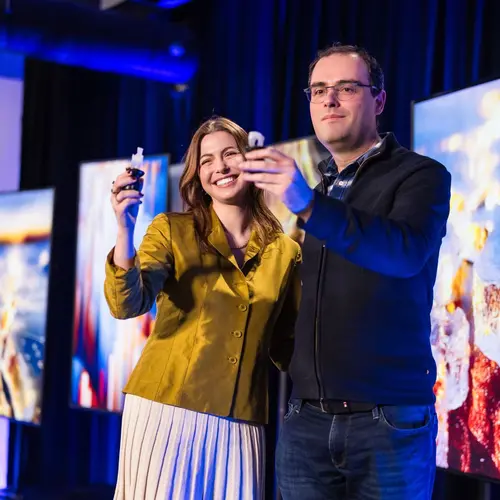
Rejoignez-nous le 19 novembre pour la troisième édition du concours de vulgarisation scientifique de Mila, où les étudiant·e·s présenteront leurs recherches complexes en trois minutes devant un jury.
Nous utilisons des témoins pour analyser le trafic et l’utilisation de notre site web, afin de personnaliser votre expérience. Vous pouvez désactiver ces technologies à tout moment, mais cela peut restreindre certaines fonctionnalités du site. Consultez notre Politique de protection de la vie privée pour en savoir plus.
Paramètre des cookies
Vous pouvez activer et désactiver les types de cookies que vous souhaitez accepter. Cependant certains choix que vous ferez pourraient affecter les services proposés sur nos sites (ex : suggestions, annonces personnalisées, etc.).
Cookies essentiels
Ces cookies sont nécessaires au fonctionnement du site et ne peuvent être désactivés. (Toujours actif)
Cookies analyse
Acceptez-vous l'utilisation de cookies pour mesurer l'audience de nos sites ?
Lecteur Multimédia
Acceptez-vous l'utilisation de cookies pour afficher et vous permettre de regarder les contenus vidéo hébergés par nos partenaires (YouTube, etc.) ?
Maricarmen Arenas
Alumni

Publications
Social Media as a Vector for Escort Ads:A Study on OnlyFans advertisements on Twitter
Online sex trafficking is on the rise and a majority of trafficking victims report being advertised online. The use of OnlyFans as a platfor… (voir plus)m for adult content is also increasing, with Twitter as its main advertising tool. Furthermore, we know that traffickers usually work within a network and control multiple victims. Consequently, we suspect that there may be networks of traffickers promoting multiple OnlyFans accounts belonging to their victims. To this end, we present the first study of OnlyFans advertisements on Twitter in the context of finding organized activities. Preliminary analysis of this space shows that most tweets related to OnlyFans contain generic text, making text-based methods less reliable. Instead, focusing on what ties the authors of these tweets together, we propose a novel method for uncovering coordinated networks of users based on their behaviour. Our method, called Multi-Level Clustering (MLC), combines two levels of clustering that considers both the network structure as well as embedded node attribute information. It focuses jointly on user connections (through mentions) and content (through shared URLs). We apply MLC to real-world data of 2 million tweets pertaining to OnlyFans and analyse the detected groups. We also evaluate our method on synthetically generated data (with injected ground truth) and show its superior performance compared to competitive baselines. Finally, we discuss examples of organized clusters as case studies and provide interesting conclusions to our study.
2023-04-30
Proceedings of the 15th ACM Web Science Conference 2023 (publié)