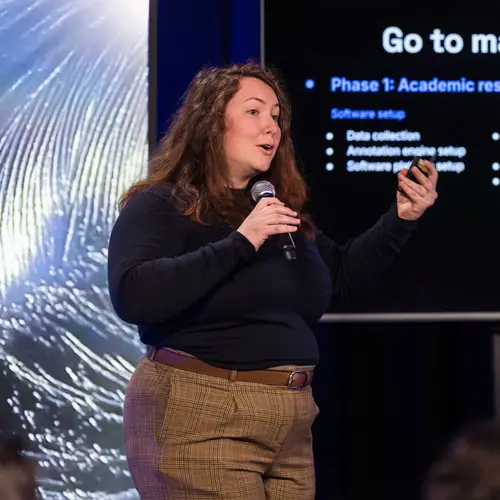
Ce programme soutient les startups spécialisées en IA à tout moment de l'année. Bénéficiez de ressources de pointe et d'un accompagnement sur mesure pour accélérer le développement de votre technologie.
Offert par Mila et le Forum des politiques publiques, ce programme est conçu pour outiller les décideur·euse·s et les responsables des politiques publiques à naviguer efficacement à travers les opportunités et les risques liés à l'IA. La prochaine cohorte se tiendra en français les 1er et 2 septembre 2026 à Mila.
Échangez avec les conseiller·ère·s académiques de Mila ainsi que des étudiant·e·s-chercheur·euse·s pour en savoir plus sur la communauté de Mila et découvrir comment nous rejoindre les 19 et 31 août et le 11 septembre 2026.
Nous utilisons des témoins pour analyser le trafic et l’utilisation de notre site web, afin de personnaliser votre expérience. Vous pouvez désactiver ces technologies à tout moment, mais cela peut restreindre certaines fonctionnalités du site. Consultez notre Politique de protection de la vie privée pour en savoir plus.
Paramètre des cookies
Vous pouvez activer et désactiver les types de cookies que vous souhaitez accepter. Cependant certains choix que vous ferez pourraient affecter les services proposés sur nos sites (ex : suggestions, annonces personnalisées, etc.).
Cookies essentiels
Ces cookies sont nécessaires au fonctionnement du site et ne peuvent être désactivés. (Toujours actif)
Cookies analyse
Acceptez-vous l'utilisation de cookies pour mesurer l'audience de nos sites ?
Lecteur Multimédia
Acceptez-vous l'utilisation de cookies pour afficher et vous permettre de regarder les contenus vidéo hébergés par nos partenaires (YouTube, etc.) ?
In multi-agent systems, should limited resources be concentrated into a few capable agents or distributed among many simpler ones? This work… (voir plus) formulates the split over
Visual Navigation Models (VNMs) promise generalizable, robot navigation by learning from large-scale visual demonstrations. Despite growing … (voir plus)real-world deployment, existing evaluations rely almost exclusively on success rate, whether the robot reaches its goal, which conceals trajectory quality, collision behavior, and robustness to environmental change. We present a real-world evaluation of five state-of-the-art VNMs (GNM, ViNT, NoMaD, NaviBridger, and CrossFormer) across two robot platforms and five environments spanning indoor and outdoor settings. Beyond success rate, we combine path-based metrics with vision-based goal-recognition scores and assess robustness through controlled image perturbations (motion blur, sunflare). Our analysis uncovers three systematic limitations: (a) even architecturally sophisticated diffusion and transformer-based models exhibit frequent collisions, indicating limited geometric understanding; (b) models fail to discriminate between different locations that are perceptually similar, however some semantics differences are present, causing goal prediction errors in repetitive environments; and (c) performance degrades under distribution shift. We will publicly release our evaluation codebase and dataset to facilitate reproducible benchmarking of VNMs.
Reinforcement Learning (RL) has emerged as a core algorithmic paradigm explicitly driving innovation in a growing number of industrial appli… (voir plus)cations, including large language models and quantitative finance. Furthermore, computational neuroscience has long found evidence of natural forms of RL in biological brains. Therefore, it is crucial for the study of social dynamics to develop a scientific understanding of how RL shapes population behaviors. We leverage the framework of Evolutionary Game Theory (EGT) to provide building blocks and insights toward this objective. We propose a methodology that enables simulating large populations of RL agents in simple game theoretic interaction models. More specifically, we derive fast and parallelizable implementations of two fundamental revision protocols from multi-agent RL - Policy Gradient (PG) and Opponent-Learning Awareness (LOLA) - tailored for population simulations of random pairwise interactions in stateless normal-form games. Our methodology enables us to simulate large populations of 200,000 independent co-learning agents, yielding compelling insights into how non-stationarity-aware learners affect social dynamics.
In particular, we find that LOLA learners promote cooperation in the Stag Hunt model, delay cooperative outcomes in the Hawk-Dove model, and reduce strategy diversity in the Rock-Paper-Scissors model.
2026-02-20
Transactions on Machine Learning Research (accepté)
Decentralized collaborative simultaneous localization and mapping (C-SLAM) is essential to enable multirobot missions in unknown environment… (voir plus)s without relying on preexisting localization and communication infrastructure. This technology is anticipated to play a key role in the exploration of the Moon, Mars, and other planets. In this article, we share insights and lessons learned from C-SLAM experiments involving three robots operating on a Mars analogue terrain and communicating over an ad hoc network. We examine the impact of limited and intermittent communication on C-SLAM performance, as well as the unique localization challenges posed by planetary-like environments. Additionally, we introduce a novel dataset collected during our experiments, which includes real-time peer-to-peer inter-robot throughput and latency measurements. This dataset aims to support future research on communication-constrained, decentralized multirobot operations.
The emerging behaviors of swarms have fascinated scientists and gathered significant interest in the field of robotics. Traditionally, swarm… (voir plus)s are viewed as egalitarian, with robots sharing identical roles and capabilities. However, recent findings highlight the importance of hierarchy for deploying robot swarms more effectively in diverse scenarios. Despite nature's preference for hierarchies, the robotics field has clung to the egalitarian model, partly due to a lack of empirical evidence for the conditions favoring hierarchies. Our research demonstrates that while egalitarian swarms excel in environments proportionate to their collective sensing abilities, they struggle in larger or more complex settings. Hierarchical swarms, conversely, extend their sensing reach efficiently, proving successful in larger, more unstructured environments with fewer resources. We validated these concepts through simulations and physical robot experiments, using a complex radiation cleanup task. This study paves the way for developing adaptable, hierarchical swarm systems applicable in areas like planetary exploration and autonomous vehicles. Moreover, these insights could deepen our understanding of hierarchical structures in biological organisms.