


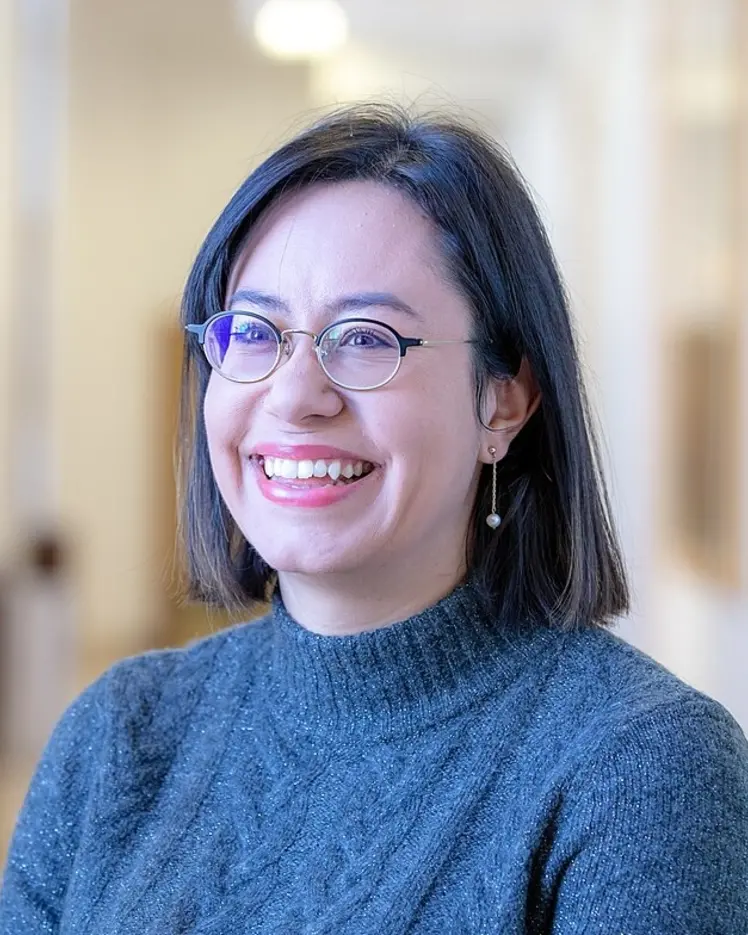
Portrait de Julie Hlavacek-Larrondo

Julie Hlavacek-Larrondo

Membre académique associé
Professeur agrégé, Université de Montréal
Alumni
Sujets de recherche
Apprentissage automatique appliqué
Astronomie
Astrophysique
Astrophysique computationnelle
IA pour la science

Étudiants actuels

Publications

MISTRAL: a model for AGN winds from radiatively efficient accretion in cosmological simulations
Marion Farcy
Michaela Hirschmann
Rachel S. Somerville
Ena Choi
Sophie Koudmani
Thorsten Naab
Rainer Weinberger
Jake S. Bennett
Aklant K. Bhowmick
Hyunseop Choi
Lars Hernquist
Bryan A. Terrazas
Francesco Valentino
ABSTRACT Feedback from active galactic nuclei (AGNs) is crucial for regulating galaxy evolution. Motivated by observations of broad absorpti… (voir plus)on line winds from rapidly accreting supermassive black holes (SMBHs), we introduce the mistral AGN feedback model, implemented in the arepo code. mistral comes in two versions: continuous radial (mistral-continuous) and stochastic bipolar momentum deposition (mistral-stochastic). Using the framework of the IllustrisTNG simulations, we explore the effect of mistral on BH and galaxy properties, through an idealized Milky Way-mass galaxy and cosmological zoom simulations run down to
Probabilistic Interpolation of Sagittarius A*’s Multi-Wavelength Light Curves Using Machine Learning
G. Sasseville
Daryl Haggard
Hadrien Paugnat
G. Witzel
Abstract Understanding the variability of Sagittarius A* (Sgr A*) requires coordinated, multi-wavelength observations. However, these observ… (voir plus)ations suffer from irregular sampling, noise, and large data gaps, limiting our ability to identify flares and infer cross-wavelength time lags. We address this challenge using machine learning models designed for sparse, multivariate time series. In particular, we introduce a diffusion-based generative model, representing the first application of score-based diffusion models to astronomical time series. We also use a transformer-based model, and benchmark both against a multi-output Gaussian Process. The models are trained on simulated light curves that replicate the cadence, noise, and cross-band correlations of real Sgr A* data, including observations from ALMA, Spitzer, GRAVITY, and Chandra. Our results show that the diffusion model outperforms other methods in accuracy and uncertainty calibration, on both synthetic and real data. This work highlights the potential of generative models for reconstructing astrophysical variability from incomplete observations.
Reconstructing robust background integral field unit spectra using machine learning
Carter Lee Rhea
Hyunseop Choi
Laurie Rousseau-Nepton
Marie-Lou Gendron-Marsolais
Mario Pasquato
Simon Prunet
ABSTRACT In astronomy, spectroscopy consists of observing an astrophysical source and extracting its spectrum of electromagnetic radiation. … (voir plus)Once extracted, a model is fit to the spectra to measure the observables, leading to an understanding of the underlying physics of the emission mechanism. One crucial, and often overlooked, aspect of this model is the background emission, which contains foreground and background astrophysical sources, intervening atmospheric emission, and artefacts related to the instrument such as noise. This paper proposes an algorithmic approach to constructing a background model for SITELLE observations using statistical tools and supervised machine learning algorithms. SITELLE is an imaging Fourier transform spectrometer located at the Canada-France-Hawaii Telescope, which produces a three-dimensional data cube containing the position of the emission (two dimensions) and the spectrum of the emission. SITELLE has a wide field of view (11 arcmin × 11 arcmin), which makes the background emission particularly challenging to model. We apply a segmentation algorithm implemented in photutils to divide the data cube into background and source spaxels. After applying a principal component analysis (PCA) on the background spaxels, we train an artificial neural network to interpolate from the background to the source spaxels in the PCA coefficient space, which allows us to generate a local background model over the entire data cube. We highlight the performance of this methodology by applying it to SITELLE observations obtained of a Star-formation, Ionized Gas and Nebular Abundances Legacy Survey galaxy, NGC 4449, and the Perseus galaxy cluster of galaxies, NGC 1275. We discuss the physical interpretation of the principal components and noise reduction in the resulting PCA-based reconstructions. Additionally, we compare the fit results using our new background modelling approach with standard methods used in the literature and find that our method better captures the emission from H ii regions in NGC 4449 and the faint emission regions in NGC 1275. These methods also demonstrate that the background does change as a function of the position of the data cube. While the approach is applied explicitly to SITELLE data in this study, we argue that it can be readily adapted to any integral field unit style data, enabling the user to obtain more robust measurements on the flux of the emission lines.