

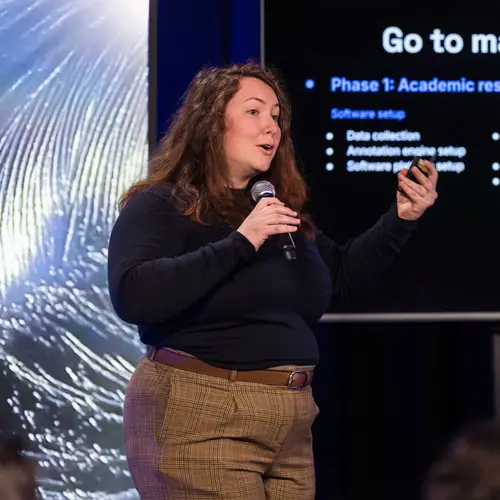

Portrait de John Kildea

John Kildea

Membre affilié
Professeur adjoint, McGill University, Département d'oncologie
Sujets de recherche
Traitement du langage naturel

Biographie

John Kildea est professeur agrégé permanent de physique médicale au Département d'oncologie Gerald-Bronfman de l'Université McGill, scientifique à l'Institut de recherche du Centre universitaire de santé McGill (IR-CUSM) et titulaire d'une Chaire de recherche double en intelligence artificielle en santé / santé numérique et sciences de la vie du Fonds de recherche du Québec - Santé (FRQS).

Ses recherches se concentrent sur la création de logiciels dans le domaine de l'informatique de la santé centrée sur le patient, et sur les méthodes expérimentales permettant d’examiner la biophysique sous-jacente à la carcinogenèse induite par les radiations. Au IR-CUSM, John Kildea dirige les activités de recherche, de développement et d'innovation technologique pour le Groupe d’informatique de la santé Opal (O-HIG).

Publications

<i>In silico</i> Neutron Relative Biological Effectiveness Estimations For Pre-DNA Repair And Post-DNA Repair Endpoints
Nicolas Desjardins
Reference radiation selection is confirmed as a significant source of relative biological effectiveness variation for neutrons.
Laura C Paterson
Stephen Pecoskie
Farrah Norton
Norma Ybarra
Richard B Richardson
Development of a defacing algorithm to protect the privacy of head and neck cancer patients in publicly-accessible radiotherapy datasets
Kayla O'Sullivan‐Steben
Luc Galarneau
In silico Neutron Relative Biological Effectiveness Estimations For Pre-DNA Repair And Post-DNA Repair Endpoints
Nicolas Desjardins
Development of a defacing algorithm to protect the privacy of head and neck cancer patients in publicly-accessible radiotherapy datasets
Kayla O'Sullivan‐Steben
Luc Galarneau
Quantification of head and neck cancer patients'anatomical changes during radiotherapy: prediction of replanning need
Odette Rios-Ibacache
James Manalad
Kayla O'Sullivan‐Steben
Emily Poon
Luc Galarneau
Julia Khriguian
Georges Shenouda
Quantification of head and neck cancer patients' anatomical changes during radiotherapy: Toward the prediction of replanning need
Odette Rios‐Ibacache
James Manalad
Kayla O'Sullivan‐Steben
Emily Poon
Luc Galarneau
Julia Khriguian
George Shenouda
Abstract Background Head and neck cancer (HNC) patients undergoing radiotherapy (RT) may experience anatomical changes during treatment, whi… (voir plus)ch can compromise the validity of the initial treatment plan, necessitating replanning. However, ad hoc replanning disrupts clinical workflows and increases workload. Currently, no standardized method exists to quantify anatomical variation that necessitates replanning. Purpose This project aimed to create geometrical metrics to describe anatomical changes in HNC patients during RT. The usefulness of these metrics was evaluated by a univariate analysis and through machine learning (ML) models to predict the need for replanning. Methods A cohort of 150 HNC patients treated at McGill University Health Centre was analyzed. Based on the shapes of the RT structures (body, PTV, mandible, neck, and submandibular contours), we developed 43 metrics and automatically calculated them through a Python pipeline that we called HNGeoNatomyX. Univariate analysis using linear regression was conducted to obtain the rate of change of each metric. We also obtained the relative variation of each metric between the pre‐treatment and replanning‐requested scans. Fraction‐specific ML models (incorporating information available up to and including the specific fraction) for fractions 5, 10, and 15 were built using metrics, clinical data, and feature selection techniques. Model performance was estimated with repeated stratified 5‐fold cross‐validation resampling technique and the area under the curve (AUC) of the receiver operating characteristic (ROC) curve. Results Univariate analysis showed that body‐ and neck‐related metrics were most predictive of replanning need. Our best specific multivariate models for fractions 5, 10, and 15 yielded testing scores of 0.82, 0.70, and 0.79, respectively. Our models early predicted replanning for 76% of the true positives. Conclusions The created metrics have the potential to characterize and distinguish which patients will necessitate RT replanning. They show promise in guiding clinicians to evaluate RT replanning for HNC patients and streamline workflows.
Relative biological effectiveness of 31 meV thermal neutrons in peripheral blood lymphocytes
Laura C Paterson
Fawaz Ali
Mohsen Naseri
David Perez Loureiro
Amy Festarini
Marilyne Stuart
Chad Boyer
Ronald Rogge
Christie Costello
Norma Ybarra
Richard B Richardson
Who is your ideal peer mentor? A qualitative study to identify cancer patient preferences for a digital peer support app
Loes Knaapen
Andrea M. Laizner
Kelly Agnew
Xiao Jian Du
Douaa El Abiad
Luc Galarneau
Susie Judd
James Manalad
Ridhi Mittal
Tristan Williams
Brandon Woolfson
Angele Wen
RadiSeq: a single- and bulk-cell whole-genome DNA sequencing simulator for radiation-damaged cell models
Felix Mathew
Luc Galarneau
Objective To build and validate a simulation framework to perform single-cell and bulk-cell whole genome sequencing simulation of radiation-… (voir plus)exposed Monte Carlo cell models to assist radiation genomics studies. Approach Sequencing the genomes of radiation-damaged cells can provide useful insight into radiation action for radiobiology research. However, carrying out post-irradiation sequencing experiments can often be challenging, expensive, and time-consuming. Although computational simulations have the potential to provide solutions to these experimental challenges, and aid in designing optimal experiments, the absence of tools currently limits such application. Monte Carlo toolkits exist to simulate radiation exposures of cell models but there are no tools to simulate single- and bulk-cell sequencing of cell models containing radiation-damaged DNA. Therefore, we aimed to develop a Monte Carlo simulation framework to address this gap by designing a tool capable of simulating sequencing processes for radiation-damaged cells. Main Results We developed RadiSeq – a multi-threaded whole-genome DNA sequencing simulator written in C++. RadiSeq can be used to simulate Illumina sequencing of radiation-damaged cell models produced by Monte Carlo simulations. RadiSeq has been validated through comparative analysis, where simulated data were matched against experimentally obtained data, demonstrating reasonable agreement between the two. Additionally, it comes with numerous features designed to closely resemble actual whole-genome sequencing. RadiSeq is also highly customizable with a single input parameter file. Significance RadiSeq enables the research community to perform complex simulations of radiation-exposed DNA sequencing, supporting the optimization, planning, and validation of costly and time-intensive radiation biology experiments. This framework provides a powerful tool for advancing radiation genomics research.
Patient Engagement in the Implementation of Electronic Patient-Reported Outcome Tools: The Experience of Two Early-Adopter Institutions in the Pan-Canadian Radiotherapy Patient-Reported Outcome Initiative
Amanda Caissie
J. Lane
B. Barber
S. Chisholm
Patient Engagement in the Implementation of Electronic Patient Reported Outcome (ePRO) Tools: The Experience of Two Early Adopter Institutions in the pan-Canadian Radiotherapy PRO Initiative
Amanda Caissie
Jennifer Lane
Brittany V Barber
Sue Chisholm