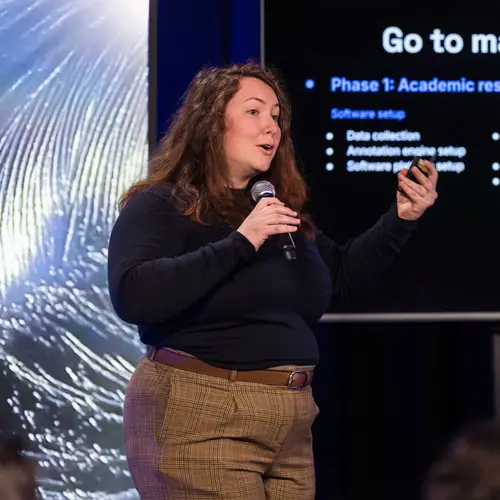
Ce programme soutient les startups spécialisées en IA à tout moment de l'année. Bénéficiez de ressources de pointe et d'un accompagnement sur mesure pour accélérer le développement de votre technologie.
Offert par Mila et le Forum des politiques publiques, ce programme est conçu pour outiller les décideur·euse·s et les responsables des politiques publiques à naviguer efficacement à travers les opportunités et les risques liés à l'IA. La prochaine cohorte se tiendra en français les 1er et 2 septembre 2026 à Mila.
Échangez avec les conseiller·ère·s académiques de Mila ainsi que des étudiant·e·s-chercheur·euse·s pour en savoir plus sur la communauté de Mila et découvrir comment nous rejoindre les 19 et 31 août et le 11 septembre 2026.
Nous utilisons des témoins pour analyser le trafic et l’utilisation de notre site web, afin de personnaliser votre expérience. Vous pouvez désactiver ces technologies à tout moment, mais cela peut restreindre certaines fonctionnalités du site. Consultez notre Politique de protection de la vie privée pour en savoir plus.
Paramètre des cookies
Vous pouvez activer et désactiver les types de cookies que vous souhaitez accepter. Cependant certains choix que vous ferez pourraient affecter les services proposés sur nos sites (ex : suggestions, annonces personnalisées, etc.).
Cookies essentiels
Ces cookies sont nécessaires au fonctionnement du site et ne peuvent être désactivés. (Toujours actif)
Cookies analyse
Acceptez-vous l'utilisation de cookies pour mesurer l'audience de nos sites ?
Lecteur Multimédia
Acceptez-vous l'utilisation de cookies pour afficher et vous permettre de regarder les contenus vidéo hébergés par nos partenaires (YouTube, etc.) ?
How do we make concrete progress towards de-signing robots that can navigate ethically sensitive contexts? Almost two decades after the word… (voir plus) ‘roboethics’ was coined, translating interdisciplinary roboethics discussions into techni-cal design still remains a daunting task. This paper describes our first attempt at addressing these challenges through a roboethics-themed design competition. The design competition setting allowed us to (a) formulate ethical considerations as an engineering design task that anyone with basic programming skills can tackle; and (b) develop a prototype evaluation scheme that incorporates diverse normative perspectives of multiple stakeholders. The initial implementation of the competition was held online at the RO-MAN 2021 conference. The competition task involved programming a simulated mobile robot (TIAGo) that delivers items for individuals in the home environment, where many of these tasks involve ethically sensitive con-texts (e.g., an underage family member asks for an alcoholic drink). This paper outlines our experiences implementing the competition and the lessons we learned. We highlight design competitions as a promising mechanism to enable a new wave of roboethics research equipped with technical design solutions.
2022-05-22
2022 International Conference on Robotics and Automation (ICRA) (publié)
Lethal autonomous weapon systems (LAWS, ethal autonomous weapon also known as killer robots) are a real and emerging technology that have th… (voir plus)e potential to radically transform warfare. Because of the myriad of moral, legal, privacy, and security risks the technology introduces, many scholars and advocates have called for a ban on the development, production, and use of fully autonomous weapons [1], [2].
Lethal autonomous weapons (LAWS) are an emerging technology capable of automatically targeting and exercising lethal force. Many scholars an… (voir plus)d advocates have petitioned to ban the technology internationally for a myriad of reasons. However, there are practical challenges to implementing a ban. One such challenge is posed by the “intangible” nature of the software that LAWS depends on, which is incompatible with implementation mechanisms such as export control. Given the dual-use nature of software, and the fact that software is developed by teams of individuals, a number of soft governance mechanisms have been proposed to regulate this technology. In this paper, we investigate the feasibility of one particular approach: leveraging open source licenses as a means to prohibit the use of certain software in LAWS. This approach is largely motivated by the fact that open source software underpins all of technology, especially AI. Through a review of the recent tech activism and open source activism, we evaluate whether open source licenses can feasibly limit the use of open source software to only non-LAWS applications. We distill the current challenges facing “ethics-driven” open source licensing efforts into three main obstacles: the need for clarity of licensing language, the lack of enforceability of licenses, and the lack of cohesiveness of the open source community. We propose that addressing these factors are also success criteria for future anti-LAWS open source initiatives. We find that open source licenses provide more theoretical than practical promise in regulating LAWS, and conclude that cohesion in the open source community is the key to their potential practical success in the future.
2020-11-11
2020 IEEE International Symposium on Technology and Society (ISTAS) (publié)