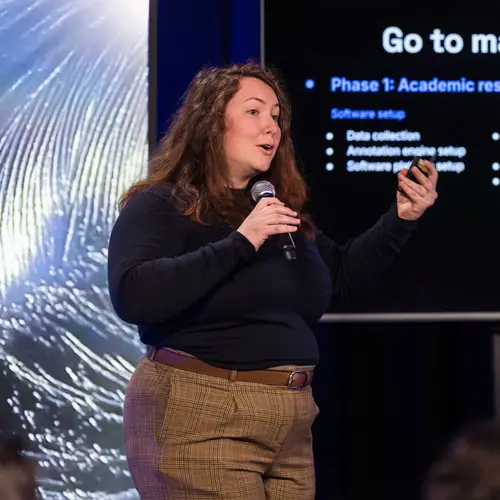

Ce programme soutient les startups spécialisées en IA à tout moment de l'année. Bénéficiez de ressources de pointe et d'un accompagnement sur mesure pour accélérer le développement de votre technologie.
Développez des compétences fondamentales en intelligence artificielle (IA) responsable grâce à des cours autodirigés, animés par des expert·e·s de Mila reconnu·e·s à l’échelle internationale.
Le Fellowship Mila en politiques de l'IA transforme l'expertise approfondie en IA en politiques rigoureuses d'intérêt public. Découvrez la dernière publication Combler la disparité en matière d’expertise : mécanismes de transfert des connaissances pour la réglementation de l’IA par Moritz von Knebel.
Nous utilisons des témoins pour analyser le trafic et l’utilisation de notre site web, afin de personnaliser votre expérience. Vous pouvez désactiver ces technologies à tout moment, mais cela peut restreindre certaines fonctionnalités du site. Consultez notre Politique de protection de la vie privée pour en savoir plus.
Paramètre des cookies
Vous pouvez activer et désactiver les types de cookies que vous souhaitez accepter. Cependant certains choix que vous ferez pourraient affecter les services proposés sur nos sites (ex : suggestions, annonces personnalisées, etc.).
Cookies essentiels
Ces cookies sont nécessaires au fonctionnement du site et ne peuvent être désactivés. (Toujours actif)
Cookies analyse
Acceptez-vous l'utilisation de cookies pour mesurer l'audience de nos sites ?
Lecteur Multimédia
Acceptez-vous l'utilisation de cookies pour afficher et vous permettre de regarder les contenus vidéo hébergés par nos partenaires (YouTube, etc.) ?
Yimeng Min
Alumni
Publications
Can Hybrid Geometric Scattering Networks Help Solve the Maximum Clique Problem?
We propose a geometric scattering-based graph neural network (GNN) for approximating solutions of the NP-hard maximum clique (MC) problem. W… (voir plus)e construct a loss function with two terms, one which encourages the network to find highly connected nodes and the other which acts as a surrogate for the constraint that the nodes form a clique. We then use this loss to train an efficient GNN architecture that outputs a vector representing the probability for each node to be part of the MC and apply a rule-based decoder to make our final prediction. The incorporation of the scattering transform alleviates the so-called oversmoothing problem that is often encountered in GNNs and would degrade the performance of our proposed setup. Our empirical results demonstrate that our method outperforms representative GNN baselines in terms of solution accuracy and inference speed as well as conventional solvers like Gurobi with limited time budgets. Furthermore, our scattering model is very parameter efficient with only
2022-11-28
Conference on Neural Information Processing Systems (Accept)
Though machine learning has achieved notable success in modeling sequential and spatial data for speech recognition and in computer vision, … (voir plus)applications to remote sensing and climate science problems are seldom considered. In this paper, we demonstrate techniques from unsupervised learning of future video frame prediction, to increase the accuracy of ice flow tracking in multi-spectral satellite images. As the volume of cryosphere data increases in coming years, this is an interesting and important opportunity for machine learning to address a global challenge for climate change, risk management from floods, and conserving freshwater resources. Future frame prediction of ice melt and tracking the optical flow of ice dynamics presents modeling difficulties, due to uncertainties in global temperature increase, changing precipitation patterns, occlusion from cloud cover, rapid melting and glacier retreat due to black carbon aerosol deposition, from wildfires or human fossil emissions. We show the adversarial learning method helps improve the accuracy of tracking the optical flow of ice dynamics compared to existing methods in climate science. We present a dataset, IceNet, to encourage machine learning research and to help facilitate further applications in the areas of cryospheric science and climate change.