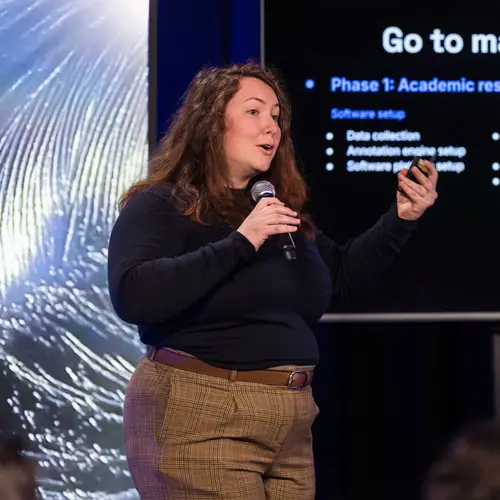
Rejoignez-nous le 19 novembre pour la troisième édition du concours de vulgarisation scientifique de Mila, où les étudiant·e·s présenteront leurs recherches complexes en trois minutes devant un jury.
Nous utilisons des témoins pour analyser le trafic et l’utilisation de notre site web, afin de personnaliser votre expérience. Vous pouvez désactiver ces technologies à tout moment, mais cela peut restreindre certaines fonctionnalités du site. Consultez notre Politique de protection de la vie privée pour en savoir plus.
Paramètre des cookies
Vous pouvez activer et désactiver les types de cookies que vous souhaitez accepter. Cependant certains choix que vous ferez pourraient affecter les services proposés sur nos sites (ex : suggestions, annonces personnalisées, etc.).
Cookies essentiels
Ces cookies sont nécessaires au fonctionnement du site et ne peuvent être désactivés. (Toujours actif)
Cookies analyse
Acceptez-vous l'utilisation de cookies pour mesurer l'audience de nos sites ?
Lecteur Multimédia
Acceptez-vous l'utilisation de cookies pour afficher et vous permettre de regarder les contenus vidéo hébergés par nos partenaires (YouTube, etc.) ?
Commonly, learning-based topological navigation approaches produce a local policy while preserving some loose connectivity of the space thro… (voir plus)ugh a topological map. Nevertheless, spurious or missing edges in the topological graph often lead to navigation failure. In this work, we propose a sampling-based graph building method, which results in sparser graphs yet with higher navigation performance compared to baseline methods. We also propose graph maintenance strategies that eliminate spurious edges and expand the graph as needed, which improves lifelong navigation performance. Unlike controllers that learn from fixed training environments, we show that our model can be fine-tuned using only a small number of collected trajectory images from a real-world environment where the agent is deployed. We demonstrate successful navigation after fine-tuning on real-world environments, and notably show significant navigation improvements over time by applying our lifelong graph maintenance strategies.