


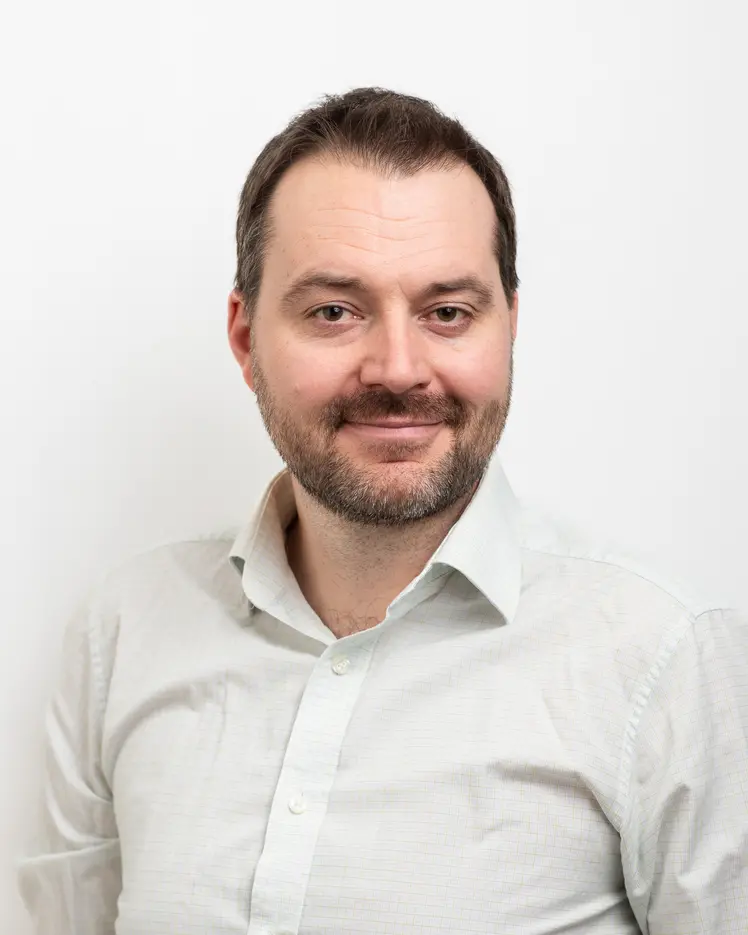
Portrait de James Richard Forbes

James Richard Forbes

Membre académique associé
Professeur titulaire, McGill University, Département de génie mécanique
Sujets de recherche
Apprentissage automatique appliqué
Navigation robotique autonome
Optimisation
Robotique
Théorie de l'information
Théorie des groupes de Lie

Étudiants actuels

Maîtrise recherche - McGill
Doctorat - McGill
Maîtrise recherche - McGill
Baccalauréat - McGill
Maîtrise recherche - McGill
Superviseur⋅e principal⋅e :

Publications

MILUV: A Multi-UAV Indoor Localization dataset with UWB and Vision
Mohammed Ayman Shalaby
Nicholas Dahdah
Syed Shabbir Ahmed
Charles Champagne Cossette
Jerome Le Ny
This paper introduces MILUV, a Multi-UAV Indoor Localization dataset with UWB and Vision measurements. This dataset comprises 217 minutes of… (voir plus) flight time over 36 experiments using three quadcopters, collecting ultra-wideband (UWB) ranging data such as the raw timestamps and channel-impulse response data, vision data from a stereo camera and a bottom-facing monocular camera, inertial measurement unit data, height measurements from a laser rangefinder, magnetometer data, and ground-truth poses from a motion-capture system. The UWB data is collected from up to 12 transceivers affixed to mobile robots and static tripods in both line-of-sight and non-line-of-sight conditions. The UAVs fly at a maximum speed of 4.418 m/s in an indoor environment with visual fiducial markers as features. MILUV is versatile and can be used for a wide range of applications beyond localization, but the primary purpose of MILUV is for testing and validating multi-robot UWB- and vision-based localization algorithms. The dataset can be downloaded at https://doi.org/10.25452/figshare.plus.28386041.v1. A development kit is presented alongside the MILUV dataset, which includes benchmarking algorithms such as visual-inertial odometry, UWB-based localization using an extended Kalman filter, and classification of CIR data using machine learning approaches. The development kit can be found at https://github.com/decargroup/miluv, and is supplemented with a website available at https://decargroup.github.io/miluv/.
The Harmonic Exponential Filter for Nonparametric Estimation on Motion Groups
Miguel Saavedra-Ruiz
Steven A. Parkison
Bayesian estimation is a vital tool in robotics as it allows systems to update the robot state belief using incomplete information from nois… (voir plus)y sensors. To render the state estimation problem tractable, many systems assume that the motion and measurement noise, as well as the state distribution, are unimodal and Gaussian. However, there are numerous scenarios and systems that do not comply with these assumptions. Existing nonparametric filters that are used to model multimodal distributions have drawbacks that limit their ability to represent a diverse set of distributions. This paper introduces a novel approach to nonparametric Bayesian filtering on motion groups, designed to handle multimodal distributions using harmonic exponential distributions. This approach leverages two key insights of harmonic exponential distributions: a) the product of two distributions can be expressed as the element-wise addition of their log-likelihood Fourier coefficients, and b) the convolution of two distributions can be efficiently computed as the tensor product of their Fourier coefficients. These observations enable the development of an efficient and asymptotically exact solution to the Bayes filter up to the band limit of a Fourier transform. We demonstrate our filter's performance compared with established nonparametric filtering methods across simulated and real-world localization tasks.
Reducing Two-Way Ranging Variance by Signal-Timing Optimization
Mohammed Ayman Shalaby
Charles Champagne Cossette
Jerome Le Ny
Time-of-flight-based ranging among transceivers with different clocks requires protocols that accommodate varying rates of the clocks. Doubl… (voir plus)e-sided two-way ranging (DS-TWR) is widely adopted as a standard protocol due to its accuracy; however, the precision of DS-TWR has not been clearly addressed. In this paper, an analytical model of the variance of DS-TWR is derived as a function of the user-programmed response delays, which is then compared to the Cramer-Rao Lower Bound (CRLB). This is then used to formulate an optimization problem over the response delays in order to maximize the information gained from range measurements. The derived analytical variance model and optimized protocol are validated experimentally with 2 ranging UWB transceivers, where 29 million range measurements are collected.