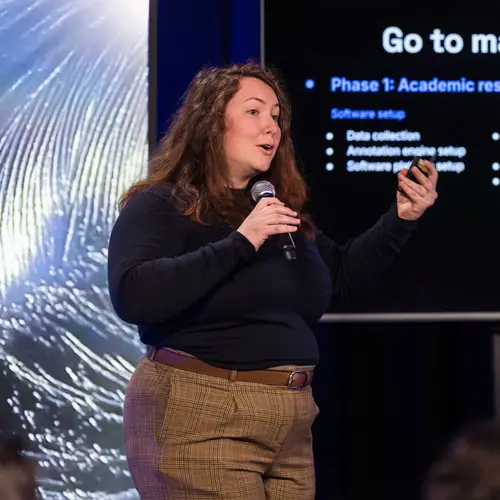
La prochaine rencontre, qui aura lieu le 10 novembre à Mila, permettra d'explorer comment pouvons-nous collectivement développer, encadrer et déployer des systèmes agentiques performants, fiables et sécuritaires en connectant chercheur·euse·s académiques, expert·e·s industriel·le·s et praticien·ne·s.
Ce programme à temps partiel offre aux scientifiques l'opportunité de tester leur intérêt pour l'entrepreneuriat. Vous avez jusqu'au 5 octobre pour postuler.
Avantage IA : productivité dans la fonction publique
Apprenez à tirer parti de l’IA générative pour soutenir et améliorer votre productivité au travail. La prochaine cohorte se déroulera en ligne les 6 et 8 octobre 2026, en anglais.
Nous utilisons des témoins pour analyser le trafic et l’utilisation de notre site web, afin de personnaliser votre expérience. Vous pouvez désactiver ces technologies à tout moment, mais cela peut restreindre certaines fonctionnalités du site. Consultez notre Politique de protection de la vie privée pour en savoir plus.
Paramètre des cookies
Vous pouvez activer et désactiver les types de cookies que vous souhaitez accepter. Cependant certains choix que vous ferez pourraient affecter les services proposés sur nos sites (ex : suggestions, annonces personnalisées, etc.).
Cookies essentiels
Ces cookies sont nécessaires au fonctionnement du site et ne peuvent être désactivés. (Toujours actif)
Cookies analyse
Acceptez-vous l'utilisation de cookies pour mesurer l'audience de nos sites ?
Lecteur Multimédia
Acceptez-vous l'utilisation de cookies pour afficher et vous permettre de regarder les contenus vidéo hébergés par nos partenaires (YouTube, etc.) ?
The physics governing the boundary between the most massive neutron stars (NSs) and the least massive black holes (BHs) is currently uncerta… (voir plus)in, but could potentially be constrained with new observations. While NSs have been observed with masses up to
Multimessenger observations of gravitational waves and electromagnetic emission from compact object mergers offer unique insights into the s… (voir plus)tructure of neutron stars, the formation of heavy elements, and the expansion rate of the Universe. With the LIGO–Virgo–KAGRA (LVK) gravitational-wave detectors currently in their fourth observing run (O4), it is an exciting time for detecting these mergers. However, assessing whether to follow up a candidate gravitational-wave event given limited telescope time and resources is challenging; the candidate can be a false alert due to detector glitches, or may not have any detectable electromagnetic counterpart even if it is real. GWSkyNet-Multi is a machine learning model developed to facilitate follow-up decisions by providing real-time classification of candidate events, using localization information released in LVK rapid public alerts. Here we introduce GWSkyNet-Multi II, an updated model targeted toward providing more robust and informative predictions during O4 and beyond. Specifically, the model now provides normalized probability scores and associated uncertainties for each of the four corresponding source categories released by the LVK: glitch, binary black hole, neutron star–black hole, and binary neutron star. Informed by explainability studies of the original model, the updated model architecture is also significantly simplified, including replacing input images with intuitive summary values that are more interpretable. For significant event alerts issued during O4a and O4b, GWSkyNet-Multi II produces a prediction that is consistent with the updated LVK classification for 93% of events. The updated model can be used by the community to help make time-critical follow-up decisions.