

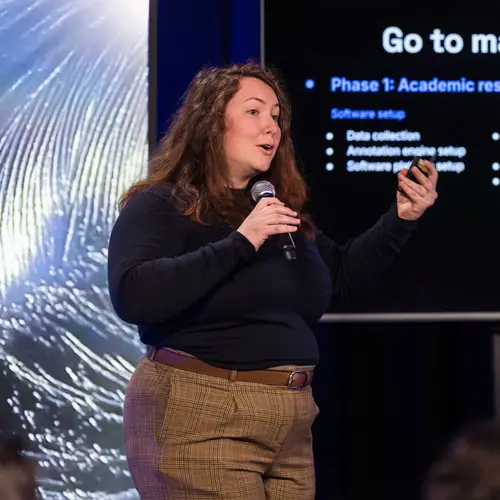


Portrait de Ahmed Ragab

Ahmed Ragab

Membre affilié
Professeur associé, Polytechnique Montréal, Département de mathématiques et génie industriel
Natural Resources Canada
Sujets de recherche
Agent basé sur un LLM
Apprentissage automatique appliqué
Apprentissage automatique et changement climatique
Apprentissage par renforcement
Apprentissage profond
Causalité
Détection d'anomalies
IA centrée sur l'humain
IA et durabilité
IA pour l'humanité
Interprétabilité
Modélisation moléculaire
Optimisation
Planification
Recherche opérationnelle
Sécurité de l'IA
Systèmes énergétiques
Systèmes multi-agents
Télédétection par satellite
Théorie de l'information quantique
XAI (IA explicable)

Publications

Accelerated green material and solvent discovery with chemistry- and physics-guided generative AI
Eslam G. Al-Sakkari
Marzouk Benali
Olumoye Ajao
Daria C. Boffito
Simulate intelligently: Causal incremental reinforcement learning for streamlined industrial chemical process design optimization
Eslam G. Al-Sakkari
Mohamed Ali
Daria C. Boffito
Ensemble machine learning to accelerate industrial decarbonization: Prediction of Hansen solubility parameters for streamlined chemical solvent selection
Eslam G. Al-Sakkari
Mostafa Amer
Olumoye Ajao
Marzouk Benali
Daria C. Boffito
Mouloud Amazouz
Learn-To-Design: Reinforcement Learning-Assisted Chemical Process Optimization
Eslam G. Al-Sakkari
Mohamed Ali
Daria C. Boffito
Mouloud Amazouz
This paper proposes an AI-assisted approach aimed at accelerating chemical process design through causal incremental reinforcement learning … (voir plus)(CIRL) where an intelligent agent is interacting iteratively with a process simulation environment (e.g., Aspen HYSYS, DWSIM, etc.). The proposed approach is based on an incremental learnable optimizer capable of guiding multi-objective optimization towards optimal design variable configurations, depending on several factors including the problem complexity, selected RL algorithm and hyperparameters tuning. One advantage of this approach is that the agent-simulator interaction significantly reduces the vast search space of design variables, leading to an accelerated and optimized design process. This is a generic causal approach that enables the exploration of new process configurations and provides actionable insights to designers to improve not only the process design but also the design process across various applications. The approach was validated on industrial processes including an absorption-based carbon capture, considering the economic and technological uncertainties of different capture processes, such as energy price, production cost, and storage capacity. It achieved a cost reduction of up to 5.5% for the designed capture process, after a few iterations, while also providing the designer with actionable insights. From a broader perspective, the proposed approach paves the way for accelerating the adoption of decarbonization technologies (CCUS value chains, clean fuel production, etc.) at a larger scale, thus catalyzing climate change mitigation.
Carbon capture, utilization and sequestration systems design and operation optimization: Assessment and perspectives of artificial intelligence opportunities
Eslam G. Al-Sakkari
Daria C. Boffito
Mouloud Amazouz
Carbon capture, utilization, and sequestration (CCUS) is a promising solution to decarbonize the energy and industrial sector to mitigate cl… (voir plus)imate change. An integrated assessment of technological options is required for the effective deployment of CCUS large-scale infrastructure between CO2 production and utilization/sequestration nodes. However, developing cost-effective strategies from engineering and operation perspectives to implement CCUS is challenging. This is due to the diversity of upstream emitting processes located in different geographical areas, available downstream utilization technologies, storage sites capacity/location, and current/future energy/emissions/economic conditions. This paper identifies the need to achieve a robust hybrid assessment tool for CCUS modeling, simulation, and optimization based mainly on artificial intelligence (AI) combined with mechanistic methods. Thus, a critical literature review is conducted to assess CCUS technologies and their related process modeling/simulation/optimization techniques, while evaluating the needs for improvements or new developments to reduce overall CCUS systems design and operation costs. These techniques include first principles- based and data-driven ones, i.e. AI and related machine learning (ML) methods. Besides, the paper gives an overview on the role of life cycle assessment (LCA) to evaluate CCUS systems where the combined LCA-AI approach is assessed. Other advanced methods based on the AI/ML capabilities/algorithms can be developed to optimize the whole CCUS value chain. Interpretable ML combined with explainable AI can accelerate optimum materials selection by giving strong rules which accelerates the design of capture/utilization plants afterwards. Besides, deep reinforcement learning (DRL) coupled with process simulations will accelerate process design/operation optimization through considering simultaneous optimization of equipment sizing and operating conditions. Moreover, generative deep learning (GDL) is a key solution to optimum capture/utilization materials design/discovery. All of these developed methods will be generalizable where the extracted knowledge can be transferred to future works to help cutting the costs of CCUS value chain.
Machine learning-assisted selection of adsorption-based carbon dioxide capture materials
Eslam G. Al-Sakkari
Terry M.Y. So
Marzieh Shokrollahi
Philippe Navarri
Ali Elkamel
Mouloud Amazouz