

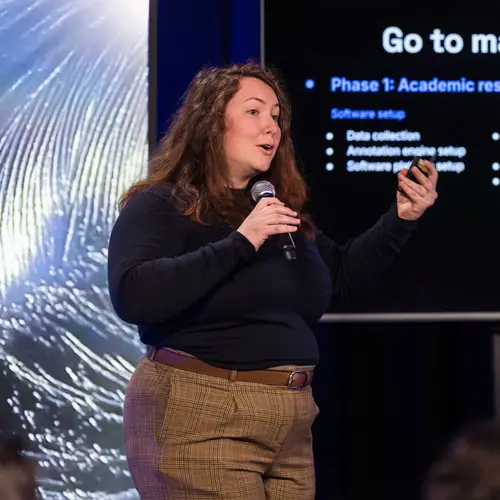


Portrait of Guillaume Rabusseau

Guillaume Rabusseau

Core Academic Member
Canada CIFAR AI Chair
Assistant Professor, Université de Montréal, Department of Computer Science and Operations Research
Research Topics
Deep Learning
Graph Neural Networks
Learning on Graphs
Machine Learning Theory
Probabilistic Models
Quantum Information Theory
Recommender Systems
Recurrent Neural Networks
Tensor Factorization

Biography

I have been an assistant professor at Mila – Quebec Artificial Intelligence Institute and in the Department of Computer Science and Operations Research (DIRO) at Université de Montréal (UdeM) since September 2018. I was awarded a Canada CIFAR AI Chair in March 2019. Before joining UdeM, I was a postdoctoral research fellow in the Reasoning and Learning Lab at McGill University, where I worked with Prakash Panangaden, Joelle Pineau and Doina Precup.

I obtained my PhD in 2016 from Aix-Marseille University (AMU) in France, where I worked in the Qarma team (Machine Learning and Multimedia) under the supervision of François Denis and Hachem Kadri. I also obtained my MSc in fundamental computer science and my BSc in computer science from AMU. I am interested in tensor methods for machine learning and in designing learning algorithms for structured data by leveraging linear and multilinear algebra (e.g., spectral methods).

Current Students

Postdoctorate - Université de Montréal
Collaborating Alumni - Université de Montréal
PhD - Université de Montréal
Co-supervisor :
Collaborating Alumni - McGill University
Principal supervisor :
Collaborating researcher - Université de Montréal
PhD - Université de Montréal
Postdoctorate - McGill University
Co-supervisor :
Collaborating researcher - INRIA
Master's Research - Université de Montréal
Collaborating Alumni - McGill University
Principal supervisor :
PhD - Université de Montréal
Co-supervisor :
PhD - Université de Montréal
Co-supervisor :
Collaborating researcher - Université de Montréal
Co-supervisor :
PhD - Université de Montréal

Publications

Representation of Reinforcement Learning Policies in Reproducing Kernel Hilbert Spaces
We propose a general framework for policy representation for reinforcement learning tasks. This framework involves finding a low-dimensional… (see more) embedding of the policy on a reproducing kernel Hilbert space (RKHS). The usage of RKHS based methods allows us to derive strong theoretical guarantees on the expected return of the reconstructed policy. Such guarantees are typically lacking in black-box models, but are very desirable in tasks requiring stability. We conduct several experiments on classic RL domains. The results confirm that the policies can be robustly embedded in a low-dimensional space while the embedded policy incurs almost no decrease in return.
Efficient Planning under Partial Observability with Unnormalized Q Functions and Spectral Learning
Tensor Networks for Probabilistic Sequence Modeling
Tensor networks are a powerful modeling framework developed for computational many-body physics, which have only recently been applied withi… (see more)n machine learning. In this work we utilize a uniform matrix product state (u-MPS) model for probabilistic modeling of sequence data. We first show that u-MPS enable sequence-level parallelism, with length-n sequences able to be evaluated in depth O(log n). We then introduce a novel generative algorithm giving trained u-MPS the ability to efficiently sample from a wide variety of conditional distributions, each one defined by a regular expression. Special cases of this algorithm correspond to autoregressive and fill-in-the-blank sampling, but more complex regular expressions permit the generation of richly structured data in a manner that has no direct analogue in neural generative models. Experiments on sequence modeling with synthetic and real text data show u-MPS outperforming a variety of baselines and effectively generalizing their predictions in the presence of limited data.
Tensorized Random Projections
Beheshteh T. Rakhshan
Neural Architecture Search for Class-incremental Learning
In class-incremental learning, a model learns continuously from a sequential data stream in which new classes occur. Existing methods often … (see more)rely on static architectures that are manually crafted. These methods can be prone to capacity saturation because a neural network's ability to generalize to new concepts is limited by its fixed capacity. To understand how to expand a continual learner, we focus on the neural architecture design problem in the context of class-incremental learning: at each time step, the learner must optimize its performance on all classes observed so far by selecting the most competitive neural architecture. To tackle this problem, we propose Continual Neural Architecture Search (CNAS): an autoML approach that takes advantage of the sequential nature of class-incremental learning to efficiently and adaptively identify strong architectures in a continual learning setting. We employ a task network to perform the classification task and a reinforcement learning agent as the meta-controller for architecture search. In addition, we apply network transformations to transfer weights from previous learning step and to reduce the size of the architecture search space, thus saving a large amount of computational resources. We evaluate CNAS on the CIFAR-100 dataset under varied incremental learning scenarios with limited computational power (1 GPU). Experimental results demonstrate that CNAS outperforms architectures that are optimized for the entire dataset. In addition, CNAS is at least an order of magnitude more efficient than naively using existing autoML methods.
Recognizable series on graphs and hypergraphs
Raphaël Bailly
François Denis
Connecting Weighted Automata and Recurrent Neural Networks through Spectral Learning
In this paper, we unravel a fundamental connection between weighted finite automata~(WFAs) and second-order recurrent neural networks~(2-RNN… (see more)s): in the case of sequences of discrete symbols, WFAs and 2-RNNs with linear activation functions are expressively equivalent. Motivated by this result, we build upon a recent extension of the spectral learning algorithm to vector-valued WFAs and propose the first provable learning algorithm for linear 2-RNNs defined over sequences of continuous input vectors. This algorithm relies on estimating low rank sub-blocks of the so-called Hankel tensor, from which the parameters of a linear 2-RNN can be provably recovered. The performances of the proposed method are assessed in a simulation study.
Clustering-Oriented Representation Learning with Attractive-Repulsive Loss
The standard loss function used to train neural network classifiers, categorical cross-entropy (CCE), seeks to maximize accuracy on the trai… (see more)ning data; building useful representations is not a necessary byproduct of this objective. In this work, we propose clustering-oriented representation learning (COREL) as an alternative to CCE in the context of a generalized attractive-repulsive loss framework. COREL has the consequence of building latent representations that collectively exhibit the quality of natural clustering within the latent space of the final hidden layer, according to a predefined similarity function. Despite being simple to implement, COREL variants outperform or perform equivalently to CCE in a variety of scenarios, including image and news article classification using both feed-forward and convolutional neural networks. Analysis of the latent spaces created with different similarity functions facilitates insights on the different use cases COREL variants can satisfy, where the Cosine-COREL variant makes a consistently clusterable latent space, while Gaussian-COREL consistently obtains better classification accuracy than CCE.
Minimization of Graph Weighted Models over Circular Strings
Sequential Coordination of Deep Models for Learning Visual Arithmetic
Achieving machine intelligence requires a smooth integration of perception and reasoning, yet models developed to date tend to specialize in… (see more) one or the other; sophisticated manipulation of symbols acquired from rich perceptual spaces has so far proved elusive. Consider a visual arithmetic task, where the goal is to carry out simple arithmetical algorithms on digits presented under natural conditions (e.g. hand-written, placed randomly). We propose a two-tiered architecture for tackling this problem. The lower tier consists of a heterogeneous collection of information processing modules, which can include pre-trained deep neural networks for locating and extracting characters from the image, as well as modules performing symbolic transformations on the representations extracted by perception. The higher tier consists of a controller, trained using reinforcement learning, which coordinates the modules in order to solve the high-level task. For instance, the controller may learn in what contexts to execute the perceptual networks and what symbolic transformations to apply to their outputs. The resulting model is able to solve a variety of tasks in the visual arithmetic domain, and has several advantages over standard, architecturally homogeneous feedforward networks including improved sample efficiency.
Learning Graph Weighted Models on Pictures
Graph Weighted Models (GWMs) have recently been proposed as a natural generalization of weighted automata over strings and trees to arbitrar… (see more)y families of labeled graphs (and hypergraphs). A GWM generically associates a labeled graph with a tensor network and computes a value by successive contractions directed by its edges. In this paper, we consider the problem of learning GWMs defined over the graph family of pictures (or 2-dimensional words). As a proof of concept, we consider regression and classification tasks over the simple Bars & Stripes and Shifting Bits picture languages and provide an experimental study investigating whether these languages can be learned in the form of a GWM from positive and negative examples using gradient-based methods. Our results suggest that this is indeed possible and that investigating the use of gradient-based methods to learn picture series and functions computed by GWMs over other families of graphs could be a fruitful direction.
Nonlinear Weighted Finite Automata