

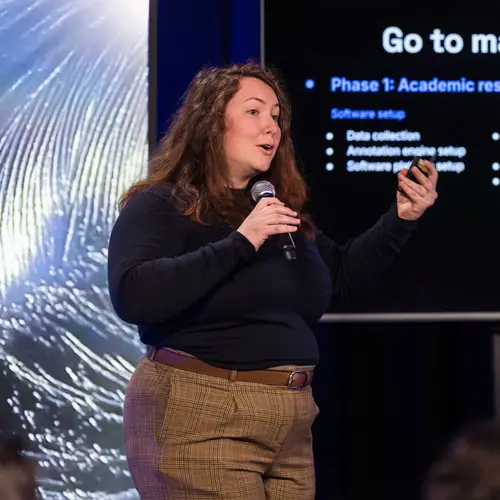


Portrait of Eugene Belilovsky

Eugene Belilovsky

Associate Academic Member
Assistant Professor, Concordia University, Department of Computer Science and Software Engineering
Adjunct Professor, Université de Montréal, Department of Computer Science and Operations Research
Research Topics
Continual Learning
Deep Learning
Federated Learning
Large Language Models (LLM)
Optimization

Biography

Eugene Belilovsky is an assistant professor in the Department of Computer Science and Software Engineering at Concordia University.

He is also an associate academic member of Mila – Quebec Artificial Intelligence Institute and an adjunct professor at Université de Montréal.

Belilovsky’s research specialties lie in computer vision and deep learning. His current interests include continual learning and few-shot learning, along with applications of these aspects at the intersection of computer vision and language processing.

Current Students

PhD - Concordia University
Co-supervisor :
Master's Research - Concordia University
Co-supervisor :
PhD - Concordia University
Co-supervisor :
PhD - Concordia University
Co-supervisor :
Master's Research - Concordia University
Co-supervisor :
PhD - Concordia University
Postdoctorate - Concordia University
Co-supervisor :
PhD - Concordia University
Co-supervisor :
PhD - Concordia University
Co-supervisor :
PhD - Université de Montréal
Principal supervisor :
Collaborating Alumni - Université de Montréal
Principal supervisor :
PhD - Concordia University
Co-supervisor :

Publications

Unifying Local Communications and Local Updates for LLM Pretraining
Communication-efficient pre-training of LLMs is increasingly important as training draws on compute distributed across clusters, data center… (see more)s, and lower-bandwidth links. Many practical methods reduce communication frequency but still rely on synchronous All-Reduce operations that maintain identical model states and tie progress to global collectives. This can become a bottleneck when bandwidth or worker speed is heterogeneous. We introduce GASLoC, a novel decentralized pre-training algorithm that generalizes the notion of communication acceleration to the recently popular"outer optimizer"to allow a practical gossip-based training framework that is compatible with adaptive optimizers, allows for local optimizer steps, and can utilize sparse randomized peer communication. Empirically, on a number of standard LLM training tasks, we demonstrate that GASLoC outperforms state-of-the-art decentralized algorithms in single step per communication setting for a number of topologies and, unlike existing decentralized methods in the LLM setting, it allows to obtain performance competitive with DiLoCo when utilizing multiple local steps. In the heterogeneous bandwidth setting we demonstrate the advantage of GASLoC showing that it can significantly outperform DiLoCo.
Learned Subspace Compression for Communication-Efficient Pipeline Parallelism
Pipeline parallelism enables training of large language models that exceed single-device memory, yet inter-stage activation communication be… (see more)comes the dominant bottleneck when trained on low-bandwidth networks. Recent work in this area has proposed using fixed orthogonal projections to compress activations. However, this still results in a significant performance degradation and requires a number of non-standard adaptations to constrain the optimization. A natural alternative is to learn a low rank projection for each pipeline stage, however maintaining the necessary orthogonality of these projectors during training remains a challenge. We present Manifold Aware Projection Learning (MAPL), a method that treats inter-stage compression as a learnable orthogonal projection under explicit Stiefel manifold (orthogonal matrices) constraints. Rather than prescribing a fixed global subspace, MAPL lets each pipeline stage discover and continuously adapt its own task-optimal compression subspace via manifold-constrained steepest descent. To recover token-specific signals at stage boundaries, we introduce per-stage factorized anchor embeddings that allow for full-rank activation reconstruction with negligible communication overhead. We further show that we can incorporate residual vector quantization after projection with a streaming codebook synchronization protocol that amortizes dictionary communication. Across LLaMA models from 150M to 1B parameters we show that MAPL can be easily applied to the existing pipeline and can achieve high compression with neglibile performance degradation with a drastically improved tradeoffs in performance vs. compression compared to Subspace Networks.
Meta-Merging by Checkpoint Nowcasting
Albert Manuel Orozco Camacho
Model merging---the direct combination of parameters from independently fine-tuned networks---offers a way to compose task-specific capabili… (see more)ties without retraining or ensemble inference. Existing merge methods are often built from hand-crafted arithmetic or sparsification heuristics, leaving open whether general learned weight-space operators can be repurposed for merging directly. We study this question with NiNo, a pre-trained checkpoint-nowcasting meta-network originally designed to predict near-future training states from short checkpoint histories. We show that pre-trained NiNo can be reused as a data-free pairwise meta-merge operator for independently fine-tuned models. On an 8-task CLIP ViT-B/16 benchmark, NiNo is competitive with strong arithmetic baselines and consistently lands in the same functional region as weight averaging, Task Arithmetic, and TIES. Moreover, NiNo is best on HumanEval in a Qwen3 language extension among the compared merge methods, while extending meta-merge beyond pairs remains an open challenge. These results position learned checkpoint nowcasting as a practical starting point for data-free model merging and motivate future weight-space learners trained for merging explicitly.
Path-independent Flow Matching for Multi-parameter Generative Dynamics
Flow Matching is a powerful framework for learning transport maps between probability distributions. Yet its standard single-parameter formu… (see more)lation is not designed to capture multi-parameter variations where the resulting transport should be path-independent. Path independence is crucial because it ensures that transformations depend only on the initial and target distributions, not on the specific path. In this work, we introduce Path-independent Flow Matching (PiFM), a method for learning vector fields whose induced flows yield path-independent transport between distributions. We show that PiFM generalizes Flow Matching to higher-dimensional parameter domains while enforcing structural conditions that ensure consistency of composed transformations. In addition, we show that, under suitable assumptions, PiFM approximates the Wasserstein barycenter, linking the framework to a notion of distributional interpolation. To enable practical training, we propose a tractable, simulation-free objective that regresses onto multi-parameter conditional probability paths. We showcase empirically that PiFM outperforms other approaches on both synthetic and real world data in interpolating path-independent trajectories and generating desired out of distribution samples.
Covenant-72B: Pre-Training a 72B LLM with Trustless Peers Over-the-Internet
Joel Lidin
Amir Sarfi
Erfan Miahi
Quentin Anthony
Shivam Chauhan
Evangelos Pappas
Samuel Dare
Recently, there has been increased interest in globally distributed training, which has the promise to both reduce training costs and democr… (see more)atize participation in building large-scale foundation models. However, existing models trained in a globally distributed manner are relatively small in scale and have only been trained with whitelisted participants. Therefore, they do not yet realize the full promise of democratized participation. In this report, we describe Covenant-72B, an LLM produced by the largest collaborative globally distributed pre-training run (in terms of both compute and model scale), which simultaneously allowed open, permissionless participation supported by a live blockchain protocol. We utilized a state-of-the-art communication-efficient optimizer, SparseLoCo, supporting dynamic participation with peers joining and leaving freely. Our model, pre-trained on approximately 1.1T tokens, performs competitively with fully centralized models pre-trained on similar or higher compute budgets, demonstrating that fully democratized, non-whitelisted participation is not only feasible, but can be achieved at unprecedented scale for a globally distributed pre-training run.
End-to-End Fine-Tuning of 3D Texture Generation using Differentiable Rewards
Tianhao Xie
Amir G. Aghdam
Tiberiu Popa
While recent 3D generative models can produce high-quality texture images, they often fail to capture human preferences or meet task-specifi… (see more)c requirements. Moreover, a core challenge in the 3D texture generation domain is that most existing approaches rely on repeated calls to 2D text-to-image generative models, which lack an inherent understanding of the 3D structure of the input 3D mesh object. To alleviate these issues, we propose an end-to-end differentiable, reinforcement-learning-free framework that embeds human feedback, expressed as differentiable reward functions, directly into the 3D texture synthesis pipeline. By back-propagating preference signals through both geometric and appearance modules of the proposed framework, our method generates textures that respect the 3D geometry structure and align with desired criteria. To demonstrate its versatility, we introduce three novel geometry-aware reward functions, which offer a more controllable and interpretable pathway for creating high-quality 3D content from natural language. By conducting qualitative, quantitative, and user-preference evaluations against state-of-the-art methods, we demonstrate that our proposed strategy consistently outperforms existing approaches. Our implementation code is publicly available at: https://github.com/AHHHZ975/Differentiable-Texture-Learning
Efficient Refusal Ablation in LLM through Optimal Transport
Safety-aligned language models refuse harmful requests through learned refusal behaviors encoded in their internal representations. Recent a… (see more)ctivation-based jailbreaking methods circumvent these safety mechanisms by applying orthogonal projections to remove refusal directions, but these approaches treat refusal as a one-dimensional phenomenon and ignore the rich distributional structure of model activations. We introduce a principled framework based on optimal transport theory that transforms the entire distribution of harmful activations to match harmless ones. By combining PCA with closed-form Gaussian optimal transport, we achieve efficient computation in high-dimensional representation spaces while preserving essential geometric structure. Across six models (Llama-2, Llama-3.1, Qwen-2.5; 7B-32B parameters), our method achieves up to 11% higher attack success rates than state-of-the-art baselines while maintaining comparable perplexity, demonstrating superior preservation of model capabilities. Critically, we discover that layer-selective intervention (applying optimal transport to 1-2 carefully chosen layers at approximately 40-60% network depth) substantially outperforms full-network interventions, revealing that refusal mechanisms may be localized rather than distributed. Our analysis provides new insights into the geometric structure of safety representations and suggests that current alignment methods may be vulnerable to distributional attacks beyond simple direction removal.
DiffuMamba: High-Throughput Diffusion LMs with Mamba Backbone
Pierre-Andre Noel
Torsten Scholak
Diffusion language models (DLMs) have emerged as a promising alternative to autoregressive (AR) generation, yet their reliance on Transforme… (see more)r backbones limits inference efficiency due to quadratic attention or KV-cache overhead. We introduce DiffuMamba, a masked diffusion language model built on a bidirectional Mamba backbone that combines the diffusion objective with linear-time sequence modeling, and DiffuMamba-H, a hybrid variant with interleaved attention. Across scales up to 1.3B parameters, our models match Transformer-based diffusion in downstream performance while achieving up to 8.2× and 4.3× higher inference throughput, respectively, on long sequences. We further present a systematic analysis of inference efficiency across modern DLM variants, combining asymptotic complexity with empirical measurements. Notably, cache-efficient block diffusion with Mamba mixers emerges as the only strategy that scales linearly with sequence length and achieves the strongest performance across all baselines, suggesting a promising direction for future diffusion-based generation systems.
Celo2: Towards Learned Optimization Free Lunch
Learned optimizers are powerful alternatives to hand-designed update rules like Adam, yet they have seen limited practical adoption since th… (see more)ey often fail to meta-generalize beyond their training distribution and incur high meta-training cost. For instance, prior work, VeLO, scaled meta-training to 4,000 TPU months (
Stabilizing Native Low-Rank LLM Pretraining
Foundation models have achieved remarkable success, yet their growing parameter counts pose significant computational and memory challenges.… (see more) Low-rank factorization offers a promising route to reduce training and inference costs, but the community lacks a stable recipe for training models from scratch using exclusively low-rank weights while matching the performance of the dense model. We demonstrate that Large Language Models (LLMs) can be trained from scratch using exclusively low-rank factorized weights for all non-embedding matrices without auxiliary"full-rank"guidance required by prior methods. While native low-rank training often suffers from instability and loss spikes, we identify uncontrolled growth in the spectral norm (largest singular value) of the weight matrix update as the dominant factor. To address this, we introduce Spectron: Spectral renormalization with orthogonalization, which dynamically bounds the resultant weight updates based on the current spectral norms of the factors. Our method enables stable, end-to-end factorized training with negligible overhead. Finally, we establish compute-optimal scaling laws for natively low-rank transformers, demonstrating predictable power-law behavior and improved inference efficiency relative to dense models.
Dual-Phase Continual Learning: Supervised Adaptation Meets Unsupervised Retention
Foundational vision-language models (VLMs) excel across diverse tasks, but adapting them to new domains without forgetting prior knowledge r… (see more)emains a critical challenge. Continual Learning (CL) addresses this challenge by enabling models to learn sequentially from new data while mitigating the forgetting of prior information, typically under supervised settings involving label shift. Nonetheless, abrupt distribution shifts can still cause substantial forgetting, potentially nullifying the benefits of supervised updates, especially when storing or replaying past data is infeasible. In this work, we propose leveraging unlabeled test-time data in an unsupervised manner to reinforce prior task performance without requiring replay or stored examples. Unlike traditional Test-Time Adaptation (TTA), which primarily focuses on domain shift or corruption, our method improves performance on earlier tasks by exploiting representative test samples encountered during deployment. We introduce a simple teacher-student framework with gradient-based sparse parameter updates, and show that it effectively mitigates forgetting in class-incremental CL for VLMs, offering a memory-free alternative to episodic replay with strong empirical results.
$\mu$LO: Compute-Efficient Meta-Generalization of Learned Optimizers
Learned optimizers (LOs) have the potential to significantly reduce the wall-clock training time of neural networks. However, they can strug… (see more)gle to optimize unseen tasks (*meta-generalize*), especially when training networks wider than those seen during meta-training. To address this, we derive the Maximal Update Parametrization (