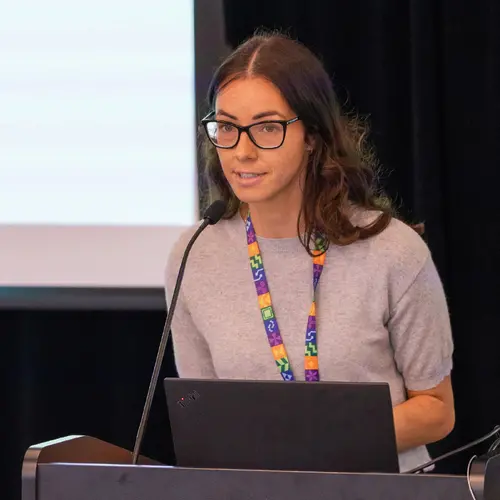
Opening Conference | Building Safer AI for Youth Mental Health
On March 16, join leading AI researchers, clinical experts, and voices from the ground for an event exploring the frameworks needed to design AI that is not only powerful, but also safe for mental health.

TRAIL: Responsible AI for Professionals and Leaders
Learn how to integrate responsible AI practices into your organization with TRAIL. Join our information session on March 12, where you’ll discover the program in detail and have the chance to ask all your questions.

We use cookies to analyze the browsing and usage of our website and to personalize your experience. You can disable these technologies at any time, but this may limit certain functionalities of the site. Read our Privacy Policy for more information.
Setting cookies
You can enable and disable the types of cookies you wish to accept. However certain choices you make could affect the services offered on our sites (e.g. suggestions, personalised ads, etc.).
Essential cookies
These cookies are necessary for the operation of the site and cannot be deactivated. (Still active)
Analytics cookies
Do you accept the use of cookies to measure the audience of our sites?
Multimedia Player
Do you accept the use of cookies to display and allow you to watch the video content hosted by our partners (YouTube, etc.)?
Zhouhan Lin
Alumni
Publications
Theano: A Python framework for fast computation of mathematical expressions
Theano is a Python library that allows to define, optimize, and evaluate mathematical expressions involving multi-dimensional arrays efficie… (see more)ntly. Since its introduction, it has been one of the most used CPU and GPU mathematical compilers - especially in the machine learning community - and has shown steady performance improvements. Theano is being actively and continuously developed since 2008, multiple frameworks have been built on top of it and it has been used to produce many state-of-the-art machine learning models.
The present article is structured as follows. Section I provides an overview of the Theano software and its community. Section II presents the principal features of Theano and how to use them, and compares them with other similar projects. Section III focuses on recently-introduced functionalities and improvements. Section IV compares the performance of Theano against Torch7 and TensorFlow on several machine learning models. Section V discusses current limitations of Theano and potential ways of improving it.