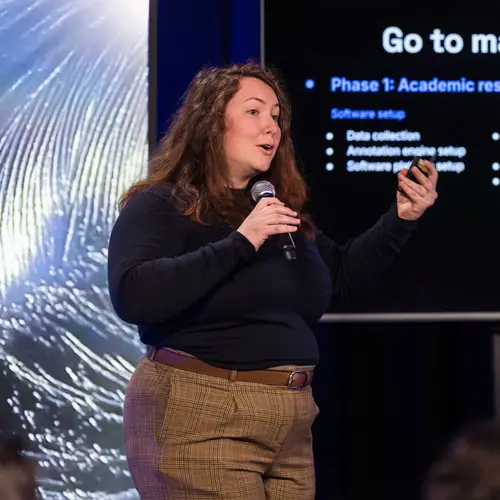
The upcoming meeting, taking place on November 10 at Mila, will explore how we can collectively develop, govern, and deploy high-performing, reliable, and secure agentic systems by connecting academic researchers, industry experts, and practitioners.
We use cookies to analyze the browsing and usage of our website and to personalize your experience. You can disable these technologies at any time, but this may limit certain functionalities of the site. Read our Privacy Policy for more information.
Setting cookies
You can enable and disable the types of cookies you wish to accept. However certain choices you make could affect the services offered on our sites (e.g. suggestions, personalised ads, etc.).
Essential cookies
These cookies are necessary for the operation of the site and cannot be deactivated. (Still active)
Analytics cookies
Do you accept the use of cookies to measure the audience of our sites?
Multimedia Player
Do you accept the use of cookies to display and allow you to watch the video content hosted by our partners (YouTube, etc.)?
Publications
SATCLIP-GNN: Cold-Start PM2.5 Forecasting with Satellite-Derived Location Priors
Siam Shibly Antar
Syem Shibly Ador
Steven H. H. Ding
Benjamin C. M. Fung
Spatiotemporal PM2.5 forecasting is commonly framed as diffusion on a station graph, yet many strong models rely on learned node embeddings … (see more)that are tightly coupled to the training station set and can generalize poorly when new monitoring sites are deployed. This paper studies a forecasting pipeline that replaces trainable station embeddings with frozen SatCLIP location representations derived from satellite imagery, and combines them with temporal modeling and graph message passing. We additionally investigate a physicsinspired wind-gated dynamic graph enforcing downwind transport. On a five-year U.S. dataset with 596 stations and a chronological split (train 2019-2021, val 2022, test 2023), a Graph WaveNet baseline provides slightly stronger 2023 performance under a PM2.5 only “proper baseline” setting (24 h history
2026-04-21
IEEE Mediterranean and Middle-East Geoscience and Remote Sensing Symposium (published)
Identifying sequences of syllables within birdsongs is key to tackling a wide array of challenges, including bird individual identification … (see more)and better understanding of animal communication and sensory-motor learning. Recently, machine learning approaches have demonstrated great potential to alleviate the need for experts to label long audio recordings by hand. However, they still typically rely on the availability of labelled data for model training, restricting applicability to a few species and datasets. In this work, we build the first fully unsupervised algorithm to decompose birdsong recordings into sequences of syllables. We first detect syllable events, then cluster them to extract templates -- syllable representations -- before performing matching pursuit to decompose the recording as a sequence of syllables. We evaluate our automatic annotations against human labels on a dataset of Bengalese finch songs and find that our unsupervised method achieves high performance. We also demonstrate that our approach can distinguish individual birds within a species through their unique vocal signatures, for both Bengalese finches and another species, the great tit.
2026-04-20
IEEE Conference on Acoustics, Speech and Signal Processing (published)
Classical psychedelics induce complex visual hallucinations in humans, generating percepts that are coherent at a low level, but which have … (see more)surreal, dream-like qualities at a high level. While there are many hypotheses as to how classical psychedelics could induce these effects, there are no concrete mechanistic models that capture the variety of observed effects in humans, while remaining consistent with the known pharmacological effects of classical psychedelics on neural circuits. In this work, we propose the ‘oneirogen hypothesis,’ which posits that the perceptual effects of classical psychedelics are a result of their pharmacological actions inducing neural activity states that truly are more similar to dream-like states. We simulate classical psychedelics’ effects via manipulating neural network models trained on perceptual tasks with the Wake-Sleep algorithm. This established machine learning algorithm leverages two activity phases: a perceptual phase (wake) where sensory inputs are encoded, and a generative phase (dream) where the network internally generates activity consistent with stimulus-evoked responses. We simulate the action of psychedelics by partially shifting the model to the ‘Sleep’ state, which entails a greater influence of top-down connections, in line with the impact of psychedelics on apical dendrites. The effects resulting from this manipulation capture a number of experimentally observed phenomena, including the emergence of hallucinations, increases in stimulus-conditioned variability, and large increases in synaptic plasticity. We further provide a number of testable predictions which could be used to validate or invalidate our oneirogen hypothesis.
We introduce the Latent Fourier Transform (LatentFT), a framework that provides novel frequency-domain controls for generative music models.… (see more) LatentFT combines a diffusion autoencoder with a latent-space Fourier transform to separate musical patterns by timescale. By masking latents in the frequency domain during training, our method yields representations that can be manipulated coherently at inference. This allows us to generate musical variations and blends from reference examples while preserving characteristics at desired timescales, which are specified as frequencies in the latent space. LatentFT parallels the role of the equalizer in music production: while traditional equalizers operates on audible frequencies to shape timbre, LatentFT operates on latent-space frequencies to shape musical structure. Experiments and listening tests show that LatentFT improves condition adherence and quality compared to baselines. We also present a technique for hearing frequencies in the latent space in isolation, and show different musical attributes reside in different regions of the latent spectrum. Our results show how frequency-domain control in latent space provides an intuitive, continuous frequency axis for conditioning and blending, advancing us toward more interpretable and interactive generative music models.
Security risk assessment of android automotive OS software supply chain using firmware reverse engineering
Hanbo Yu
Faiyaz Khan
Steven H.H. Ding
Junjie Wu
Natalia Stakhanova
Benjamin C.M. Fung
As Android Automotive OS (AAOS) becomes the in-vehicle platform of choice for infotainment and domain-controller functions in modern passeng… (see more)er cars, its software supply chain has emerged as a critical security frontier. AAOS spans both infotainment and vehicle-control domains within the automotive electronics architecture by supporting media streaming, over-the-air updates, navigation, and sensor fusion. Its open-source foundations and reliance on third-party libraries introduce risks, from outdated components to malicious modules, that can undermine vehicle functionality and passenger safety. In recognition of these threats, ISO/SAE 21434 and UNECE WP.29 R155 mandate structured security assessments for vehicular systems to prevent software-chain vulnerabilities from compromising safety. In this study, we apply a shift-right security analysis via firmware reverse engineering to AAOS images from four leading OEMs. We unpack each firmware image, extract software bills of materials (SBOMs), map Common Vulnerabilities and Exposures (CVE) to components, and characterize system-level attack surfaces across infotainment and control subsystems. Proof-of-concept exploits were developed for high-risk vulnerabilities. One critical CVE was successfully triggered, while others were mitigated by missing dependencies or built-in protections. Our work delivers a reproducible firmware-analysis workflow for automotive supply-chain risk assessment, a comparative survey of third-party and proprietary component management, and the evidence of inconsistent security postures in AAOS-based vehicular electronics. These vulnerabilities underscore the need for harmonized SBOM practices and targeted hardening in next-generation in-vehicle systems.
Dynamic graph learning methods have recently emerged as powerful tools for modelling relational data evolving through time. However, despite… (see more) extensive benchmarking efforts, it remains unclear whether current Temporal Graph Neural Networks (TGNNs) effectively capture core temporal patterns such as periodicity, cause-and-effect, and long-range dependencies. In this work, we introduce the Temporal Graph Reasoning Benchmark (T-GRAB), a comprehensive set of synthetic tasks designed to systematically probe the capabilities of TGNNs to reason across time. T-GRAB provides controlled, interpretable tasks that isolate key temporal skills: counting/memorizing periodic repetitions, inferring delayed causal effects, and capturing long-range dependencies over both spatial and temporal dimensions. We evaluate 11 temporal graph learning methods on these tasks, revealing fundamental shortcomings in their ability to generalize temporal patterns. Our findings offer actionable insights into the limitations of current models, highlight challenges hidden by traditional real-world benchmarks, and motivate the development of architectures with stronger temporal reasoning abilities. The code for T-GRAB can be found at: https://github.com/alirezadizaji/T-GRAB.
2026-04-19
ACM SIGKDD Conference on Knowledge Discovery and Data Mining (published)
Artificial intelligence (AI) technologies are increasingly used in modern weapons systems. Notably, these systems have recently been involve… (see more)d in mass killings and destruction at scale. Furthermore, there is currently a strong interest and competition among powerful players to accelerate the proliferation of weapons with automated or AI-based components, a phenomenon known as AI arms race. This competition poses a risk of causing even more deaths and devastation in the future, as well as increased power and wealth inequality. In this work, we aim to shed light on the role of AI researchers as implicated subjects in the harms caused by weapons enabled by AI technologies. We investigate and discuss the specifics of this implication and explore ways to transfigure this position of implication into one of differentiated, long-distance solidarity with the victims of technologically fortified injustices.
Frontier models have demonstrated exceptional capabilities following the integration of task-reward-based reinforcement learning (RL) into t… (see more)heir training pipelines, enabling systems to evolve from pure reasoning models into sophisticated agents. However, debate persists regarding whether RL genuinely instills new skills within a base model or merely sharpens its existing distribution to elicit latent capabilities. To address this dichotomy, we present an explicit comparison between distribution sharpening and task-reward-based learning, utilizing RL as a tool to implement both paradigms. Our analysis reveals the inherent limitations of distribution sharpening, demonstrating from first principles how and why the optima can be unfavorable and the approach fundamentally unstable. Furthermore, our experiments using Llama-3.2-3B-Instruct, Qwen2.5-3B-Instruct and Qwen3-4B-Instruct-2507 on math datasets confirm that sharpening yields limited gains, whereas incorporating task-based reward signal can greatly help achieve robust performance improvements and stable learning.
Speech translation for low-resource languages remains fundamentally limited by the scarcity of high-quality, diverse parallel speech data, a… (see more) challenge that is especially pronounced in African linguistic contexts. To address this, we introduce NaijaS2ST, a parallel speech translation dataset spanning Igbo, Hausa, Yor\`ub\'a, and Nigerian Pidgin paired with English. The dataset comprises approximately 50 hours of speech per language and captures substantial variation in speakers and accents, reflecting realistic multilingual and multi-accent conditions. With NaijaS2ST, we conduct a comprehensive benchmark of cascaded, end-to-end (E2E), and AudioLLM-based approaches across bidirectional translation settings. Our results show that audio LLMs with few-shot examples are more effective for speech-to-text translation than cascaded and end-to-end methods trained on fine-tuned data. However, for speech-to-speech translation, the cascaded and audio LLM paradigms yield comparable performance, indicating that there is still considerable room for improvement in developing targeted, task-specific models for this setting. By providing both a high-quality dataset and a systematic benchmark, we hope that NaijaS2ST will serve as a strong foundation for advancing research in low-resource, multilingual speech translation.
A Universal Systematic Method to Generate Error Patterns on Memoryless Channels
Marwan Jalaleddine
Jiajie Li
Syed Mohsin Abbas
Warren J. Gross
The high computational cost of approaching the performance of Maximum-likelihood (ML) decoding has limited its practical use for decades. Be… (see more)cause the complexity grows exponentially with the message length, researchers have spent years developing algorithms like Ordered Statistics Decoding (OSD), Partial Ordered Statistics Decoding (POSD) and Guessing Random Additive Noise decoding (GRAND) which try to approach ML performance. OSD, POSD and GRAND work by trying to guess the error patterns affecting the received signals. However, there does not exist a systematic method to extend the error pattern guesses to novel channels. This work introduces a systematic method that uses the Probability Density Function (PDF) of a memoryless channel to generate a set of error patterns that can be applied on any future received signal on this channel. Simulation results show that our proposed method applied on GRAND, OSD and POSD generally matches or outperforms current pre-generated error patterns on additive white Gaussian noise (AWGN) channel, mixture of Gaussian distribution channels, Rayleigh fading channel with perfect knowledge of Channel State Information (CSI) and Rayleigh fading channel with no perfect knowledge of Channel State Information (NCSI).