The upcoming meeting, taking place on November 10 at Mila, will explore how we can collectively develop, govern, and deploy high-performing, reliable, and secure agentic systems by connecting academic researchers, industry experts, and practitioners.
Join us on the Venture Scientist Bootcamp, a full time, 4-month incubator at Mila, built specifically for deep tech founders with elite STEM backgrounds. You have until November 21, 2026 to apply!
We use cookies to analyze the browsing and usage of our website and to personalize your experience. You can disable these technologies at any time, but this may limit certain functionalities of the site. Read our Privacy Policy for more information.
Setting cookies
You can enable and disable the types of cookies you wish to accept. However certain choices you make could affect the services offered on our sites (e.g. suggestions, personalised ads, etc.).
Essential cookies
These cookies are necessary for the operation of the site and cannot be deactivated. (Still active)
Analytics cookies
Do you accept the use of cookies to measure the audience of our sites?
Multimedia Player
Do you accept the use of cookies to display and allow you to watch the video content hosted by our partners (YouTube, etc.)?
Neural music editing requires a system to perform a requested change while preserving the musical content that should remain unchanged. Exis… (see more)ting evaluations often lack a paired target edit, making these requirements difficult to measure separately. We introduce SMEBench, a large-scale benchmark of controlled music edits constructed by modifying symbolic MIDI performances and rendering matched source and target audio. Each example contains a source, an instruction, a paired target, edit metadata, and complementary descriptions. The benchmark covers twelve instrumentation, articulation, dynamics, and pitch operations and includes a balanced 3,600-example test set together with a smaller real-audio complement derived from multitrack recordings. The paired targets allow source preservation, target agreement, and textual compatibility to be evaluated independently. We use these references to diagnose common audio-editing metrics and benchmark six representative editing systems, showing that the metric used to rank a system can materially change the conclusion. The dataset is available at our repository.
Speech self-supervised learning aims to learn general-purpose representations for downstream speech tasks. However, current approaches rely … (see more)on complex, carefully designed prediction targets. We challenge this necessity with GLaS-JEPA, a framework that directly predicts the current encoder's continuous representations at masked positions, without contrastive learning, discrete targets, or separate EMA target encoders. We prevent representation collapse using SIGReg representation-space regularization, eliminating the need for engineered target-generation mechanisms. Pretrained on 960 hours of LibriSpeech, our 57M-parameter model achieves a 6.89% WER on frozen-encoder SUPERB ASR and a 25.87% CER on slot filling, outperforming the best non-distilled sub-90M baselines by 43.1% and 22.0%, respectively. These results demonstrate that highly competitive speech representations can emerge from a radically simplified training recipe.
Neural audio codecs provide compact discrete representations for speech generation and manipulation. However, most codecs organize tokens as… (see more) frame-level sequences, making it difficult to study or intervene on global factors of variation. In this work, we propose the Latent Audio Tokenizer for Token-space Editing (LATTE) that appends a fixed set of learnable latent tokens to the audio feature sequence and retains only these tokens for quantization and decoding. This design produces a compact, non-temporally aligned bottleneck in which each token can aggregate global information across the full utterance. We show that the resulting tokenizer preserves competitive reconstruction quality in low-bitrate speech coding settings while enabling simple token-space interventions. In particular, we find that swapping selected latent token positions between utterances can modify global attributes, such as speaker identity and background noise, and we evaluate these interventions on voice conversion and denoising tasks. Our results suggest that compact latent audio tokenizers can support controllable audio manipulation without supervision in task-specific editing models.
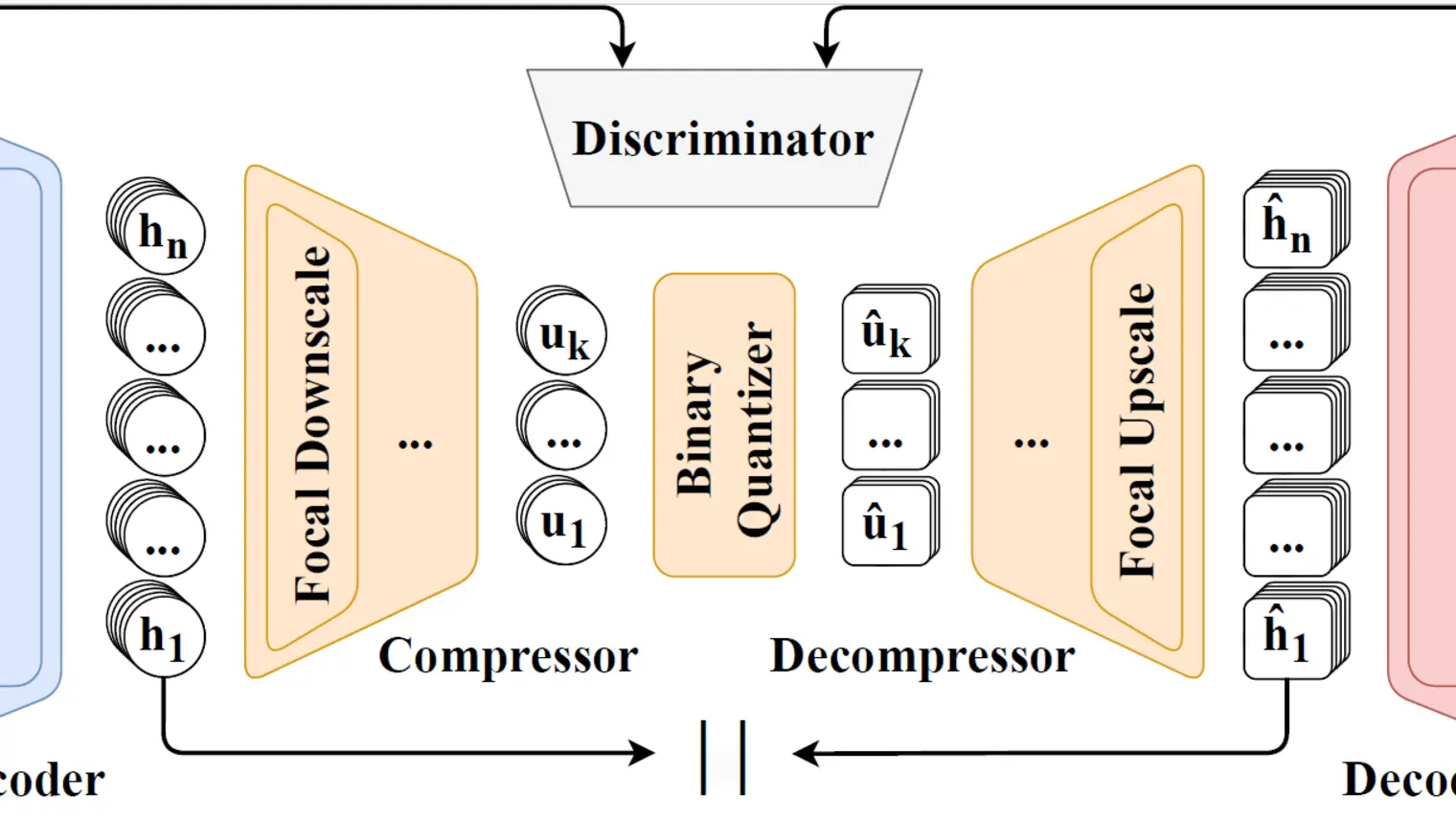
Large language models have revolutionized natural language processing through self-supervised pretraining on massive datasets. Inspired by t… (see more)his success, researchers have explored adapting these methods to speech by discretizing continuous audio into tokens using neural audio codecs. However, existing approaches face limitations, including high bitrates, the loss of either semantic or acoustic information, and the reliance on multi-codebook designs when trying to capture both, which increases architectural complexity for downstream tasks. To address these challenges, we introduce FocalCodec, an efficient low-bitrate codec based on focal modulation that utilizes a single binary codebook to compress speech between 0.16 and 0.65 kbps. FocalCodec delivers competitive performance in speech resynthesis and voice conversion at lower bitrates than the current state-of-the-art, while effectively handling multilingual speech and noisy environments. Evaluation on downstream tasks shows that FocalCodec successfully preserves sufficient semantic and acoustic information, while also being well-suited for generative modeling. Demo samples and code are available at https://lucadellalib.github.io/focalcodec-web/.
Free-form, text-based audio editing remains a persistent challenge, despite progress in inversion-based neural methods. Current approaches r… (see more)ely on slow inversion procedures, limiting their practicality. We present a virtual-consistency based audio editing system that bypasses inversion by adapting the sampling process of diffusion models. Our pipeline is model-agnostic, requiring no fine-tuning or architectural changes, and achieves substantial speed-ups over recent neural editing baselines. Crucially, it achieves this efficiency without compromising quality, as demonstrated by quantitative benchmarks and a user study involving 16 participants.
Speech impairments in Parkinson's disease (PD) provide significant early indicators for diagnosis. While models for speech-based PD detectio… (see more)n have shown strong performance, their interpretability remains underexplored. This study systematically evaluates several explainability methods to identify PD-specific speech features, aiming to support the development of accurate, interpretable models for clinical decision-making in PD diagnosis and monitoring. Our methodology involves (i) obtaining attributions and saliency maps using mainstream interpretability techniques, (ii) quantitatively evaluating the faithfulness of these maps and their combinations obtained via union and intersection through a range of established metrics, and (iii) assessing the information conveyed by the saliency maps for PD detection from an auxiliary classifier. Our results reveal that, while explanations are aligned with the classifier, they often fail to provide valuable information for domain experts.
2025-04-05
ICASSPW @ IEEE International Conference on Acoustics, Speech, and Signal Processing (published)
Neural networks are typically black-boxes that remain opaque with regards to their decision mechanisms. Several works in the literature have… (see more) proposed post-hoc explanation methods to alleviate this issue. This paper proposes LMAC-TD, a post-hoc explanation method that trains a decoder to produce explanations directly in the time domain. This methodology builds upon the foundation of L-MAC, Listenable Maps for Audio Classifiers, a method that produces faithful and listenable explanations. We incorporate SepFormer, a popular transformer-based time-domain source separation architecture. We show through a user study that LMAC-TD significantly improves the audio quality of the produced explanations while not sacrificing from faithfulness.
2025-04-05
IEEE Conference on Acoustics, Speech and Signal Processing (published)
In this paper, we explore audio-editing with non-rigid text edits. We show that the proposed editing pipeline is able to create audio edits … (see more)that remain faithful to the input audio. We explore text prompts that perform addition, style transfer, and in-painting. We quantitatively and qualitatively show that the edits are able to obtain results which outperform Audio-LDM, a recently released text-prompted audio generation model. Qualitative inspection of the results points out that the edits given by our approach remain more faithful to the input audio in terms of keeping the original onsets and offsets of the audio events.
Interpreting the decisions of deep learning models, including audio classifiers, is crucial for ensuring the transparency and trustworthines… (see more)s of this technology. In this paper, we introduce LMAC-ZS (Listenable Maps for Audio Classifiers in the Zero-Shot context), which, to the best of our knowledge, is the first decoder-based post-hoc interpretation method for explaining the decisions of zero-shot audio classifiers. The proposed method utilizes a novel loss function that maximizes the faithfulness to the original similarity between a given text-and-audio pair. We provide an extensive evaluation using the Contrastive Language-Audio Pretraining (CLAP) model to showcase that our interpreter remains faithful to the decisions in a zero-shot classification context. Moreover, we qualitatively show that our method produces meaningful explanations that correlate well with different text prompts.
SpeechBrain is an open-source Conversational AI toolkit based on PyTorch, focused particularly on speech processing tasks such as speech rec… (see more)ognition, speech enhancement, speaker recognition, text-to-speech, and much more. It promotes transparency and replicability by releasing both the pre-trained models and the complete "recipes" of code and algorithms required for training them. This paper presents SpeechBrain 1.0, a significant milestone in the evolution of the toolkit, which now has over 200 recipes for speech, audio, and language processing tasks, and more than 100 models available on Hugging Face. SpeechBrain 1.0 introduces new technologies to support diverse learning modalities, Large Language Model (LLM) integration, and advanced decoding strategies, along with novel models, tasks, and modalities. It also includes a new benchmark repository, offering researchers a unified platform for evaluating models across diverse tasks.
Despite the impressive performance of deep learning models across diverse tasks, their complexity poses challenges for interpretation. This … (see more)challenge is particularly evident for audio signals, where conveying interpretations becomes inherently difficult. To address this issue, we introduce Listenable Maps for Audio Classifiers (L-MAC), a posthoc interpretation method that generates faithful and listenable interpretations. L-MAC utilizes a decoder on top of a pretrained classifier to generate binary masks that highlight relevant portions of the input audio. We train the decoder with a loss function that maximizes the confidence of the classifier decision on the masked-in portion of the audio while minimizing the probability of model output for the masked-out portion. Quantitative evaluations on both in-domain and out-of-domain data demonstrate that L-MAC consistently produces more faithful interpretations than several gradient and masking-based methodologies. Furthermore, a user study confirms that, on average, users prefer the interpretations generated by the proposed technique.
2024-07-22
International Conference on Machine Learning (Accept (Oral))