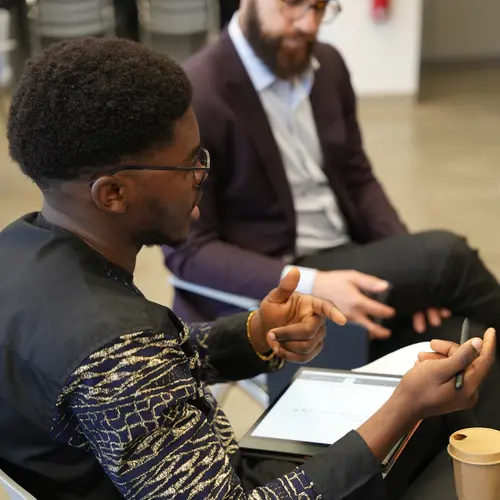



On July 16, 2026, the third cohort of the Indigenous Pathfinders in AI program took the stage at Mila for Pitch Day, showcasing the AI prototypes they developed throughout their curriculum. Held as part of the Indigenous AI Gathering 2026, the event marked the culmination of seven weeks of learning, collaboration, and innovation, bringing First Nations, Inuit, and Métis participants together to build and lead in AI.
This year’s projects span language revitalization, education, data sovereignty, social services, environmental stewardship, and health, with each team grounding its work in the priorities and needs of its community. The two winning teams will continue their journey at Mila through a residency, allowing them to further develop their AI solutions.
Explore the projects driving meaningful change, created by the third cohort:
LandLens (Winning Project)
An innovative AI solution developed to support Indigenous nations in assessing proposed land developments by making existing data on the cumulative impacts of projects over decades more accessible. LandLens brings together public satellite imagery, environmental data, and GIS layers in a centralized, user-friendly platform, accelerating analysis while ensuring communities remain at the centre of decision-making.
Participants: Jacob Umble, Ruth Anna Ritchotte, Mishra Cameron.
SAI Cheese (Winning Project)
An AI-powered oral health platform created to improve preventive care and generate meaningful health data that benefits Indigenous communities. Tooth decay affects 85% of Inuit children aged 3 to 5, and delayed care can turn a preventable condition into a lifelong burden. The solution provides personalized oral health guidance, resources and real-time support through an AI assistant.
Participants: Deborah Baker, Joseph Foote, Leslie Labrecque, Morgan Walsh.
visRecall
A proposed visual-language learning tool for second-language learners of indigenous polysynthetic languages. It teaches whole words and word parts by centering visual assets rather than English translations, which often lose meaning in part or in full. Its database of community-curated, community-approved visuals streamlines authorship and retrieval with optional AI features, and includes a built-in stewardship system with tiered access, from sacred knowledge that is never circulated to public material, so communities retain control over how their language and imagery circulate.
Participants: Kai Currie, Cierra Bettens.
Portage: Indigenous-led AI for the classroom
A suite of AI-assisted teaching tools designed for Indigenous educators. It combines an AI teaching assistant, intelligent tutoring, lesson creation, and adaptive courses, all powered by a community knowledge base governed by a data governance policy embedded into the platform's architecture.
Participants: Corrine Hunt, Darrell Fraser, Jasmine Spence, Ali Lang.
DataSov AI
A local, on-premise AI system that lets communities query their own records without sending data to outside servers. Where cloud AI tools route sensitive data through external networks and big tech servers, DataSov AI keeps data, compute, and the resulting model on a private network the community owns and refines.
Participants: Anthony Huete-Jacobs and Kanatahe'le Brown.
Fieldnote
A case management tool built to give social workers time back for direct care. The need is particularly urgent for Indigenous families, as Indigenous children make up approximately 7% of Canada's child population but over 50% of children in foster care. Fieldnote turns a few rough lines into a complete case note, flags what's missing, and suggests next steps, while keeping AI as an optional, advisory tool that never makes decisions on a practitioner's behalf.
Participants: Troy Bird, Cole Robulack, Devon Williams-Gionet, Chase Stark.
Each project reflects the central message that resonated throughout the Indigenous AI Gathering 2026: AI created by Indigenous peoples, for Indigenous communities and guided by Indigenous values and priorities. Congratulations to LandLens and SAI Cheese, the two winning teams of this year’s cohort, and to all six teams for their meaningful and innovative contributions.