


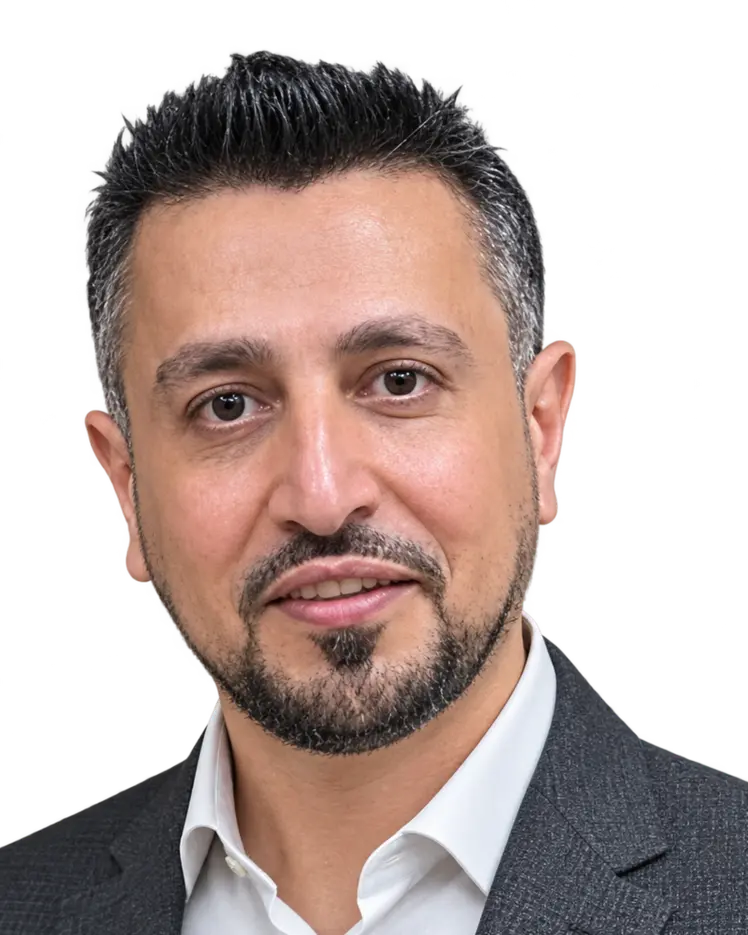
Portrait of Mohammad Hamdaqa

Mohammad Hamdaqa

Associate Academic Member
Associate professor, Polytechnique Montréal
Research Topics
AI and Sustainability
AI for Software Engineering
AI Safety
Blockchain
Cybersecurity
Distributed Systems
Knowledge Graphs
LLM Agent
Model-Driven Engineering
Multi-Agent Systems
Reasoning
Trustworthy AI

Biography

Mohammad Hamdaqa, Eng., Ph.D., is an Associate Professor in the Department of Computer and Software Engineering at Polytechnique Montréal, where he leads the Software and Emerging Technologies (SæT) Lab. He is also an Associate Academic Member at Mila, an IVADO Researcher, a member of the Multidisciplinary Institute for Cybersecurity and Cyber Resilience (IMC2), and co-founder of the Center of Financial Technology at Reykjavik University.

Guided by the SæT motto, “In Software We Trust” his research focuses on advancing the trustworthiness of software and AI-enabled systems. He combines model-based abstraction, automation, program analysis, and empirical software engineering to improve software security, reliability, safety, and sustainability. Central to his work is a vision of intent-driven software engineering to bridge the gap between human intent and software behaviour while making advanced development and assurance techniques more accessible.

His research spans trustworthy AI, agentic AI security, and self-adaptive agents, with applications in AI-generated code assurance, LLM-driven software modeling and testing, smart contract auditing, software sustainability, and autonomous systems. His contributions have received Best Paper recognition at EASE 2026 and ICST 2026.

Hamdaqa is actively engaged in the international software engineering research community. He is a member of the SANER Steering Committee, served as General Co-Chair of SANER 2025, and regularly contributes to the program committees of leading conferences, including ICSE, ESEC/FSE, ASE, MSR, MODELS, ICSME, and ISSTA. He is also affiliated with the Software Engineering for Machine Learning Applications (SEMLA) research community and is a member of the IEEE Computer Society and ACM.

Current Students

PhD - Polytechnique Montréal
Co-supervisor :

Publications

Revisiting the Impact of Anti-patterns on Fault-Proneness: A Differentiated Replication
Aurel Ikama
Vincent Du
Philippe Belias
Biruk Asmare Muse
Anti-patterns manifesting on software code through code smells have been investigated in terms of their prevalence, detection, refactoring, … (see more)and impact on software quality attributes. In particular, leveraging heuristics to identify fault-fixing commits, Khomh et al. have found that anti-patterns and code smells have an impact on the fault-proneness of a software system. Similarly, Saboury et al. found a relationship between anti-pattern occurrences and fault-proneness, using heuristic to identify fault-fixing commits and fault-inducing changes. However, recent studies question the accuracy of heuristics, and thus the validity of empirical studies that leverage it. Hence, in this work, we would like to investigate to what extent the results of empirical studies using heuristics to identify bug fix commits are affected by the limitations of the heuristics based approach using manually validated bug fix commits as a ground truth. In particular, we conduct a differentiated replication of the work by Khomh et al. We particularly focused on the impact of anti-patterns on fault-proneness as it is the only dependent variable that may be affected by noise in the collected faults data. In our differentiated replication study, (1) we expanded the number of subject systems from 5 to 38, (2) utilized a manually validated dataset of bug-fixing commits from the work of Herbold et al., and (3) answered research questions from Khomh et al., that are related to the relationship between anti-pattern occurrences and fault-proneness. (4) We added an additional research question to investigate if combining results from several heuristic-based approaches could help reduce the impact of noise. Our findings show that the impact of the noise generated by the automatic algorithm heuristic based is negligible for the studied subject systems; meaning that the reported relation observed on noisy data still holds on the clean data. However, we also observed that combining results from several heuristic based approaches do not reduce this noise, quite the contrary.