

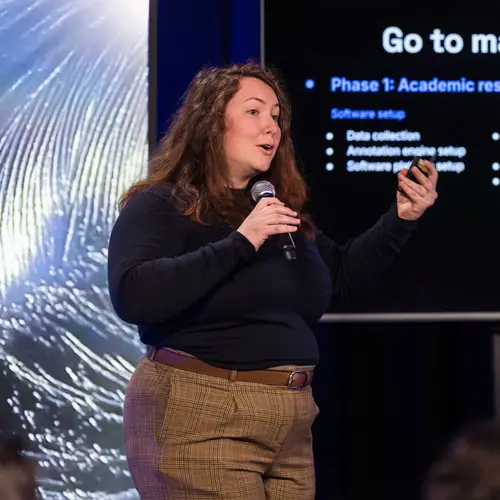

Portrait of Marco Pedersoli

Marco Pedersoli

Affiliate Member
Associate Professor, École de technologie suprérieure
Research Topics
Building Energy Management Systems
Computer Vision
Deep Learning
Generalization
Generative Models
Multimodal Learning
Representation Learning
Robustness
Satellite Imagery
Vision and Language
Weak Supervision

Biography

I am an Associate Professor at ÉTS Montreal, a member of LIVIA (le Laboratoire d'Imagerie, Vision et Intelligence Artificielle), and part of the International Laboratory of Learning Systems (ILLS). I am also a member of ELLIS, the European network of excellence in AI. Since 2021, I have co-held the Distech Industrial Research Chair on Embedded Neural Networks for Connected Building Control.

My research centers on Deep Learning methods and algorithms, with a focus on visual recognition, and the automatic interpretation and understanding of images and videos. A key objective of my work is to advance machine intelligence by minimizing two critical factors: computational load and the need for human supervision. These reductions are essential for scalable AI, enabling more efficient, adaptive, and embedded systems. In my recent work, I have contributed to developing neural networks for smart buildings, integrating AI-driven solutions to enhance energy efficiency and comfort in intelligent environments.

Publications

TeD-Loc: Text Distillation for Weakly Supervised Object Localization
Shakeeb Murtaza
Soufiane Belharbi
Eric Granger
Weakly supervised object localization (WSOL) using classification models trained with only image-class labels remains an important challenge… (see more) in computer vision. Given their reliance on classification objectives, traditional WSOL methods like class activation mapping focus on the most discriminative object parts, often missing the full spatial extent. In contrast, recent WSOL methods based on vision-language models like CLIP require ground truth classes or external classifiers to produce a localization map, limiting their deployment in downstream tasks. Moreover, methods like GenPromp attempt to address these issues but introduce considerable complexity due to their reliance on conditional denoising processes and intricate prompt learning. This paper introduces Text Distillation for Localization (TeD-Loc), an approach that directly distills knowledge from CLIP text embeddings into the model backbone and produces patch-level localization. Multiple instance learning of these image patches allows for accurate localization and classification using one model without requiring external classifiers. Such integration of textual and visual modalities addresses the longstanding challenge of achieving accurate localization and classification concurrently, as WSOL methods in the literature typically converge at different epochs. Extensive experiments show that leveraging text embeddings and localization cues provides a cost-effective WSOL model. TeD-Loc improves Top-1 LOC accuracy over state-of-the-art models by about 5% on both CUB and ILSVRC datasets, while significantly reducing computational complexity compared to GenPromp.
Advancements in Affective and Behavior Analysis: The 8th ABAW Workshop and Competition
Dimitrios Kollias
Panagiotis Tzirakis
Alan Cowen
Stefanos Zafeiriou
Irene Kotsia
Eric Granger
Simon Bacon
Alice Baird
Chris Gagne
Chunchang Shao
Guanyu Hu
Soufiane Belharbi
Muhammad Haseeb Aslam
Advancements in Affective and Behavior Analysis: The 8th ABAW Workshop and Competition
Dimitrios D. Kollias
Panagiotis Tzirakis
Alan Cowen
Stefanos P. Zafeiriou
Irene Kotsia
Eric Granger
Simon Bacon
Alice Baird
Chris Gagne 0001
Chunchang Shao
Guanyu Hu
Soufiane Belharbi
Muhammad Haseeb Aslam
BigDocs: An Open and Permissively-Licensed Dataset for Training Multimodal Models on Document and Code Tasks
Xiangru Jian
Akshay Kalkunte
Franccois Savard
Amirhossein Abaskohi
Pierre-Andre Noel
M. L. Richter
Shubbam Agarwal
Sanket Biswas … (see 23 more)
Sara Shanian
Noah Bolger
Kurt MacDonald
Simon Fauvel
Sathwik Tejaswi
Srinivas Sunkara
Joao Monteiro
Krishnamurthy Dj Dvijotham
Torsten Scholak
Sepideh Kharagani
Sean Hughes
M. Özsu
Issam Hadj Laradji
Spandanna Gella
Sai Rajeswar
Multimodal AI has the potential to significantly enhance document-understanding tasks, such as processing receipts, understanding workflows,… (see more) extracting data from documents, and summarizing reports. Code generation tasks that require long-structured outputs can also be enhanced by multimodality. Despite this, their use in commercial applications is often limited due to limited access to training data and restrictive licensing, which hinders open access. To address these limitations, we introduce BigDocs-7.5M, a high-quality, open-access dataset comprising 7.5 million multimodal documents across 30 tasks. We use an efficient data curation process to ensure our data is high-quality and license-permissive. Our process emphasizes accountability, responsibility, and transparency through filtering rules, traceable metadata, and careful content analysis. Additionally, we introduce BigDocs-Bench, a benchmark suite with 10 novel tasks where we create datasets that reflect real-world use cases involving reasoning over Graphical User Interfaces (GUI) and code generation from images. Our experiments show that training with BigDocs-Bench improves average performance up to 25.8% over closed-source GPT-4o in document reasoning and structured output tasks such as Screenshot2HTML or Image2Latex generation. Finally, human evaluations showed a preference for outputs from models trained on BigDocs over GPT-4o. This suggests that BigDocs can help both academics and the open-source community utilize and improve AI tools to enhance multimodal capabilities and document reasoning. The project is hosted at https://bigdocs.github.io .
BigDocs: An Open and Permissively-Licensed Dataset for Training Multimodal Models on Document and Code Tasks
Xiangru Jian
Akshay Kalkunte
Franccois Savard
Amirhossein Abaskohi
Pierre-Andre Noel
M. L. Richter
Shubbam Agarwal
Sanket Biswas … (see 23 more)
Sara Shanian
Noah Bolger
Kurt MacDonald
Simon Fauvel
Sathwik Tejaswi
Srinivas Sunkara
Joao Monteiro
Krishnamurthy Dj Dvijotham
Torsten Scholak
Sepideh Kharagani
Sean Hughes
M. Özsu
Issam Hadj Laradji
Spandanna Gella
Sai Rajeswar
Multimodal AI has the potential to significantly enhance document-understanding tasks, such as processing receipts, understanding workflows,… (see more) extracting data from documents, and summarizing reports. Code generation tasks that require long-structured outputs can also be enhanced by multimodality. Despite this, their use in commercial applications is often limited due to limited access to training data and restrictive licensing, which hinders open access. To address these limitations, we introduce BigDocs-7.5M, a high-quality, open-access dataset comprising 7.5 million multimodal documents across 30 tasks. We use an efficient data curation process to ensure our data is high-quality and license-permissive. Our process emphasizes accountability, responsibility, and transparency through filtering rules, traceable metadata, and careful content analysis. Additionally, we introduce BigDocs-Bench, a benchmark suite with 10 novel tasks where we create datasets that reflect real-world use cases involving reasoning over Graphical User Interfaces (GUI) and code generation from images. Our experiments show that training with BigDocs-Bench improves average performance up to 25.8% over closed-source GPT-4o in document reasoning and structured output tasks such as Screenshot2HTML or Image2Latex generation. Finally, human evaluations showed a preference for outputs from models trained on BigDocs over GPT-4o. This suggests that BigDocs can help both academics and the open-source community utilize and improve AI tools to enhance multimodal capabilities and document reasoning. The project is hosted at https://bigdocs.github.io .
BigDocs: An Open and Permissively-Licensed Dataset for Training Multimodal Models on Document and Code Tasks
Xiangru Jian
Akshay Kalkunte
Franccois Savard
Amirhossein Abaskohi
Pierre-Andre Noel
Shubbam Agarwal
Sanket Biswas … (see 23 more)
Sara Shanian
Noah Bolger
Kurt MacDonald
Simon Fauvel
Sathwik Tejaswi
Srinivas Sunkara
Joao Monteiro
Krishnamurthy Dj Dvijotham
Torsten Scholak
Sepideh Kharaghani
Sean Hughes
M. Özsu
Issam Hadj Laradji
Spandanna Gella
Sai Rajeswar
Multimodal AI has the potential to significantly enhance document-understanding tasks, such as processing receipts, understanding workflows,… (see more) extracting data from documents, and summarizing reports. Code generation tasks that require long-structured outputs can also be enhanced by multimodality. Despite this, their use in commercial applications is often limited due to limited access to training data and restrictive licensing, which hinders open access. To address these limitations, we introduce BigDocs-7.5M, a high-quality, open-access dataset comprising 7.5 million multimodal documents across 30 tasks. We use an efficient data curation process to ensure our data is high-quality and license-permissive. Our process emphasizes accountability, responsibility, and transparency through filtering rules, traceable metadata, and careful content analysis. Additionally, we introduce BigDocs-Bench, a benchmark suite with 10 novel tasks where we create datasets that reflect real-world use cases involving reasoning over Graphical User Interfaces (GUI) and code generation from images. Our experiments show that training with BigDocs-Bench improves average performance up to 25.8% over closed-source GPT-4o in document reasoning and structured output tasks such as Screenshot2HTML or Image2Latex generation. Finally, human evaluations showed a preference for outputs from models trained on BigDocs over GPT-4o. This suggests that BigDocs can help both academics and the open-source community utilize and improve AI tools to enhance multimodal capabilities and document reasoning. The project is hosted at https://bigdocs.github.io .
BigDocs: An Open and Permissively-Licensed Dataset for Training Multimodal Models on Document and Code Tasks
Xiangru Jian
Akshay Kalkunte
Franccois Savard
Amirhossein Abaskohi
Pierre-Andre Noel
Shubbam Agarwal
Sanket Biswas … (see 23 more)
Sara Shanian
Noah Bolger
Kurt MacDonald
Simon Fauvel
Sathwik Tejaswi
Srinivas Sunkara
Joao Monteiro
Krishnamurthy Dj Dvijotham
Torsten Scholak
Sepideh Kharaghani
Sean Hughes
M. Özsu
Issam Hadj Laradji
Spandanna Gella
Sai Rajeswar
Multimodal AI has the potential to significantly enhance document-understanding tasks, such as processing receipts, understanding workflows,… (see more) extracting data from documents, and summarizing reports. Code generation tasks that require long-structured outputs can also be enhanced by multimodality. Despite this, their use in commercial applications is often limited due to limited access to training data and restrictive licensing, which hinders open access. To address these limitations, we introduce BigDocs-7.5M, a high-quality, open-access dataset comprising 7.5 million multimodal documents across 30 tasks. We use an efficient data curation process to ensure our data is high-quality and license-permissive. Our process emphasizes accountability, responsibility, and transparency through filtering rules, traceable metadata, and careful content analysis. Additionally, we introduce BigDocs-Bench, a benchmark suite with 10 novel tasks where we create datasets that reflect real-world use cases involving reasoning over Graphical User Interfaces (GUI) and code generation from images. Our experiments show that training with BigDocs-Bench improves average performance up to 25.8% over closed-source GPT-4o in document reasoning and structured output tasks such as Screenshot2HTML or Image2Latex generation. Finally, human evaluations showed a preference for outputs from models trained on BigDocs over GPT-4o. This suggests that BigDocs can help both academics and the open-source community utilize and improve AI tools to enhance multimodal capabilities and document reasoning. The project is hosted at https://bigdocs.github.io .
BigDocs: An Open and Permissively-Licensed Dataset for Training Multimodal Models on Document and Code Tasks
Xiangru Jian
Akshay Kalkunte
Franccois Savard
Amirhossein Abaskohi
Pierre-Andre Noel
Shubbam Agarwal
Sanket Biswas … (see 23 more)
Sara Shanian
Noah Bolger
Kurt MacDonald
Simon Fauvel
Sathwik Tejaswi
Srinivas Sunkara
Joao Monteiro
Krishnamurthy Dj Dvijotham
Torsten Scholak
Sepideh Kharaghani
Sean Hughes
M. Özsu
Issam Hadj Laradji
Spandanna Gella
Sai Rajeswar
Multimodal AI has the potential to significantly enhance document-understanding tasks, such as processing receipts, understanding workflows,… (see more) extracting data from documents, and summarizing reports. Code generation tasks that require long-structured outputs can also be enhanced by multimodality. Despite this, their use in commercial applications is often limited due to limited access to training data and restrictive licensing, which hinders open access. To address these limitations, we introduce BigDocs-7.5M, a high-quality, open-access dataset comprising 7.5 million multimodal documents across 30 tasks. We use an efficient data curation process to ensure our data is high-quality and license-permissive. Our process emphasizes accountability, responsibility, and transparency through filtering rules, traceable metadata, and careful content analysis. Additionally, we introduce BigDocs-Bench, a benchmark suite with 10 novel tasks where we create datasets that reflect real-world use cases involving reasoning over Graphical User Interfaces (GUI) and code generation from images. Our experiments show that training with BigDocs-Bench improves average performance up to 25.8% over closed-source GPT-4o in document reasoning and structured output tasks such as Screenshot2HTML or Image2Latex generation. Finally, human evaluations showed a preference for outputs from models trained on BigDocs over GPT-4o. This suggests that BigDocs can help both academics and the open-source community utilize and improve AI tools to enhance multimodal capabilities and document reasoning. The project is hosted at https://bigdocs.github.io .
BigDocs: An Open Dataset for Training Multimodal Models on Document and Code Tasks
Juan A. Rodriguez
Xiangru Jian
Akshay Kalkunte Suresh
Amirhossein Abaskohi
Pierre-Andre Noel
Sanket Biswas … (see 23 more)
Sara Shanian
Noah Bolger
Kurt MacDonald
Simon Fauvel
Sathwik Tejaswi Madhusudhan
Srinivas Sunkara
Joao Monteiro
Krishnamurthy Dj Dvijotham
Torsten Scholak
Sepideh Kharaghani
Sean Hughes
M. Özsu
Issam Hadj Laradji
Sai Rajeswar
Multimodal AI has the potential to significantly enhance document-understanding tasks, such as processing receipts, understanding workflows,… (see more) extracting data from documents, and summarizing reports. Code generation tasks that require long-structured outputs can also be enhanced by multimodality. Despite this, their use in commercial applications is often limited due to limited access to training data and restrictive licensing, which hinders open access. To address these limitations, we introduce BigDocs-7.5M, a high-quality, open-access dataset comprising 7.5 million multimodal documents across 30 tasks. We use an efficient data curation process to ensure our data is high-quality and license-permissive. Our process emphasizes accountability, responsibility, and transparency through filtering rules, traceable metadata, and careful content analysis. Additionally, we introduce BigDocs-Bench, a benchmark suite with 10 novel tasks where we create datasets that reflect real-world use cases involving reasoning over Graphical User Interfaces (GUI) and code generation from images. Our experiments show that training with BigDocs-Bench improves average performance up to 25.8% over closed-source GPT-4o in document reasoning and structured output tasks such as Screenshot2HTML or Image2Latex generation. Finally, human evaluations showed a preference for outputs from models trained on BigDocs over GPT-4o. This suggests that BigDocs can help both academics and the open-source community utilize and improve AI tools to enhance multimodal capabilities and document reasoning. The project is hosted at https://bigdocs.github.io .
BigDocs: An Open Dataset for Training Multimodal Models on Document and Code Tasks
Juan A. Rodriguez
Xiangru Jian
Akshay Kalkunte Suresh
Amirhossein Abaskohi
Pierre-Andre Noel
Sanket Biswas … (see 23 more)
Sara Shanian
Noah Bolger
Kurt MacDonald
Simon Fauvel
Sathwik Tejaswi Madhusudhan
Srinivas Sunkara
Joao Monteiro
Krishnamurthy Dj Dvijotham
Torsten Scholak
Sepideh Kharaghani
Sean Hughes
M. Özsu
Issam Hadj Laradji
Sai Rajeswar
Multimodal AI has the potential to significantly enhance document-understanding tasks, such as processing receipts, understanding workflows,… (see more) extracting data from documents, and summarizing reports. Code generation tasks that require long-structured outputs can also be enhanced by multimodality. Despite this, their use in commercial applications is often limited due to limited access to training data and restrictive licensing, which hinders open access. To address these limitations, we introduce BigDocs-7.5M, a high-quality, open-access dataset comprising 7.5 million multimodal documents across 30 tasks. We use an efficient data curation process to ensure our data is high-quality and license-permissive. Our process emphasizes accountability, responsibility, and transparency through filtering rules, traceable metadata, and careful content analysis. Additionally, we introduce BigDocs-Bench, a benchmark suite with 10 novel tasks where we create datasets that reflect real-world use cases involving reasoning over Graphical User Interfaces (GUI) and code generation from images. Our experiments show that training with BigDocs-Bench improves average performance up to 25.8% over closed-source GPT-4o in document reasoning and structured output tasks such as Screenshot2HTML or Image2Latex generation. Finally, human evaluations showed a preference for outputs from models trained on BigDocs over GPT-4o. This suggests that BigDocs can help both academics and the open-source community utilize and improve AI tools to enhance multimodal capabilities and document reasoning. The project is hosted at https://bigdocs.github.io .
Visual Modality Prompt for Adapting Vision-Language Object Detectors
Heitor Rapela Medeiros
Atif Belal
Srikanth Muralidharan
Eric Granger
The zero-shot performance of object detectors degrades when tested on different modalities, such as infrared and depth. While recent work ha… (see more)s explored image translation techniques to adapt detectors to new modalities, these methods are limited to a single modality and apply only to traditional detectors. Recently, vision-language detectors, such as YOLO-World and Grounding DINO, have shown promising zero-shot capabilities, however, they have not yet been adapted for other visual modalities. Traditional fine-tuning approaches tend to compromise the zero-shot capabilities of the detectors. The visual prompt strategies commonly used for classification with vision-language models apply the same linear prompt translation to each image making them less effective. To address these limitations, we propose ModPrompt, a visual prompt strategy to adapt vision-language detectors to new modalities without degrading zero-shot performance. In particular, an encoder-decoder visual prompt strategy is proposed, further enhanced by the integration of inference-friendly task residuals, facilitating more robust adaptation. Empirically, we benchmark our method for modality adaptation on two vision-language detectors, YOLO-World and Grounding DINO, and on challenging infrared (LLVIP, FLIR) and depth (NYUv2) data, achieving performance comparable to full fine-tuning while preserving the model's zero-shot capability. Our code is available at: https://github.com/heitorrapela/ModPrompt
Words Matter: Leveraging Individual Text Embeddings for Code Generation in CLIP Test-Time Adaptation
Shambhavi Mishra
Julio Silva-Rodríguez
Ismail Ben Ayed
Jose Dolz
Vision-language foundation models, such as CLIP, have shown unprecedented zero-shot performance across a wide range of tasks. Nevertheless, … (see more)these models may be unreliable under distributional shifts, as their performance is significantly degraded. In this work, we explore how to efficiently leverage class text information to mitigate these distribution drifts encountered by large pre-trained vision-language models (VLMs) during test-time inference. In particular, we propose to generate pseudo-labels for the test-time samples by exploiting generic class text embeddings as fixed centroids of a label assignment problem, which is efficiently solved with Optimal Transport. Furthermore, the proposed adaptation method (CLIP-OT) integrates a multiple template knowledge distillation approach, which replicates multi-view contrastive learning strategies in unsupervised representation learning but without incurring additional computational complexity. Extensive experiments on multiple popular test-time adaptation benchmarks presenting diverse complexity empirically show the superiority of CLIP-OT, achieving performance gains of up to 7% over recent state-of-the-art methods, yet being computationally and memory efficient.