

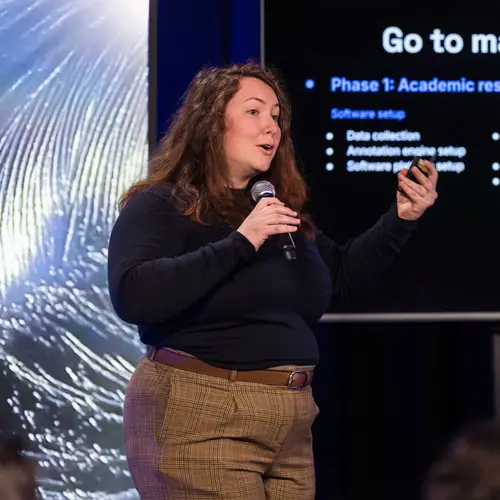


Portrait of Laurence Perreault-Levasseur is unavailable

Laurence Perreault-Levasseur

Associate Academic Member
Assistant Professor, Université de Montréal, Department of Physics
Research Topics
Computer Vision
Deep Learning
Dynamical Systems
Generative Models
Graph Neural Networks
Probabilistic Models

Biography

Laurence Perreault-Levasseur is the Canada Research Chair in Computational Cosmology and Artificial Intelligence. She is an assistant professor at Université de Montréal and an associate academic member of Mila – Quebec Artificial Intelligence Institute. Perreault-Levasseur’s research focuses on the development and application of machine learning methods to cosmology.

She is also a Visiting Scholar at the Flatiron Institute in New York City. Prior to that, she was a research fellow at their Center for Computational Astrophysics, and a KIPAC postdoctoral fellow at Stanford University.

For her PhD degree at the University of Cambridge, she worked on applications of open effective field theory methods to the formalism of inflation. She completed her BSc and MSc degrees at McGill University.

Current Students

PhD - Université de Montréal
PhD - McGill University
Principal supervisor :
PhD - Université de Montréal
Co-supervisor :
PhD - Université de Montréal
Principal supervisor :
Research Intern - Université de Montréal
Co-supervisor :
PhD - Université de Montréal
Co-supervisor :
PhD - Université de Montréal
Principal supervisor :
Postdoctorate - Université de Montréal
Co-supervisor :
PhD - Université de Montréal
Master's Research - Université de Montréal
Principal supervisor :
PhD - Université de Montréal
Co-supervisor :
PhD - Université de Montréal
Master's Research - Université de Montréal
Postdoctorate - Université de Montréal
Principal supervisor :
Postdoctorate - McGill University
Co-supervisor :
Postdoctorate - Université de Montréal
Co-supervisor :

Publications

Transformer Embeddings for Fast Microlensing Inference
Neural Deprojection of Galaxy Stellar Mass Profiles
M. J. Yantovski-Barth
Hengyue Zhang
Martin Bureau
We introduce a neural approach to dynamical modeling of galaxies that replaces traditional imaging-based deprojections with a differentiable… (see more) mapping. Specifically, we train a neural network to translate Nuker profile parameters into analytically deprojectable Multi Gaussian Expansion components, enabling physically realistic stellar mass models without requiring optical observations. We integrate this model into SuperMAGE, a differentiable dynamical modelling pipeline for Bayesian inference of supermassive black hole masses. Applied to ALMA data, our approach finds results consistent with state-of-the-art models while extending applicability to dust-obscured and active galaxies where optical data analysis is challenging.
Mind the Information Gap: Unveiling Detailed Morphologies of z 0.5-1.0 Galaxies with SLACS Strong Lenses and Data-Driven Analysis
Pixellated Posterior Sampling of Point Spread Functions in Astronomical Images
We introduce a novel framework for upsampled Point Spread Function (PSF) modeling using pixel-level Bayesian inference. Accurate PSF charact… (see more)erization is critical for precision measurements in many fields including: weak lensing, astrometry, and photometry. Our method defines the posterior distribution of the pixelized PSF model through the combination of an analytic Gaussian likelihood and a highly expressive generative diffusion model prior, trained on a library of HST ePSF templates. Compared to traditional methods (parametric Moffat, ePSF template-based, and regularized likelihood), we demonstrate that our PSF models achieve orders of magnitude higher likelihood and residuals consistent with noise, all while remaining visually realistic. Further, the method applies even for faint and heavily masked point sources, merely producing a broader posterior. By recovering a realistic, pixel-level posterior distribution, our technique enables the first meaningful propagation of detailed PSF morphological uncertainty in downstream analysis. An implementation of our posterior sampling procedure is available on GitHub.
Blind Strong Gravitational Lensing Inversion: Joint Inference of Source and Lens Mass with Score-Based Models
The spatially-resolved effect of mergers on the stellar mass assembly of MaNGA galaxies
Eirini Angeloudi
Marc Huertas-Company
Jesús Falcón-Barroso
Alina Boecker
The spatially-resolved effect of mergers on the stellar mass assembly of MaNGA galaxies
Eirini Angeloudi
Marc Huertas-Company
Jesús Falcón-Barroso
Alina Boecker
Understanding the origin of stars within a galaxy - whether formed in-situ or accreted from other galaxies (ex-situ) - is key to constrainin… (see more)g its evolution. Spatially resolving these components provides crucial insights into a galaxy's mass assembly history. We aim to predict the spatial distribution of ex-situ stellar mass fraction in MaNGA galaxies, and to identify distinct assembly histories based on the radial gradients of these predictions in the central regions. We employ a diffusion model trained on mock MaNGA analogs (MaNGIA), derived from the TNG50 cosmological simulation. The model learns to predict the posterior distribution of resolved ex-situ stellar mass fraction maps, conditioned on stellar mass density, velocity, and velocity dispersion gradient maps. After validating the model on an unseen test set from MaNGIA, we apply it to MaNGA galaxies to infer the spatially-resolved distribution of their ex-situ stellar mass fractions - i.e. the fraction of stellar mass in each spaxel originating from mergers. We identify four broad categories of ex-situ mass distributions: flat gradient, in-situ dominated; flat gradient, ex-situ dominated; positive gradient; and negative gradient. The vast majority of MaNGA galaxies fall in the first category - flat gradients with low ex-situ fractions - confirming that in-situ star formation is the main assembly driver for low- to intermediate-mass galaxies. At high stellar masses, the ex-situ maps are more diverse, highlighting the key role of mergers in building the most massive systems. Ex-situ mass distributions correlate with morphology, star-formation activity, stellar kinematics, and environment, indicating that accretion history is a primary factor shaping massive galaxies. Finally, by tracing their assembly histories in TNG50, we link each class to distinct merger scenarios, ranging from secular evolution to merger-dominated growth.
Predicting the Subhalo Mass Functions in Simulations from Galaxy Images
Tri Nguyen
J. Rose
Chris Lovell
Francisco Villaescusa-navarro
Strong gravitational lensing provides a powerful tool to directly infer the dark matter (DM) subhalo mass function (SHMF) in lens galaxies. … (see more)However, comparing observationally inferred SHMFs to theoretical predictions remains challenging, as the predicted SHMF can vary significantly between galaxies - even within the same cosmological model - due to differences in the properties and environment of individual galaxies. We present a machine learning framework to infer the galaxy-specific predicted SHMF from galaxy images, conditioned on the assumed inverse warm DM particle mass
Predicting the Subhalo Mass Functions in Simulations from Galaxy Images
Tri Nguyen
J. Rose
Chris Lovell
Francisco Villaescusa-navarro
The spatially-resolved effect of mergers on the stellar mass assembly of MaNGA galaxies
E. Angeloudi
Marc Huertas-Company
Jes'us Falc'on-Barroso
A. Boecker
Understanding the origin of stars within a galaxy - whether formed in-situ or accreted from other galaxies (ex-situ) - is key to constrainin… (see more)g its evolution. Spatially resolving these components provides crucial insights into a galaxy's mass assembly history. We aim to predict the spatial distribution of ex-situ stellar mass fraction in MaNGA galaxies, and to identify distinct assembly histories based on the radial gradients of these predictions in the central regions. We employ a diffusion model trained on mock MaNGA analogs (MaNGIA), derived from the TNG50 cosmological simulation. The model learns to predict the posterior distribution of resolved ex-situ stellar mass fraction maps, conditioned on stellar mass density, velocity, and velocity dispersion gradient maps. After validating the model on an unseen test set from MaNGIA, we apply it to MaNGA galaxies to infer the spatially-resolved distribution of their ex-situ stellar mass fractions - i.e. the fraction of stellar mass in each spaxel originating from mergers. We identify four broad categories of ex-situ mass distributions: flat gradient, in-situ dominated; flat gradient, ex-situ dominated; positive gradient; and negative gradient. The vast majority of MaNGA galaxies fall in the first category - flat gradients with low ex-situ fractions - confirming that in-situ star formation is the main assembly driver for low- to intermediate-mass galaxies. At high stellar masses, the ex-situ maps are more diverse, highlighting the key role of mergers in building the most massive systems. Ex-situ mass distributions correlate with morphology, star-formation activity, stellar kinematics, and environment, indicating that accretion history is a primary factor shaping massive galaxies. Finally, by tracing their assembly histories in TNG50, we link each class to distinct merger scenarios, ranging from secular evolution to merger-dominated growth.
caskade: building Pythonic scientific simulators
Massive Extremely High-Velocity Outflow in the Quasar J164653.72+243942.2
Paola Rodríguez Hidalgo
Hyunseop 현섭 Choi 최
Patrick B. Hall
Karen M. Leighly
Liliana Flores
Mikel M. Charles
Cora DeFrancesco
J. Hlavacek-Larrondo