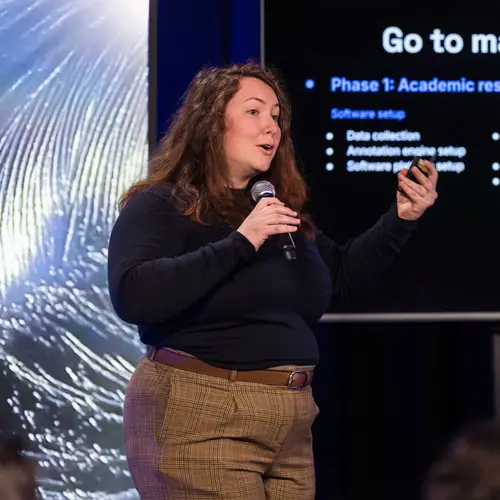
Portrait of Farimah Poursafaei

Farimah Poursafaei

Collaborating Alumni - McGill University
Supervisor
Research Topics
Data Mining
Graph Neural Networks
Knowledge Graphs
Learning on Graphs
Recommender Systems
Recurrent Neural Networks

Publications

TGM: a Modular and Efficient Library for Machine Learning on Temporal Graphs
Tran Gia Bao Ngo
Jure Leskovec
Michael M. Bronstein
Matthias Fey
Well-designed open-source software drives progress in Machine Learning (ML) research. While static graph ML enjoys mature frameworks like Py… (see more)Torch Geometric and DGL, ML for temporal graphs (TG), networks that evolve over time, lacks comparable infrastructure. Existing TG libraries are often tailored to specific architectures, hindering support for diverse models in this rapidly evolving field. Additionally, the divide between continuous- and discrete-time dynamic graph methods (CTDG and DTDG) limits direct comparisons and idea transfer. To address these gaps, we introduce Temporal Graph Modelling (TGM), a research-oriented library for ML on temporal graphs, the first to unify CTDG and DTDG approaches. TGM offers first-class support for dynamic node features, time-granularity conversions, and native handling of link-, node-, and graph-level tasks. Empirically, TGM achieves an average 7.8x speedup across multiple models, datasets, and tasks compared to the widely used DyGLib, and an average 175x speedup on graph discretization relative to available implementations. Beyond efficiency, we show in our experiments how TGM unlocks entirely new research possibilities by enabling dynamic graph property prediction and time-driven training paradigms, opening the door to questions previously impractical to study. TGM is available at https://github.com/tgm-team/tgm
MiNT: Multi-Network Transfer Benchmark for Temporal Graph Learning
Kiarash Shamsi
Tran Gia Bao Ngo
Poupak Azad
Baris Coskunuzer
Cuneyt Gurcan Akcora
Temporal Graph Learning (TGL) aims to discover patterns in evolving networks or temporal graphs and leverage these patterns to predict futur… (see more)e interactions. However, most existing research focuses on learning from a single network in isolation, leaving the challenges of within-domain and cross-domain generalization largely unaddressed. In this study, we introduce a new benchmark of 84 real-world temporal transaction networks and propose **Temporal Multi-network Transfer (MiNT)**, a pre-training framework designed to capture transferable temporal dynamics across diverse networks. We train MiNT models on up to 64 transaction networks and evaluate their generalization ability on 20 held-out, unseen networks. Our results show that MiNT consistently outperforms individually trained models, revealing a strong relation between the number of pre-training networks and transfer performance. These findings highlight scaling trends in temporal graph learning and underscore the importance of network diversity in improving generalization. This work establishes the first large-scale benchmark for studying transferability in TGL and lays the groundwork for developing Temporal Graph Foundation Models. Our code is available at https://github.com/benjaminnNgo/ScalingTGNs
Temporal Graph Learning Workshop
Daniele Zambon
Andrea Cini
Michael M. Bronstein
TGM: A Modular Framework for Machine Learning on Temporal Graphs
While deep learning on static graphs has been revolutionized by standardized libraries like PyTorch Geometric and DGL, machine learning on T… (see more)emporal Graphs (TG), networks that evolve over time, lacks comparable software infrastructure. Existing TG libraries are limited in scope, focusing on a single method category or specific algorithms. We introduce Temporal Graph Modelling (TGM), a comprehensive framework for machine learning on temporal graphs to address this gap. Through a modular architecture, TGM is the first library to support both discrete and continuous-time TG methods and implements a wide range of TG methods. The TGM framework combines an intuitive front-end API with an optimized backend storage, enabling reproducible research and efficient experimentation at scale. Key features include graph-level optimizations for offline training and built-in performance profiling capabilities. Through extensive benchmarking on five real-world networks, TGM is up to 6 times faster than the widely used DyGLib library on TGN and TGAT models and up to 8 times faster than the UTG framework for converting edges into coarse-grained snapshots.
TGB 2.0: A Benchmark for Learning on Temporal Knowledge Graphs and Heterogeneous Graphs
Multi-relational temporal graphs are powerful tools for modeling real-world data, capturing the evolving and interconnected nature of entiti… (see more)es over time. Recently, many novel models are proposed for ML on such graphs intensifying the need for robust evaluation and standardized benchmark datasets. However, the availability of such resources remains scarce and evaluation faces added complexity due to reproducibility issues in experimental protocols. To address these challenges, we introduce Temporal Graph Benchmark 2.0 (TGB 2.0), a novel benchmarking framework tailored for evaluating methods for predicting future links on Temporal Knowledge Graphs and Temporal Heterogeneous Graphs with a focus on large-scale datasets, extending the Temporal Graph Benchmark. TGB 2.0 facilitates comprehensive evaluations by presenting eight novel datasets spanning five domains with up to 53 million edges. TGB 2.0 datasets are significantly larger than existing datasets in terms of number of nodes, edges, or timestamps. In addition, TGB 2.0 provides a reproducible and realistic evaluation pipeline for multi-relational temporal graphs. Through extensive experimentation, we observe that 1) leveraging edge-type information is crucial to obtain high performance, 2) simple heuristic baselines are often competitive with more complex methods, 3) most methods fail to run on our largest datasets, highlighting the need for research on more scalable methods.
On the Scalability of GNNs for Molecular Graphs
Maciej Sypetkowski
Nia Dickson
Karush Suri
Philip Fradkin
Scaling deep learning models has been at the heart of recent revolutions in language modelling and image generation. Practitioners have obse… (see more)rved a strong relationship between model size, dataset size, and performance. However, structure-based architectures such as Graph Neural Networks (GNNs) are yet to show the benefits of scale mainly due to the lower efficiency of sparse operations, large data requirements, and lack of clarity about the effectiveness of various architectures. We address this drawback of GNNs by studying their scaling behavior. Specifically, we analyze message-passing networks, graph Transformers, and hybrid architectures on the largest public collection of 2D molecular graphs. For the first time, we observe that GNNs benefit tremendously from the increasing scale of depth, width, number of molecules, number of labels, and the diversity in the pretraining datasets, resulting in a 30.25% improvement when scaling to 1 billion parameters and 28.98% improvement when increasing size of dataset to eightfold. We further demonstrate strong finetuning scaling behavior on 38 tasks, outclassing previous large models. We hope that our work paves the way for an era where foundational GNNs drive pharmaceutical drug discovery.
MiNT: Multi-Network Training for Transfer Learning on Temporal Graphs
Tran Gia Bao Ngo
Kiarash Shamsi
Poupak Azad
Baris Coskunuzer
Cuneyt Gurcan Akcora
Temporal Graph Analysis with TGX
Real-world networks, with their evolving relations, are best captured as temporal graphs. However, existing software libraries are largely d… (see more)esigned for static graphs where the dynamic nature of temporal graphs is ignored. Bridging this gap, we introduce TGX, a Python package specially designed for analysis of temporal networks that encompasses an automated pipeline for data loading, data processing, and analysis of evolving graphs. TGX provides access to eleven built-in datasets and eight external Temporal Graph Benchmark (TGB) datasets as well as any novel datasets in the .csv format. Beyond data loading, TGX facilitates data processing functionalities such as discretization of temporal graphs and node subsampling to accelerate working with larger datasets. For comprehensive investigation, TGX offers network analysis by providing a diverse set of measures, including average node degree and the evolving number of nodes and edges per timestamp. Additionally, the package consolidates meaningful visualization plots indicating the evolution of temporal patterns, such as Temporal Edge Appearance (TEA) and Temporal Edge Trafficc (TET) plots. The TGX package is a robust tool for examining the features of temporal graphs and can be used in various areas like studying social networks, citation networks, and tracking user interactions. We plan to continuously support and update TGX based on community feedback. TGX is publicly available on: https://github.com/ComplexData-MILA/TGX.


UTG: Towards a Unified View of Snapshot and Event Based Models for Temporal Graphs
Many real world graphs are inherently dynamic, constantly evolving with node and edge additions. These graphs can be represented by temporal… (see more) graphs, either through a stream of edge events or a sequence of graph snapshots. Until now, the development of machine learning methods for both types has occurred largely in isolation, resulting in limited experimental comparison and theoretical crosspollination between the two. In this paper, we introduce Unified Temporal Graph (UTG), a framework that unifies snapshot-based and event-based machine learning models under a single umbrella, enabling models developed for one representation to be applied effectively to datasets of the other. We also propose a novel UTG training procedure to boost the performance of snapshot-based models in the streaming setting. We comprehensively evaluate both snapshot and event-based models across both types of temporal graphs on the temporal link prediction task. Our main findings are threefold: first, when combined with UTG training, snapshot-based models can perform competitively with event-based models such as TGN and GraphMixer even on event datasets. Second, snapshot-based models are at least an order of magnitude faster than most event-based models during inference. Third, while event-based methods such as NAT and DyGFormer outperforms snapshot-based methods on both types of temporal graphs, this is because they leverage joint neighborhood structural features thus emphasizing the potential to incorporate these features into snapshotbased models as well. These findings highlight the importance of comparing model architectures independent of the data format and suggest the potential of combining the efficiency of snapshot-based models with the performance of event-based models in the future.
Exhaustive Evaluation of Dynamic Link Prediction
Dynamic link prediction is a crucial task in the study of evolving graphs, which serve as abstract models for various real-world application… (see more)s. Recent dynamic graph representation learning models have claimed near-perfect performance in this task. However, we argue that the standard evaluation strategy for dynamic link prediction overlooks the sparsity and recurrence patterns inherent in dynamic networks. Specifically, the current strategy suffers from issues such as evaluating models on a balanced set of positive and negative edges, neglecting the reassessment of frequently recurring positive edges, and lacking a comprehensive evaluation of both recurring and new edges.To address these limitations, we propose a novel evaluation strategy called EXHAUSTIVE, which takes into account all relevant negative edges and separately assesses the performance on recurring and new edges. Using our proposed evaluation strategy, we compare the performance of five state-of-the-art dynamic graph learning models on seven benchmark datasets. Compared to the previous common evaluation strategy, we observe an average drop of 62% in Average Precision for dynamic link prediction. Additionally, the ranking of the models also changes under the new evaluation setting. Furthermore, we demonstrate that while all models perform considerably worse when predicting new edges compared to recurring ones, the best performing models differ between the two scenarios. This highlights the importance of employing the proposed evaluation strategy for both the assessment and design of dynamic link prediction models. By adopting our novel evaluation strategy, researchers can obtain a more accurate understanding of model performance in dynamic link prediction, leading to improved evaluation and design of such models.
Temporal Graph Benchmark for Machine Learning on Temporal Graphs
Matthias Fey
Weihua Hu
Emanuele Rossi
Jure Leskovec
Michael M. Bronstein
We present the Temporal Graph Benchmark (TGB), a collection of challenging and diverse benchmark datasets for realistic, reproducible, and r… (see more)obust evaluation of machine learning models on temporal graphs. TGB datasets are of large scale, spanning years in duration, incorporate both node and edge-level prediction tasks and cover a diverse set of domains including social, trade, transaction, and transportation networks. For both tasks, we design evaluation protocols based on realistic use-cases. We extensively benchmark each dataset and find that the performance of common models can vary drastically across datasets. In addition, on dynamic node property prediction tasks, we show that simple methods often achieve superior performance compared to existing temporal graph models. We believe that these findings open up opportunities for future research on temporal graphs. Finally, TGB provides an automated machine learning pipeline for reproducible and accessible temporal graph research, including data loading, experiment setup and performance evaluation. TGB will be maintained and updated on a regular basis and welcomes community feedback. TGB datasets, data loaders, example codes, evaluation setup, and leaderboards are publicly available at https://tgb.complexdatalab.com/.
Active Keyword Selection to Track Evolving Topics on Twitter
How can we study social interactions on evolving topics at a mass scale? Over the past decade, researchers from diverse fields such as econo… (see more)mics, political science, and public health have often done this by querying Twitter's public API endpoints with hand-picked topical keywords to search or stream discussions. However, despite the API's accessibility, it remains difficult to select and update keywords to collect high-quality data relevant to topics of interest. In this paper, we propose an active learning method for rapidly refining query keywords to increase both the yielded topic relevance and dataset size. We leverage a large open-source COVID-19 Twitter dataset to illustrate the applicability of our method in tracking Tweets around the key sub-topics of Vaccine, Mask, and Lockdown. Our experiments show that our method achieves an average topic-related keyword recall 2x higher than baselines. We open-source our code along with a web interface for keyword selection to make data collection from Twitter more systematic for researchers.