
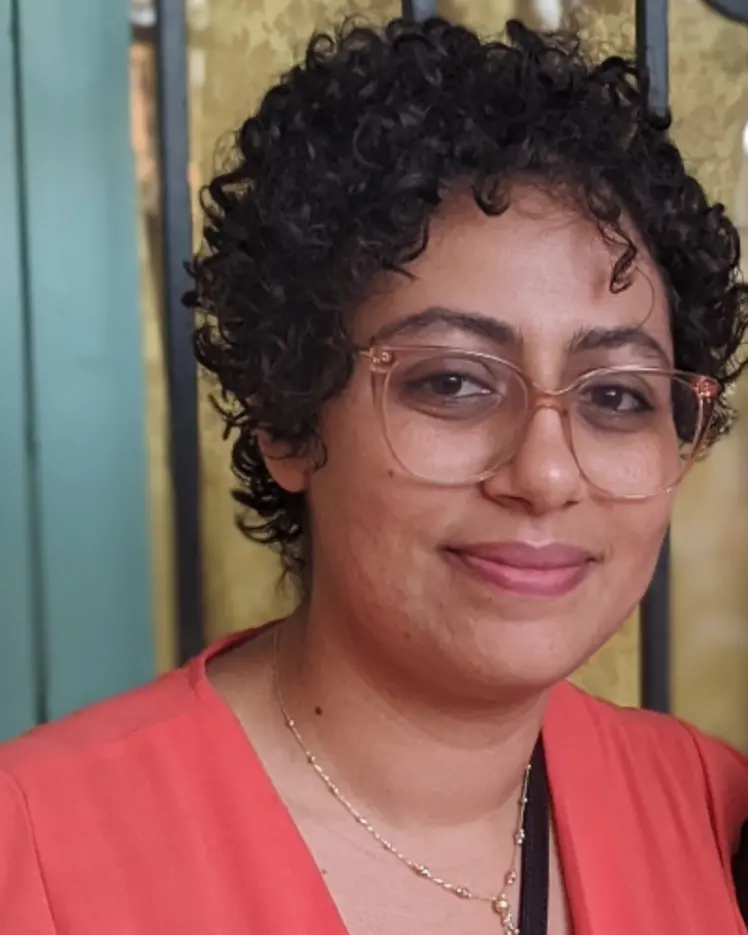
Portrait of Afaf Taïk

Afaf Taïk

Associate Academic Member
Assistant professor, Université de Sherbrooke
Research Topics
AI Ethics
Fairness
Federated Learning
Privacy
Responsible AI

Biography

I am Afaf Taïk, an assistant professor in the Faculty of Engineering at Université de Sherbrooke. I am also an Associate Academic Member at Mila – Quebec AI Institute.

Previously, I was a Claire DesChênes and FRQNT Postdoctoral Fellow at Mila, working on the intersection of fairness and privacy in machine learning with Dr. Golnoosh Farnadi.

I obtained a PhD in Electrical Engineering in June 2022 from Université de Sherbrooke, where I worked under the supervision of Pr. Soumaya Cherkaoui on problems related to distributed machine learning algorithms in wireless networks.

My research interests are deeply tied to responsible AI, with an emphasis on fairness, privacy, and accountability. I am particularly interested in exploring the limits of current auditing and evaluation practices in machine learning. I am also interested in how technical choices interact with social and institutional contexts, and how notions of fairness change across settings. I strongly value collaboration and am always happy to discuss potential projects with researchers, students, and practitioners who share these interests.

Current Students

Collaborating researcher - York University
Collaborating researcher - UQAM

Publications

Unraveling the Interconnected Axes of Heterogeneity in Machine Learning for Democratic and Inclusive Advancements
The growing utilization of machine learning (ML) in decision-making processes raises questions about its benefits to society. In this study,… (see more) we identify and analyze three axes of heterogeneity that significantly influence the trajectory of ML products. These axes are i) values, culture and regulations, ii) data composition, and iii) resource and infrastructure capacity. We demonstrate how these axes are interdependent and mutually influence one another, emphasizing the need to consider and address them jointly. Unfortunately, the current research landscape falls short in this regard, often failing to adopt a holistic approach. We examine the prevalent practices and methodologies that skew these axes in favor of a selected few, resulting in power concentration, homogenized control, and increased dependency. We discuss how this fragmented study of the three axes poses a significant challenge, leading to an impractical solution space that lacks reflection of real-world scenarios. Addressing these issues is crucial to ensure a more comprehensive understanding of the interconnected nature of society and to foster the democratic and inclusive development of ML systems that are more aligned with real-world complexities and its diverse requirements.