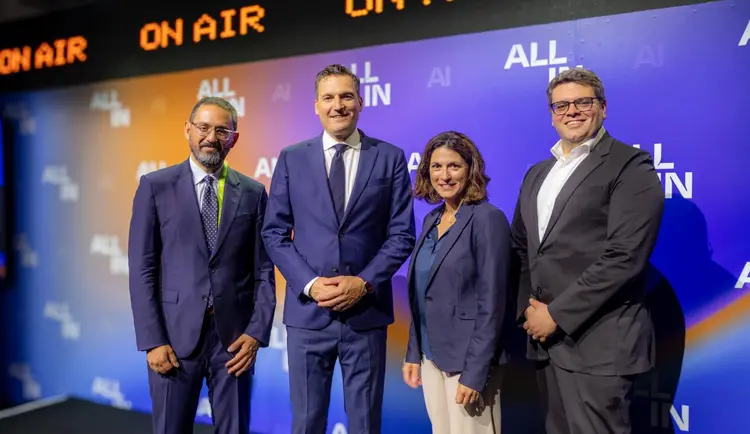



On June 26, Mila welcomed AI4Good Lab's Demo Day, the closing event of a seven-week program that brings together women and gender-diverse participants from across Canada to study machine learning and build AI projects aimed at driving social progress. This year marks the program's 10th anniversary.
As it does every year, the 2026 cohort spanned four locations: Edmonton, Montreal, Toronto, and a fully virtual stream. During Demo Day, a total of 86 participants presented 16 projects developed over the course of the program. One team from each location was selected to receive the AI4Good Lab Accelerator award in recognition of their outstanding work.
"This cohort represents the very best of what the AI4Good Lab stands for: technical excellence and practical machine learning ingenuity harnessed for profound social progress. We’ve seen a remarkable shift from the classroom to real-world application, with projects that tackle everything from food security forecasting and accessible healthcare support to systemic equity frameworks and media literacy tools. These 16 projects are more than just proofs of concept; they are a powerful reminder that when we bring diverse voices and ethical rigor to the table, AI becomes a transformative force that can dismantle barriers and foster a more just, inclusive future for all," said Jennifer Addison, Program Manager, AI4Good Lab.
Here's a look at the winning projects.
Edmonton: Feeds
Feeds is a forecasting tool built to help food banks plan proactively rather than react to rising demand after the fact. Drawing on historical data from organizations such as the Edmonton Food Bank, Food Banks Alberta, and the Red Deer Food Bank, along with external indicators from Statistics Canada, the team's model combines regression and time-series forecasting techniques to project future demand and supply trends. With food bank visits having nearly doubled since 2019 and grocery prices continuing to outpace inflation, Feeds provides food banks with the visibility they need to anticipate surges in demand and optimize inventory planning.
Montreal: Aria
Aria is a mobile app designed to help people experiencing freezing of gait, a condition that significantly raises the risk of falls, hip fractures, and other serious complications. The solution builds on rhythmic auditory stimulation, a clinically proven technique shown to improve stride length, cadence, and walking velocity, with benefits that can persist for weeks. While traditional rhythmic auditory stimulation typically requires clinical supervision and relies on a fixed metronome, Aria makes the therapy accessible anytime and anywhere.
Toronto: Okai Period
Okai Period addresses period poverty, a reality affecting one in four Canadians who menstruate, where menstrual products often become a competing expense against essentials such as food and rent. Through consultations with key stakeholders, the team found that product distribution is often reactive, driven by requests rather than anticipated need. In response, they developed a spatial accessibility framework that helps organizations and policymakers identify where menstrual products are needed most, enabling more strategic and proactive placement decisions.
Virtual: Perspect
With online content increasingly designed to trigger emotional reactions before critical thinking can take hold, Perspect brings media literacy directly into the browser. Working in real time as users browse, it identifies manipulation techniques in posts and articles, explains them in clear, accessible language, and provides a neutral rewrite. By revealing how content is attempting to persuade, the platform empowers readers to evaluate information more critically and engage with it on their own terms.
Congratulations to all four winning teams, and to everyone across Edmonton, Montreal, Toronto, and the virtual cohort who spent the past seven weeks developing their AI skills and turning them into projects with real social impact.
Ten Years of Building the Future of AI
As AI4Good Lab marks its 10th anniversary, its impact is reflected in more than the projects unveiled on Demo Day. Over the past decade, the program has built a national community of women and gender-diverse machine learning talent, offering mentorship, peer-to-peer connection and technical training grounded in the values of inclusion, curiosity and collaboration.
The need for this work remains urgent, and the numbers speak for themselves. Women represent only 22% of AI professionals globally, and the gap is even wider in Canada, where women account for just 12.5% of Canadian AI inventors, compared with 25% globally. Gender-diverse professionals are also significantly underrepresented, making up only 0.5% of Canada’s tech workforce, a gap in representation that carries through to the tools being built, with less than half of Canadian tech companies believing their AI products meet the needs of gender-diverse and queer individuals.
Addison sees these numbers as a reminder of why programs like AI4Good Lab matter, now and in the years ahead.
"Making AI accessible to all is at the heart of Canada's National AI Strategy, and programs like ours are essential to that mandate. We’re not just inviting people into the conversation, we are equipping them with the skills and confidence to help shape it, and to harness AI as a tool for social good. My wish for the next ten years is to see more investment in initiatives like this one, so that more women and gender-diverse leaders can bring their ideas, expertise and ingenuity to the future of AI," they said.