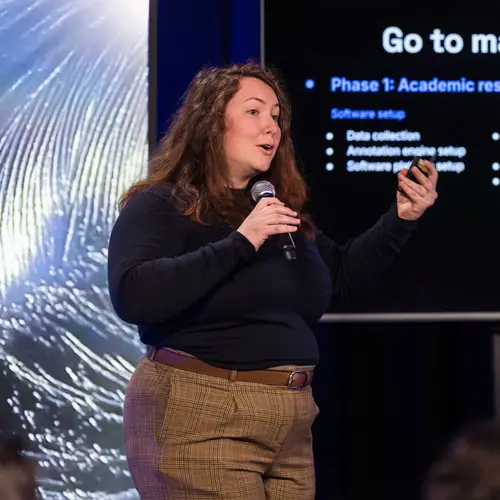


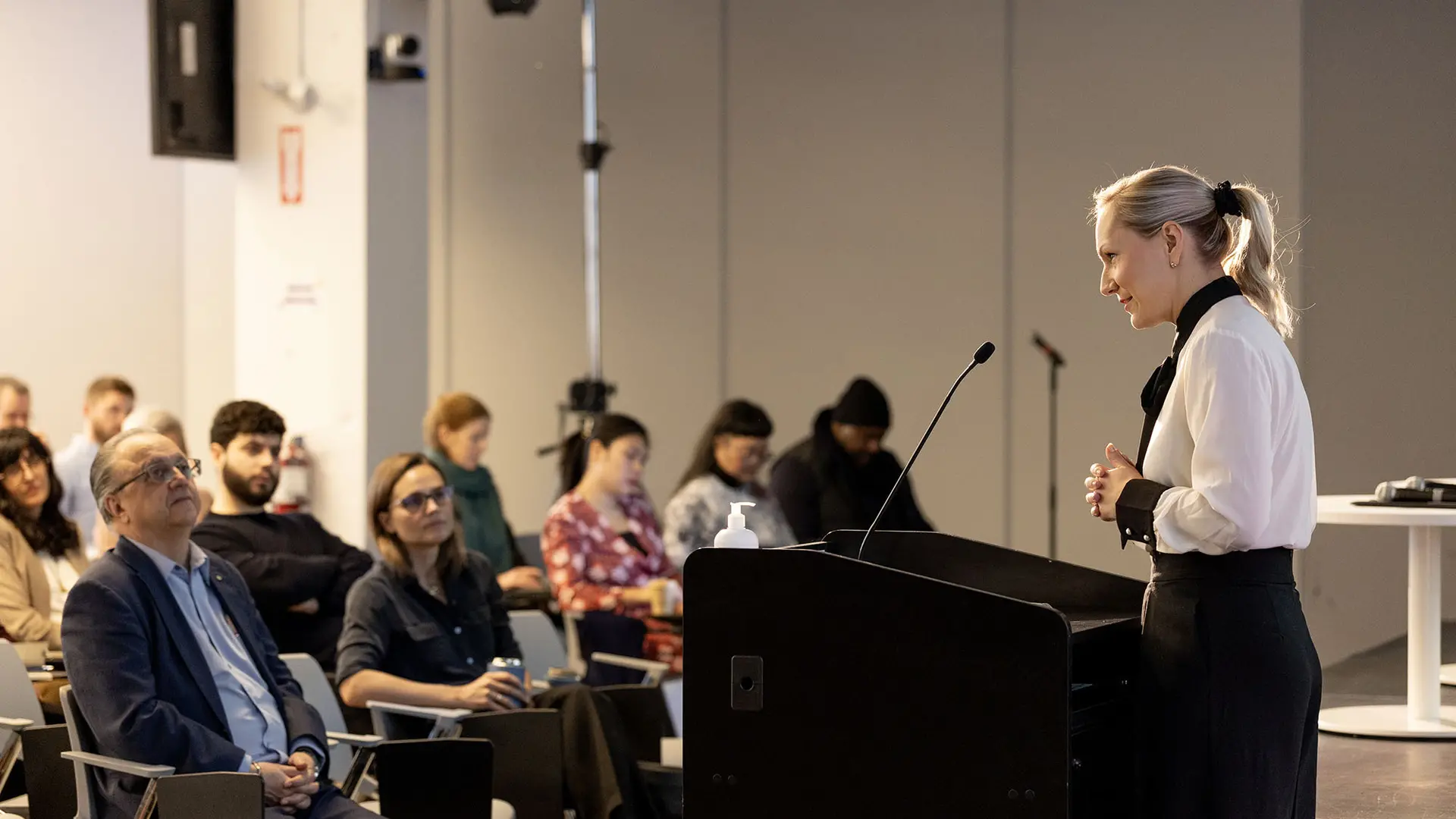
On January 15, 2026, Hugo Larochelle, Scientific Director of Mila, opened the first AI Policy Conference at Mila by drawing a parallel between science and policy. He noted that while science relies on falsifiability (the ability to be proven false), public policy must also be grounded in this quest for factual truth.
For Isadora Hellegren, Senior Project Manager in AI Public Policy Research at Mila and the event’s lead organizer, this conference marks a moment of collective mobilization to map out the challenges ahead and work on tomorrow’s solutions
Here is a look back at the highlights of a day rich in reflection on the future of AI governance.
Governing AI: A Choice, Not a Fatality
For Virginia Dignum, Professor and Director of the AI Policy Lab at Umeå University in Sweden, it is important we do not passively accept technology as an inevitable force of nature. Governance must stop being solely reactive and become proactive.
The priority is to measure AI by its societal and environmental impact rather than technical performance alone, and to base decisions on independent scientific evidence.
Bridging the Legislative Gap
The first panel highlighted the gap between the breakneck speed of AI development and the slow pace of legislation. Elissa Strome, Executive Director of CIFAR, Karim Bardeesy, Parliamentary Secretary to the Minister of Industry, and Chinasa Okolo, AI Policy Specialist at the UN, emphasized the urgent need to build sustainable bridges between researchers and policymakers.
The speakers insisted on democratizing the issue by educating the general public and ensuring global voices are included.
Shaping the Future with the Next Generation
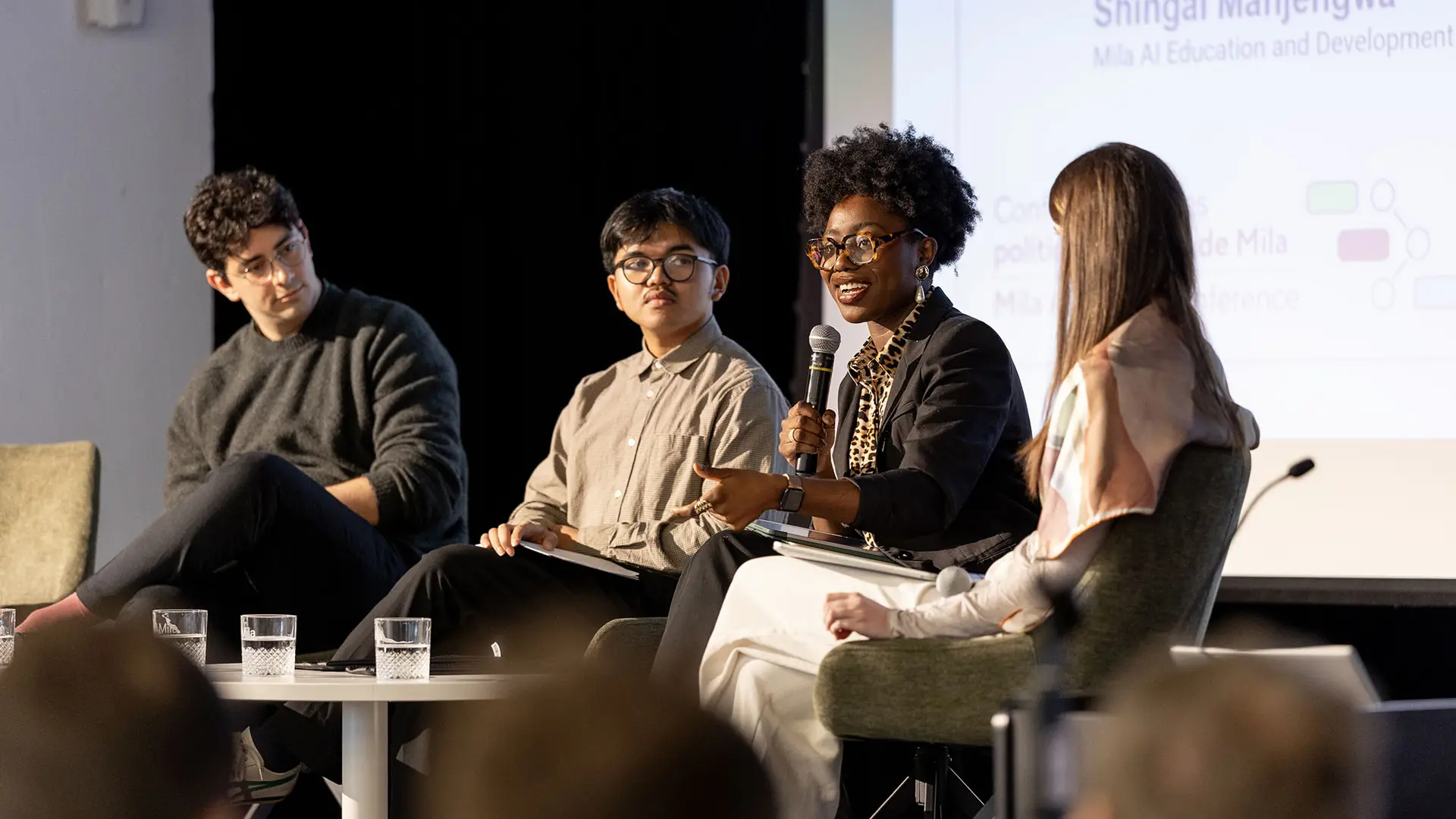
Shingai Manjengwa, Senior Director of Education and Development at Mila, reminded the audience of the duty current generations have to protect the next: "Just as we teach children not to stick their fingers in an electrical outlet, we must ensure the safety of AI tools before worrying about their educational use."
Namir Anani, President and CEO of the Information and Communications Technology Council (ICTC), and André Côté, Interim Executive Director of The Dais, warned of a decline in critical thinking among youth, who tend to trust AI more than humans.
Laurent Charlin, Core Academic Member at Mila, sees potential for personalized education through AI but also a risk of manipulation. "The genie is out of the bottle", he noted, calling for the construction of robust systems rather than bans.
Data Sovereignty and Participatory Democracy
AI ethics cannot be dissociated from global social justice. Adio-Adet Dinika, Research Fellow at The DAIR Institute, pointed out that data annotators in the Global South are the first witnesses to AI’s harmful excesses, yet are systematically ignored. He called for redistributing expertise and for listening to these "voices on the ground” before it is too late.
Echoing this, Fergus Linley-Mota, founder and director of SFU DoT, emphasized the value of participatory democracy, stating that "on-the-ground" experience detects risks and solutions invisible to technical audits.
Alejandro Mayoral Baños, Executive Director of Access Now, warned that AI reproduces old systems of domination, advocating for the decentralization of servers and data collection to return control to local communities.
When asked how to include Indigenous cultural data in AI models, Lynnsey Chartrand, Manager of Indigenous Initiatives at Mila, replied that true inclusion means asking for permission and accepting when a community says no.
Mila's Commitments to AI Policy and Safety
The day featured lightning talks from members of the first cohort of the Mila AI Policy Fellowship. Their presentations covered a wide range of issues, from the AI’s impact on youth to modernizing the mining industry and governing systemic risks.
Leading up to the conference, two events co-organized by the AI Policy Fellowship and Mila's AI Safety Studio laid the groundwork for these discussions. The first, bringing together experts Laurent Charlin, Kamel El Hilali (Consultant on AI and the Rule of Law at UNESCO), and Simon Ruel (Judge at the Quebec Court of Appeal), examined the risks and solutions regarding the integration of AI into court services.
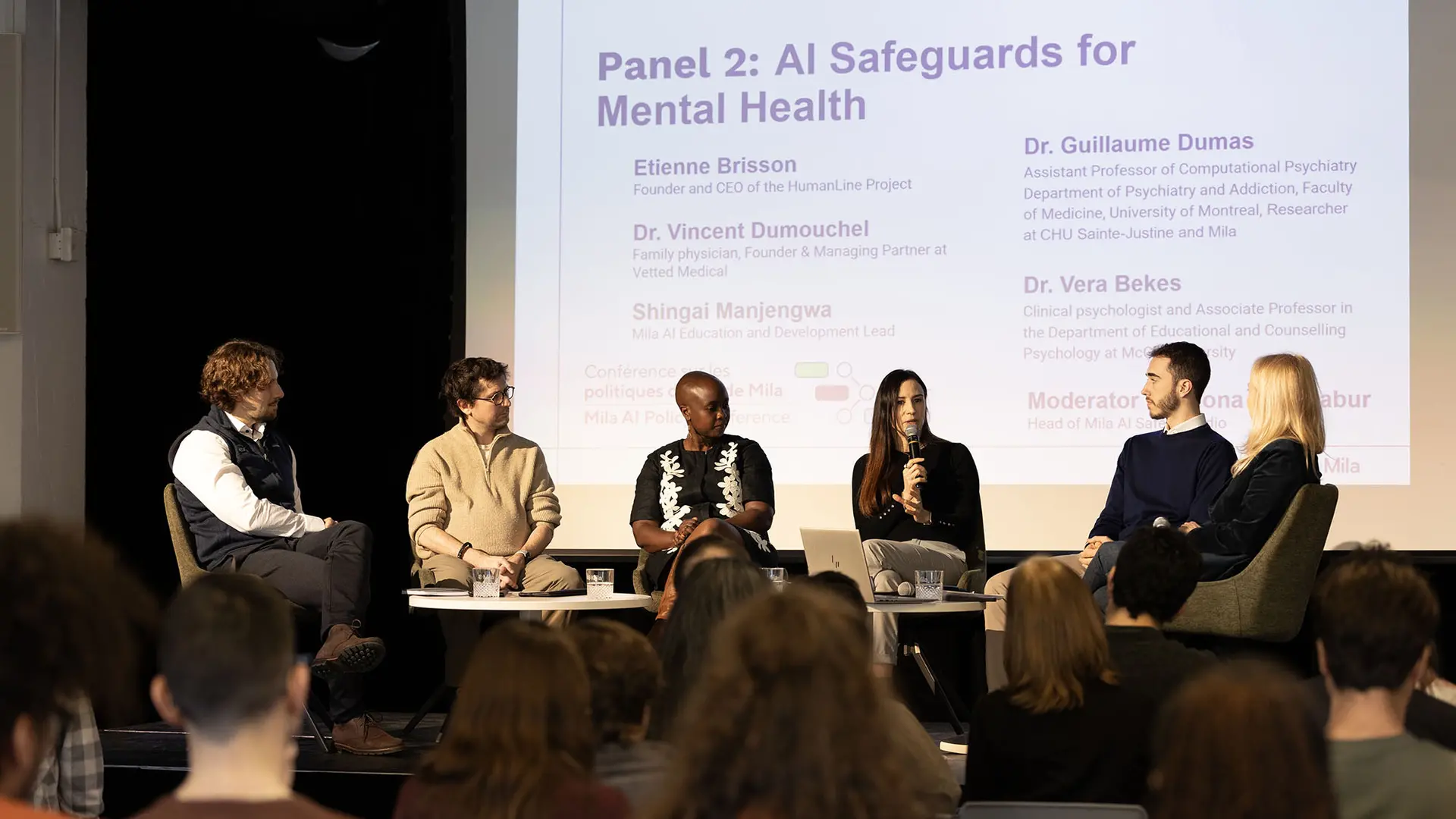
The second event addressed the risks of chatbots to youth mental health. In this vein, Mila’s AI Safety Studio is set to launch a hackathon with Bell and Kids Help Phone to protect children against harmful interactions with chatbots.
"Civic Muscle": Democracy in the Digital Age
In closing, Audrey Tang, former Minister of Digital Affairs of Taiwan, offered a powerful vision of AI serving plurality. Rejecting the idea of automating democracy, she advocates instead for AI-assisted citizen assemblies to combat polarization.
Her warning served as the perfect conclusion to the day: "The robot can become very impressive at lifting weights, but the community's civic muscle will atrophy if we delegate everything. Democracy is not just a matter of generating decisions."
For Audrey Tang, the future is not artificial super-intelligence, but rather our augmented collective intelligence.
Mila also wishes to acknowledge the essential contribution of the many experts who enriched the exchanges throughout the event, notably Alesia Zhuk, Prateek Sibal, Jake Hirsh-Allen, Anna Jahn, Lisa Mah, Geneviève Marquis, Loubna Benabbou, Alain Thivierge, Nancy Kimayo, Sonja Solomun, Alex Garcia-Hernandez, Somya Joshi, and Josée Poirier, as well as the members of the first cohort of the Mila AI Policy Fellowship: Elyas Felfoul, Christopher Wegemer, Hause Lin, Maartje Nugteren, Zhongtian Sun, Adio-Adet Dinika, Sarah Bérubé, Moritz von Knebel, and Noah Favel.