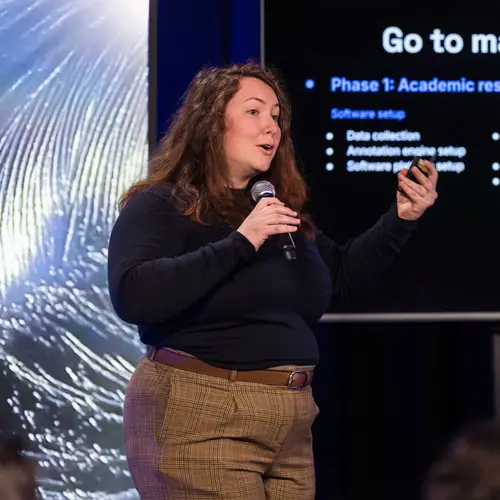


Who builds artificial intelligence shapes what it becomes. As AI systems grow more embedded in every facet of our lives, the makeup of the teams creating them carries real-world consequences. For nearly a decade, the AI4Good Lab has trained women and gender-diverse participants in applied machine learning, with the conviction that technical excellence and ethical responsibility are not separate pursuits. For International Women's Day, Mila spoke with three recent alumni about their journeys, their experience in the program, and what it takes for women and gender-diverse people to find their place in AI.
Aaina Garg | 2025 Toronto cohort
What project did your team work on as part of your training with AI4Good Lab?
We worked on de-biasing machine learning hiring systems. These models are trained on historical data, and historical data carries historical bias. We based our problem statement on the documented Amazon case study, in which the company's ML hiring system was found to favour male resumes for software engineering roles. Our analysis showed that gender signals go far beyond a candidate's name — listing participation in a women's varsity team, for instance, could be enough to identify the applicant’s gender and affect decision making. We applied a technique called adversarial de-biasing and produced a model with 68% better gender-neutrality, with only a 2% drop in accuracy. We also proposed a third-party "Fair AI" certification so that applicants could independently verify a company's fairness claims rather than taking them at face value.
Where has your path taken you since completing the program, and how did the Lab influence that trajectory?
While participating in the AI4Good Lab, I was also completing an internship at Arcadis. After the program, I continued there as both a product manager intern and machine learning engineer intern. This January, I officially joined the company’s AI and data team, becoming the first person officially recruited from Canada to be part of that group. A huge part of how I got there was the clarity I gained from taking part in the Lab. It gave me a strong project I could talk about — one I was passionate about and able to implement from a technical standpoint.
What would you say to a woman or gender-diverse person who is curious about AI but reluctant to enter the field?
From my very first year at university, I made it a point to be proactive with coffee chats — reaching out to seniors, club leaders, and people I met during internships. I really put myself out there, and I think that’s something many women and people from underrepresented groups hesitate to do. Encouragement in this space is crucial. That feeling of being supported, of someone recognizing your talent and helping you develop it further, is something everyone should experience. And honestly, don’t wait until you feel ready. Just start!
Busayo Ososanwo| 2025 virtual cohort
What drew you to apply to the AI4Good Lab?
I saw the AI4Good Lab on LinkedIn, and I read about it and thought, this is actually something I would love to do. The fact that it was centered around women and gender-diverse people made me even more excited — I really, really wanted to participate! I honestly wasn’t expecting to be selected, since I was in a diploma course, not a university degree program. I applied in good faith, and when I got selected, I was super excited. What really resonated with me was its focus on social impact. It allowed me to see the AI space in a whole new way — instead of it being just about business and finance, I could see it being used to create positive impact.
What's one thing you learned at the AI4Good Lab that you couldn't have learned anywhere else?
I think it was the impact — knowing that whatever AI system you create out there affects someone, whether negatively or positively, and that you need to be accountable for that. You have to understand that what you put out there could literally affect someone’s whole life. An AI system doesn’t have to be limited to day-to-day activities. You can create something that specifically benefits a particular group of people, something inclusive. Most AI systems people talk about are for business or finance, but here, you can actually do something for target groups. That’s something I feel I couldn’t have learned anywhere else.
What barriers do you think are keeping women and gender-diverse people from entering AI?
Imposter syndrome — the feeling that a role might be beyond your abilities, even when you clearly have the skills to succeed. I also think it comes from not seeing enough women represented in the field. When young girls do not see role models who look like them and only see men in these spaces, they may think this career is not for them. One piece of advice I received that I still carry with me is to look for your allies. Even if there are ten people in a room, there will always be someone who genuinely wants to hear from you. Find that person. Make sure your voice is heard. Do not let anyone take credit for your idea. Own your ideas.
Abby Buller | 2024 Montreal cohort
How did being in a program dedicated to women and gender-diverse people shape your experience?
On the last day of the Lab, I went up to the program manager and said that this had been the most wonderful learning experience I had ever been a part of. It was amazing to be in a room full of women and gender-diverse people who were simply there to learn, to make mistakes, and to grow. All those fears about raising your hand or worrying about asking a “stupid” question just disappeared. The network continues even after the program. My LinkedIn feed is full of women doing incredible things in tech, and it helps push narratives like “I’m not enough” or “I have imposter syndrome” into the background. Being surrounded by successful women and gender-diverse people doing highly technical work makes you think, why would I ever be afraid to do that? This is normal. It brought a whole new level of confidence to my life.
Where has your path taken you since completing the program, and how did the Lab influence that trajectory?
Every time I run into the AI4Good Lab’s program manager, I tell them that I would not be where I am without the Lab. After finishing, I returned to my master’s program and took more technical machine learning courses. Between the Lab and those courses, I was able to secure a position at the Alberta Machine Intelligence Institute, working in education and consulting for startups taking their first steps into AI. I am now in a project management role where I oversee multiple AI projects at the same time. I like to think of myself as a fairly confident person, but I honestly do not know if I would have had the self-belief to apply to these kinds of roles without the Lab. It has truly changed the trajectory of my career so far.
What is your hope for the next generation of women and gender-diverse people in AI?
I think my hope is truly that they believe in themselves and have the confidence to share their ideas. There are many moments when I am the only woman on a call, the only person who does not identify as a man, and it can be very intimidating to speak up. My hope is that women and gender-diverse people continue to raise their voices and know that their opinions are just as valid and just as important, and in some cases, depending on the context, perhaps even more important. It is crucial to be confident in your voice and to express your thoughts. We need to see women and gender-diverse people participating in these big conversations, and the only way to get there is to overcome the fear of speaking up.