

December 2025 marks an important moment for Canada on the international stage. As the country wraps up its G7 presidency and Montréal concludes its role as host of the G7 Industry, Digital and Technology Ministers’ Meeting, conversations around AI innovation, governance, and societal impact have taken centre stage.
The arrival of Mark Carney as the new Prime Minister, and Evan Solomon, Canada’s very first Minister responsible for AI and digital innovation, added fresh momentum to the country’s positioning. Their early calls for renewed international dialogue reflected a shared commitment to building durable partnerships across the globe where Canadian institutions could meaningfully contribute to shaping the AI of the future – among them, Mila, whose leadership helped define 2025 as a year of Canadian AI going global.
Mila’s Scientific Leadership on the World Stage
This year’s global momentum was underpinned by strong scientific leadership at home, highlighted by the arrival of Hugo Larochelle as Mila’s new Scientific Director. With deep international experience in both industry and academia, Hugo is steering the institute’s research direction in response to new world dynamics. Having just returned from NeurIPS, he will continue ensuring Mila remains at the cutting edge of global scientific discourse while building meaningful bridges for international scientific collaborations.
Complementing this vision, Mila Founder Yoshua Bengio’s work leading the International AI Safety Report, with nearly 100 independent experts and support of 30 countries, the OECD, the EU, and the UN, served as a cornerstone for global policy, reinforcing Mila’s commitment to helping create a responsible AI future.
International Highlights: A Year of High-Level Exchanges
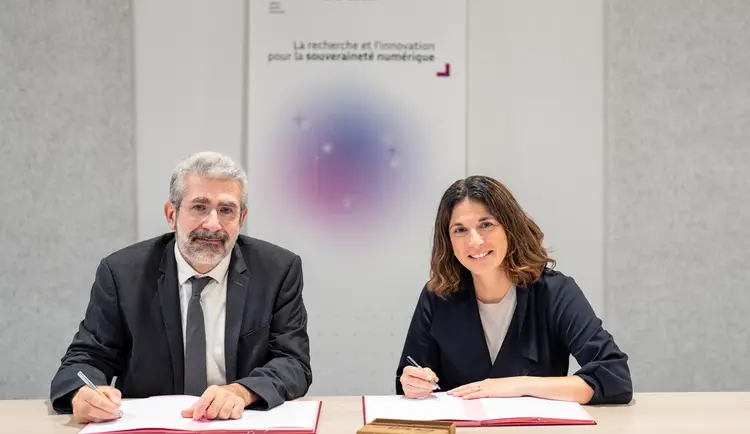
Mila’s President and CEO, Valerie Pisano, has been at the forefront of this global outreach. Throughout 2025, she served as a central figure in global dialogues, championing a human-centric approach to innovation while strengthening the fabric of international cooperation. Her leadership was defined by a deliberate effort to connect ecosystems, with a particular focus on key partners in Europe and beyond.
- France: Building strong middle-power dialogue, capped off at VivaTech
Mila’s major presence at VivaTech – Europe’s leading technology and startup event – contributed to broader Canadian momentum as Canada was honoured as "Country of the Year." Valérie Pisano visited France multiple times this year to cultivate the relationship between the French and Canadian ecosystems. These visits culminated at VivaTech, where conversations underscored how middle powers can come together to define the next stages of collaboration, positioning Mila as a hub where scientific excellence meets value-driven leadership. - Italy: Human-Centric AI and Supercomputing
In Italy, Valérie Pisano engaged directly with the Vatican to take part in a working group focused on the intersection of AI and humankind. While in the region, connections were also deepened with the Italian innovation ecosystem surrounding the Leonardo supercomputer, exploring how high-performance computing can accelerate discovery. - South Korea: Deepening Dialogue on Robotics and more
Mila’s Founder Yoshua Bengio spent time in South Korea exploring potential hubs for collaboration, leading to productive discussions about sharing expertise across borders, particularly in the field of robotics between Mila and key stakeholders from the South Korean AI ecosystem. - United Arab Emirates: A Gateway to New, Impactful Partnerships and Discoveries
During a mission to the United Arab Emirates alongside Prime Minister Mark Carney, Mila strengthened its global network through new engagements with the Technology Innovation Institute (TII). This partnership marks a significant entry into a vital AI ecosystem. By establishing meaningful research partnerships with TII, both organizations are set to advance real-world applications in areas such as large language models, sustainable energy, robotics, quantum technologies and AI safety.
Bringing the World to Montréal
Just as Mila went out to the world, the world came to Mila. This symmetry was most visible during ALL IN, Canada’s largest AI conference, co-organized by the institute. Mila’s massive presence there drew global attention, acting as a counterpart to the international missions.
Throughout 2025, Mila became a true “revolving door” of international engagement, hosting dozens of high-level delegations from governments and civil society worldwide.
An historic milestone of the year occurred in November, when Mila had the honour of welcoming Their Majesties the King and Queen of Sweden. This was not a ceremonial visit; it was a robust industry-driven visit involving an 80-plus member business delegation. Accompanied by Deputy Prime Minister Ebba Busch and Minister for Defence Pål Jonson, the visit underscored a shared responsibility between Canada and Sweden to chart a common path forward in uncertain times.
The event featured a high-level panel exploring bilateral collaboration, featuring voices like Marcus Wallenberg (Chair at Wallenberg Investments), Elena Fersman (Ericsson), Sam Ramadori (LawZero), and Joelle Pineau (Cohere). It was a powerful affirmation that by deepening collaboration, Canada and Sweden can accelerate innovation that serves the public good on both sides of the Atlantic.
Bridging Policy and Practice
2025 also marked the inaugural year of the Mila AI Policy Fellowship. This program brought together an illustrious and extremely accomplished group of fellows from around the globe.
Take, for example, legal researcher Dr. Alesia Zhuk of Spain, who is collaborating with Dr. Catherine Régis and Dr. Laurent Charlin to guide the use of AI in international courts. Or policy professional Maartje Nugteren of Belgium, who is working alongside Dr. Damiano Fornasiere and Dr. Matt McDermott to address critical implementation gaps in the EU AI Act regarding multi-agent interaction.
These experts are currently bringing their policy expertise to the intersection of AI and their specific areas of focus – from law and education to critical minerals – adding a crucial layer of depth to Mila’s ability to influence global AI governance.
Hosting the G7 Finale
Finally, from December 8 to 10, Mila welcomed many delegations tied to the culmination of Canada’s G7 presidency. Over the course of the week, the institute welcomed delegations led by Germany’s Minister Wildberger, UK Minister Murray, Japanese State Minister Horiuchi, and Korean Vice Minister Je Myung Ryu. These visits provided a platform for not only future focused conversations, but further bolstered Mila’s platform to showcase the very best of what it offers to the world’s leading economies.
Under Canada's leadership, G7 countries welcomed the Small and Medium-sized Enterprise AI Adoption Blueprint, a practical guide that was informed by a collaborative report from Canada's National AI Institutes to guide future scaling strategies.
On the margins of the G7, Minister Solomon also entered into a series of major international agreements, including two MOUs with the European Union on AI, data governance and trusted digital services, an MOU with the United Kingdom on national digital public infrastructure and a joint statement launching the Canada-Germany Digital Alliance, advancing cooperation on AI, quantum, digital infrastructure and talent mobility.
Looking Ahead
As 2025 draws to a close, the narrative of “Canadian AI Going Global” has never been more resonant. Mila’s engagement throughout the year illustrates how Canadian innovation can contribute to the global advancement of AI that benefits all, helping lead the way as actors worldwide navigate complex technological transitions and persistent geopolitical uncertainty with confidence and clarity.
With our internationally diverse community of over 1500 researchers and staff, and 131 industry partnerships – a full 30% with businesses from outside Canada – Mila will only build on this momentum. Mila will continue to foster collaborative research, deepen global relationships, and support Canada’s leadership in shaping responsible, impactful AI. In a world seeking trustworthy approaches to innovation, Canada’s contribution – and Mila’s mission – are more important than ever.