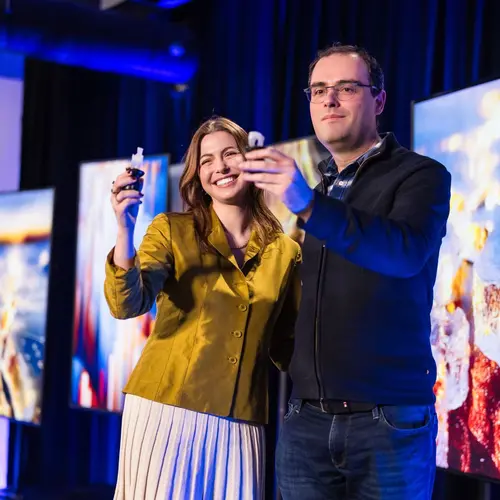
The upcoming meeting, taking place on November 10 at Mila, will explore how we can collectively develop, govern, and deploy high-performing, reliable, and secure agentic systems by connecting academic researchers, industry experts, and practitioners.
We use cookies to analyze the browsing and usage of our website and to personalize your experience. You can disable these technologies at any time, but this may limit certain functionalities of the site. Read our Privacy Policy for more information.
Setting cookies
You can enable and disable the types of cookies you wish to accept. However certain choices you make could affect the services offered on our sites (e.g. suggestions, personalised ads, etc.).
Essential cookies
These cookies are necessary for the operation of the site and cannot be deactivated. (Still active)
Analytics cookies
Do you accept the use of cookies to measure the audience of our sites?
Multimedia Player
Do you accept the use of cookies to display and allow you to watch the video content hosted by our partners (YouTube, etc.)?
Yassir Mamouni
Alumni

Publications
Machine and Deep Learning Models for Hypoxemia Severity Triage in CBRNE Emergencies
BACKGROUND/OBJECTIVES: This study develops machine learning (ML) models to predict hypoxemia severity during emergency triage, particularly … (see more)in Chemical, Biological, Radiological, Nuclear, and Explosive (CBRNE) scenarios, using physiological data from medical-grade sensors. METHODS: Tree-based models (TBMs) such as XGBoost, LightGBM, CatBoost, Random Forests (RFs), Voting Classifier ensembles, and sequential models (LSTM, GRU) were trained on the MIMIC-III and IV datasets. A preprocessing pipeline addressed missing data, class imbalances, and synthetic data flagged with masks. Models were evaluated using a 5-min prediction window with minute-level interpolations for timely interventions. RESULTS: TBMs outperformed sequential models in speed, interpretability, and reliability, making them better suited for real-time decision-making. Feature importance analysis identified six key physiological variables from the enhanced NEWS2+ score and emphasized the value of mask and score features for transparency. Voting Classifier ensembles showed slight metric gains but did not outperform individually optimized models, facing a precision-sensitivity tradeoff and slightly lower F1-scores for key severity levels. CONCLUSIONS: TBMs were effective for real-time hypoxemia prediction, while sequential models, though better at temporal handling, were computationally costly. This study highlights ML's potential to improve triage systems and reduce alarm fatigue, with future plans to incorporate multi-hospital datasets for broader applicability.