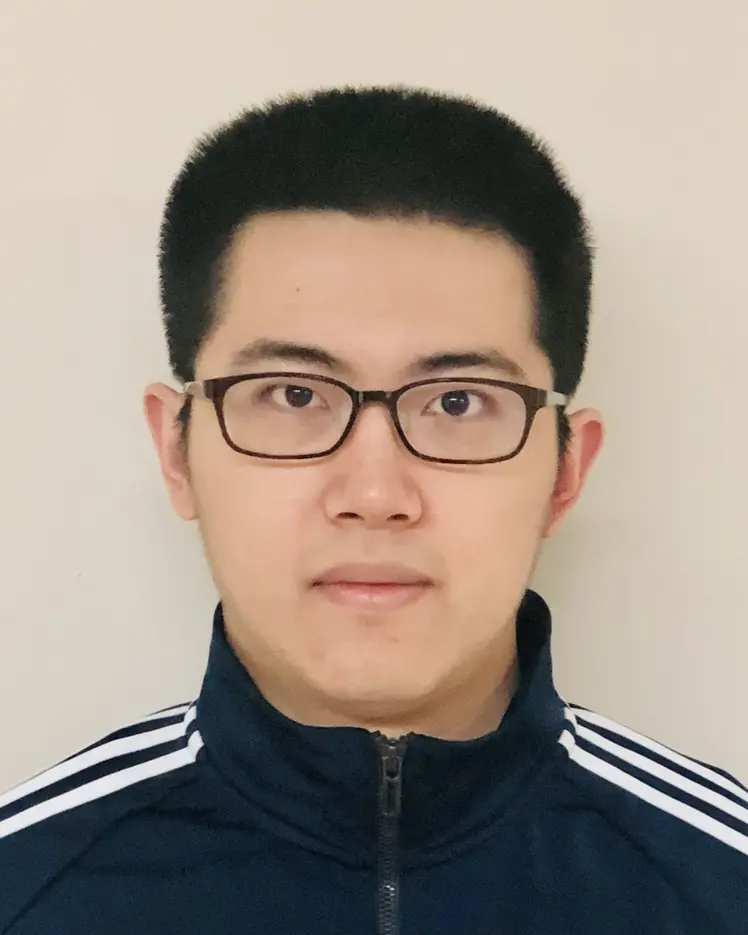
Portrait of Tianshu Kuai

Tianshu Kuai

PhD - Université de Montréal
Supervisor
Research Topics
Computer Graphics
Computer Vision
Deep Learning

Publications

Matérn Noise for Triangulation-Agnostic Flow Matching on Meshes
Arman Maesumi
Daniel Ritchie
This paper tackles the task of learning to generate signals over triangle meshes in a triangulation-agnostic manner, meaning the trained mod… (see more)el can be applied to different meshes and triangulations effectively. Practically, the paper adapts the flow matching (FM) paradigm to a mesh-based, triangulation-agnostic setting. Theoretically, it proposes a specific noise distribution which is triangulation agnostic, to be used inside the FM model's denoising process. While noise distributions are usually trivial to devise for, e.g., images, devising a triangulation-agnostic distribution proves to be a much more difficult task. We formulate a mathematical definition of triangulation agnosticism of distributions, via their spectrum. We then show that a discretization of a specific Gaussian random field called a Matérn process holds these desired properties, and provides a simple and efficient sampling algorithm. We use it as our noise model, and adapt FM to the triangulation-agnostic setting by using a state-of-the-art approach for learning signals on meshes in the gradient domain -- PoissonNet -- as the denoiser. We conduct experiments on elaborate tasks such as sampling elastic rest states, and generating poses of humanoids. Our method is shown to be capable of producing highly realistic results for meshes of over one million triangles, significantly exceeding the state-of-the-art in quality and diversity.
Self-Supervised Image-to-Point Distillation via Semantically Tolerant Contrastive Loss
Anas Mahmoud
Jordan S. K. Hu
Ali Harakeh
Steven L. Waslander
An effective framework for learning 3D representations for perception tasks is distilling rich self-supervised image features via contrastiv… (see more)e learning. However, image-to point representation learning for autonomous driving datasets faces two main challenges: 1) the abundance of self-similarity, which results in the contrastive losses pushing away semantically similar point and image regions and thus disturbing the local semantic structure of the learned representations, and 2) severe class imbalance as pretraining gets dominated by over-represented classes. We propose to alleviate the self-similarity problem through a novel semantically tolerant image-to-point contrastive loss that takes into consideration the semantic distance between positive and negative image regions to minimize contrasting semantically similar point and image regions. Additionally, we address class imbalance by designing a class-agnostic balanced loss that approximates the degree of class imbalance through an aggregate sample-to-samples semantic similarity measure. We demonstrate that our semantically-tolerant contrastive loss with class balancing improves state-of-the art 2D-to-3D representation learning in all evaluation settings on 3D semantic segmentation. Our method consistently outperforms state-of-the-art 2D-to-3D representation learning frameworks across a wide range of 2D self-supervised pretrained models.