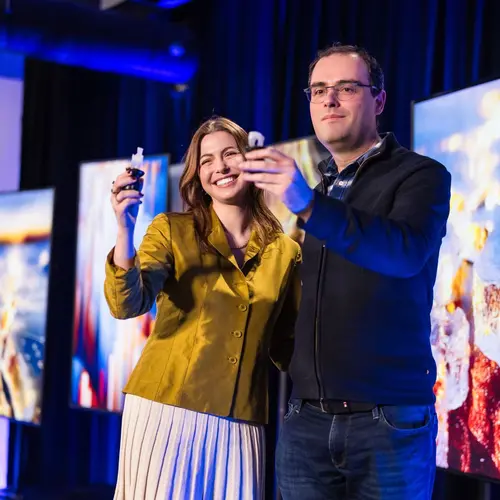
The upcoming meeting, taking place on November 10 at Mila, will explore how we can collectively develop, govern, and deploy high-performing, reliable, and secure agentic systems by connecting academic researchers, industry experts, and practitioners.
We use cookies to analyze the browsing and usage of our website and to personalize your experience. You can disable these technologies at any time, but this may limit certain functionalities of the site. Read our Privacy Policy for more information.
Setting cookies
You can enable and disable the types of cookies you wish to accept. However certain choices you make could affect the services offered on our sites (e.g. suggestions, personalised ads, etc.).
Essential cookies
These cookies are necessary for the operation of the site and cannot be deactivated. (Still active)
Analytics cookies
Do you accept the use of cookies to measure the audience of our sites?
Multimedia Player
Do you accept the use of cookies to display and allow you to watch the video content hosted by our partners (YouTube, etc.)?
Few-shot Test-Time Domain Adaptation (FSTT-DA) seeks to adapt models to novel domains using only a handful of unlabeled target samples. This… (see more) setting is more realistic than typical domain adaptation setups, which assume access to target data during source training. However, prior FSTT-DA approaches fail to effectively leverage source domain-specific knowledge, relying on shallow batch normalization updates, prompt-based methods that treat the model as a black box, or ensembling strategies that do not capture cross-domain relationships. To address these limitations, we introduce a new FSTT-DA framework that integrates LoRA fine-tuning with model merging. In our approach, separate LoRA modules are fine-tuned on CLIP's vision encoder for each source domain. Since LoRA modifies only a small fraction of the model's parameters, it retains the base model's generalized knowledge while internally learning domain-specific features. To adapt the learned knowledge to a specific target domain, we propose a hypernetwork trained via meta-learning that generates per-column merging factors to combine LoRA modules. Given a small batch of target images, the hypernetwork produces merging weights that fuse source LoRA modules into a single adapted representation. Our results demonstrate state-of-the-art performance across various domain adaptation datasets. Our code is publicly available at https://github.com/nahbois4321/DA-MergeLoRA.