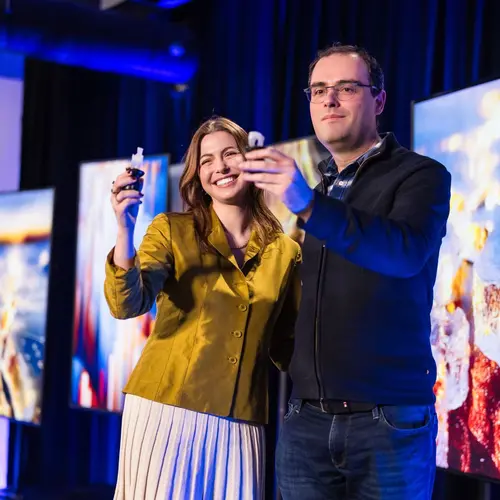
This program supports AI startups at any time of the year. Benefit from cutting-edge resources and tailored support to accelerate your technology's development.
Offered by Mila and the Public Policy Forum, this program is designed to equip policy and decision makers with the tools to navigate the opportunities and risks of AI. The next cohort will be held in French on September 1-2, 2026, at Mila.
Connect with a Mila academic advisor and current student-researchers to learn more about Mila's community and how to join us on August 19, 31 and September 11, 2026.
We use cookies to analyze the browsing and usage of our website and to personalize your experience. You can disable these technologies at any time, but this may limit certain functionalities of the site. Read our Privacy Policy for more information.
Setting cookies
You can enable and disable the types of cookies you wish to accept. However certain choices you make could affect the services offered on our sites (e.g. suggestions, personalised ads, etc.).
Essential cookies
These cookies are necessary for the operation of the site and cannot be deactivated. (Still active)
Analytics cookies
Do you accept the use of cookies to measure the audience of our sites?
Multimedia Player
Do you accept the use of cookies to display and allow you to watch the video content hosted by our partners (YouTube, etc.)?
This paper introduces MILUV, a Multi-UAV Indoor Localization dataset with UWB and Vision measurements. This dataset comprises 217 minutes of… (see more) flight time over 36 experiments using three quadcopters, collecting ultra-wideband (UWB) ranging data such as the raw timestamps and channel-impulse response data, vision data from a stereo camera and a bottom-facing monocular camera, inertial measurement unit data, height measurements from a laser rangefinder, magnetometer data, and ground-truth poses from a motion-capture system. The UWB data is collected from up to 12 transceivers affixed to mobile robots and static tripods in both line-of-sight and non-line-of-sight conditions. The UAVs fly at a maximum speed of 4.418 m/s in an indoor environment with visual fiducial markers as features. MILUV is versatile and can be used for a wide range of applications beyond localization, but the primary purpose of MILUV is for testing and validating multi-robot UWB- and vision-based localization algorithms. The dataset can be downloaded at https://doi.org/10.25452/figshare.plus.28386041.v1. A development kit is presented alongside the MILUV dataset, which includes benchmarking algorithms such as visual-inertial odometry, UWB-based localization using an extended Kalman filter, and classification of CIR data using machine learning approaches. The development kit can be found at https://github.com/decargroup/miluv, and is supplemented with a website available at https://decargroup.github.io/miluv/.
2026-01-08
International Journal of Robotics Research (published)