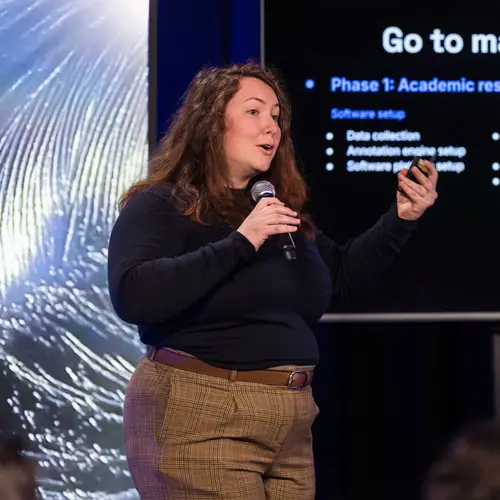
Opening Conference | Building Safer AI for Youth Mental Health
On March 16, starting at 9 AM, join leading AI researchers, clinical experts, and voices from the ground for an event exploring the frameworks needed to design AI that is not only powerful, but also safe for mental health.
TRAIL: Responsible AI for Professionals and Leaders
Learn how to integrate responsible AI practices into your organization with TRAIL. Join our information session on March 12, where you’ll discover the program in detail and have the chance to ask all your questions.
We use cookies to analyze the browsing and usage of our website and to personalize your experience. You can disable these technologies at any time, but this may limit certain functionalities of the site. Read our Privacy Policy for more information.
Setting cookies
You can enable and disable the types of cookies you wish to accept. However certain choices you make could affect the services offered on our sites (e.g. suggestions, personalised ads, etc.).
Essential cookies
These cookies are necessary for the operation of the site and cannot be deactivated. (Still active)
Analytics cookies
Do you accept the use of cookies to measure the audience of our sites?
Multimedia Player
Do you accept the use of cookies to display and allow you to watch the video content hosted by our partners (YouTube, etc.)?
Understanding the origin of stars within a galaxy - whether formed in-situ or accreted from other galaxies (ex-situ) - is key to constrainin… (see more)g its evolution. Spatially resolving these components provides crucial insights into a galaxy's mass assembly history. We aim to predict the spatial distribution of ex-situ stellar mass fraction in MaNGA galaxies, and to identify distinct assembly histories based on the radial gradients of these predictions in the central regions. We employ a diffusion model trained on mock MaNGA analogs (MaNGIA), derived from the TNG50 cosmological simulation. The model learns to predict the posterior distribution of resolved ex-situ stellar mass fraction maps, conditioned on stellar mass density, velocity, and velocity dispersion gradient maps. After validating the model on an unseen test set from MaNGIA, we apply it to MaNGA galaxies to infer the spatially-resolved distribution of their ex-situ stellar mass fractions - i.e. the fraction of stellar mass in each spaxel originating from mergers. We identify four broad categories of ex-situ mass distributions: flat gradient, in-situ dominated; flat gradient, ex-situ dominated; positive gradient; and negative gradient. The vast majority of MaNGA galaxies fall in the first category - flat gradients with low ex-situ fractions - confirming that in-situ star formation is the main assembly driver for low- to intermediate-mass galaxies. At high stellar masses, the ex-situ maps are more diverse, highlighting the key role of mergers in building the most massive systems. Ex-situ mass distributions correlate with morphology, star-formation activity, stellar kinematics, and environment, indicating that accretion history is a primary factor shaping massive galaxies. Finally, by tracing their assembly histories in TNG50, we link each class to distinct merger scenarios, ranging from secular evolution to merger-dominated growth.