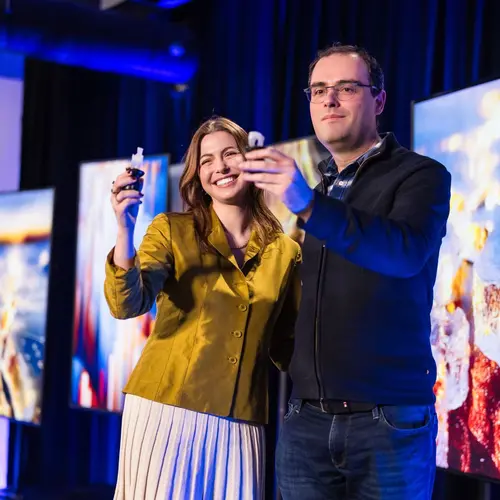
This program supports AI startups at any time of the year. Benefit from cutting-edge resources and tailored support to accelerate your technology's development.
Offered by Mila and the Public Policy Forum, this program is designed to equip policy and decision makers with the tools to navigate the opportunities and risks of AI. The next cohort will be held in French on September 1-2, 2026, at Mila.
Connect with a Mila academic advisor and current student-researchers to learn more about Mila's community and how to join us on August 19, 31 and September 11, 2026.
We use cookies to analyze the browsing and usage of our website and to personalize your experience. You can disable these technologies at any time, but this may limit certain functionalities of the site. Read our Privacy Policy for more information.
Setting cookies
You can enable and disable the types of cookies you wish to accept. However certain choices you make could affect the services offered on our sites (e.g. suggestions, personalised ads, etc.).
Essential cookies
These cookies are necessary for the operation of the site and cannot be deactivated. (Still active)
Analytics cookies
Do you accept the use of cookies to measure the audience of our sites?
Multimedia Player
Do you accept the use of cookies to display and allow you to watch the video content hosted by our partners (YouTube, etc.)?
This paper presents a novel acoustic-visual-inertial odometry solution leveraging a continuous-time trajectory estimation framework for unma… (see more)nned underwater vehicles. Underwater environments present unique challenges for visual localization and mapping, such as light attenuation, illumination variance, and the presence of particulate matter. This motivates the use of additional sensing modalities and a visual tracking pipeline that is robust to diverse subsea conditions. The proposed system is the first continuous-time trajectory estimation framework based on Gaussian processes to fuse asynchronous measurements from a Doppler velocity log, a stereo camera, and an inertial measurement unit. Additionally, a novel visual frontend is proposed, incorporating learning-based feature extraction and matching that is robust to the specific challenges that subsea environments present. The proposed framework enables seamless integration of additional sensor modalities in continuous-time and is adaptable to different environments without reconfiguration. The proposed system is extensively tested on real-world underwater inspection datasets, where it outperforms state-of-the-art visual-inertial and acoustic-visual-inertial SLAM algorithms in accuracy, robustness, and trajectory coverage. Notably, the proposed system outperforms the state-of-the-art despite only forming short-term visual data associations.