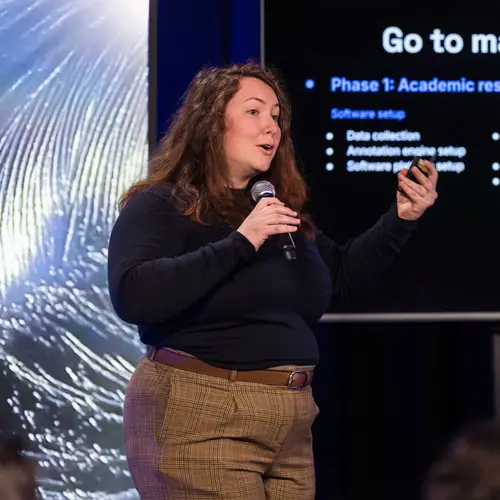
Opening Conference | Building Safer AI for Youth Mental Health
On March 16, starting at 9 AM, join leading AI researchers, clinical experts, and voices from the ground for an event exploring the frameworks needed to design AI that is not only powerful, but also safe for mental health.
TRAIL: Responsible AI for Professionals and Leaders
Learn how to integrate responsible AI practices into your organization with TRAIL. Join our information session on March 12, where you’ll discover the program in detail and have the chance to ask all your questions.
We use cookies to analyze the browsing and usage of our website and to personalize your experience. You can disable these technologies at any time, but this may limit certain functionalities of the site. Read our Privacy Policy for more information.
Setting cookies
You can enable and disable the types of cookies you wish to accept. However certain choices you make could affect the services offered on our sites (e.g. suggestions, personalised ads, etc.).
Essential cookies
These cookies are necessary for the operation of the site and cannot be deactivated. (Still active)
Analytics cookies
Do you accept the use of cookies to measure the audience of our sites?
Multimedia Player
Do you accept the use of cookies to display and allow you to watch the video content hosted by our partners (YouTube, etc.)?
Model quantization enables the deployment of deep neural networks under resource-constrained devices. Vector quantization aims at reducing t… (see more)he model size by indexing model weights with full-precision embeddings, i.e., codewords, while the index needs to be restored to 32-bit during computation. Binary and other low-precision quantization methods can reduce the model size up to 32×, however, at the cost of a considerable accuracy drop. In this paper, we propose an efficient framework for ternary quantization to produce smaller and more accurate compressed models. By integrating hyperspherical learning, pruning and reinitialization, our proposed Hyperspherical Quantization (HQ) method reduces the cosine distance between the full-precision and ternary weights, thus reducing the bias of the straight-through gradient estimator during ternary quantization. Compared with existing work at similar compression levels (~30×, ~40×), our method significantly improves the test accuracy and reduces the model size.
2023-01-02
2023 IEEE/CVF Winter Conference on Applications of Computer Vision (WACV) (published)