

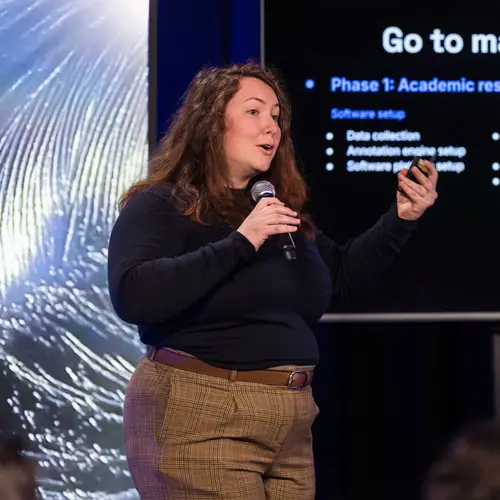

Portrait of Audrey Durand

Audrey Durand

Associate Academic Member
Canada CIFAR AI Chair
Associate professor, Université Laval, Department of Computer Science and Software Engineering
Research Topics
AI for Science
Online Learning
Reinforcement Learning

Biography

Audrey Durand is an assistant professor in the Department of Computer Science and Software Engineering and in the Department of Electrical and Computer Engineering at Université Laval.

She specializes in algorithms that learn through interaction with their environment using reinforcement learning, and is particularly interested in leveraging these approaches in health-related applications.

Current Students

Master's Research - Université Laval
Master's Research - Université de Montréal
Principal supervisor :
PhD - Université Laval
Master's Research - Université Laval
PhD - Université Laval
Postdoctorate - Université Laval

Publications

GrowSpace: A reinforcement learning environment for plant architecture
Latent Space Evolution under Incremental Learning with Concept Drift (Student Abstract)
Charles Bourbeau
This work investigates the evolution of latent space when deep learning models are trained incrementally in non-stationary environments that… (see more) stem from concept drift. We propose a methodology for visualizing the incurred change in latent representations. We further show that classes not targeted by concept drift can be negatively affected, suggesting that the observation of all classes during learning may regularize the latent space.
The Influence of Age, Sex, and Socioeconomic Status on Glycemic Control Among People With Type 1 and Type 2 Diabetes in Canada: Patient-Led Longitudinal Retrospective Cross-sectional Study With Multiple Time Points of Measurement
Seyedmostafa Mousavi
Dana Tannenbaum Greenberg
Ruth Ndjaboué
Michelle Greiver
Olivia Drescher
Selma Chipenda Dansokho
Denis Boutin
Jean-Marc Chouinard
Sylvie Dostie
Robert Fenton
Marley Greenberg
Jonathan McGavock
Adhiyat Najam
Monia Rekik
Tom Weisz
Donald J Willison
Holly O Witteman
Interpret Your Care: Predicting the Evolution of Symptoms for Cancer Patients
Jennifer Jones
Cancer treatment is an arduous process for patients and causes many side-effects during and post-treatment. The treatment can affect almost … (see more)all body systems and result in pain, fatigue, sleep disturbances, cognitive impairments, etc. These conditions are often under-diagnosed or under-treated. In this paper, we use patient data to predict the evolution of their symptoms such that treatment-related impairments can be prevented or effects meaningfully ameliorated. The focus of this study is on predicting the pain and tiredness level of a patient post their diagnosis. We implement an interpretable decision tree based model called LightGBM on real-world patient data consisting of 20163 patients. There exists a class imbalance problem in the dataset which we resolve using the oversampling technique of SMOTE. Our empirical results show that the value of the previous level of a symptom is a key indicator for prediction and the weighted average deviation in prediction of pain level is 3.52 and of tiredness level is 2.27.
Neural Bandits for Data Mining: Searching for Dangerous Polypharmacy
Informing the development of an outcome set and banks of items to measure mobility among individuals with acquired brain injury using natural language processing
Rehab Alhasani
Claudine Auger
Anouk Lamontagne
Sara Ahmed
The banks of items of mobility domains represent a first step toward establishing a comprehensive outcome set and a common language of mobil… (see more)ity to develop the ontology. It enables researchers and healthcare professionals to begin exposing the content of mobility measures as a way to assess mobility comprehensively.
Performative Prediction in Time Series: A Case Study
Jennifer Jones
David Langelier
Anthony Reiman
Jonathan Greenland
Kristin Campbell
Annotation Cost-Sensitive Deep Active Learning with Limited Data (Student Abstract)
Contextual bandit optimization of super-resolution microscopy
Anthony Bilodeau
Renaud Bernatchez
Albert Michaud-Gagnon
Microscopy analysis neural network to solve detection, enumeration and segmentation from image-level annotations
Anthony Bilodeau
Constantin V.L. Delmas
Martin Parent
Paul De Koninck
Predicting Visual Improvement After Macular Hole Surgery: A Combined Model Using Deep Learning and Clinical Features
Alexandre Lachance
Fares Antaki
Mélanie Hébert
Serge Bourgault
Mathieu Caissie
Éric Tourville
Ali Dirani
Biomedical Research & Informatics Living Laboratory for Innovative Advances of New Technologies in Community Mobility Rehabilitation: Protocol for a longitudinal evaluation of mobility outcomes (Preprint)
Sara Ahmed
Philippe Archambault
Claudine Auger
Joyce Fung
Eva Kehayia
Anouk Lamontagne
Annette Majnemer
Sylvie Nadeau
Alain Ptito
Bonnie Swaine