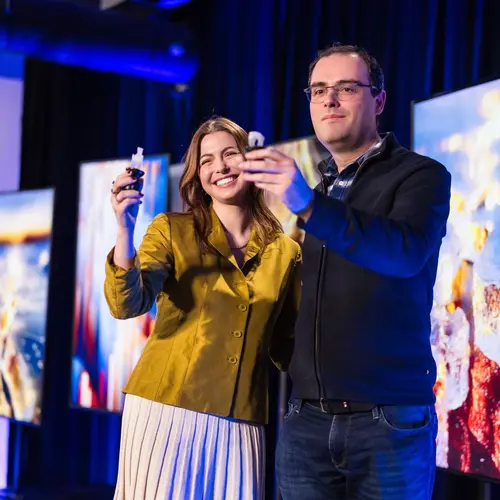
The upcoming meeting, taking place on November 10 at Mila, will explore how we can collectively develop, govern, and deploy high-performing, reliable, and secure agentic systems by connecting academic researchers, industry experts, and practitioners.
Join us on the Venture Scientist Bootcamp, a full time, 4-month incubator at Mila, built specifically for deep tech founders with elite STEM backgrounds. You have until November 21, 2026 to apply!
We use cookies to analyze the browsing and usage of our website and to personalize your experience. You can disable these technologies at any time, but this may limit certain functionalities of the site. Read our Privacy Policy for more information.
Setting cookies
You can enable and disable the types of cookies you wish to accept. However certain choices you make could affect the services offered on our sites (e.g. suggestions, personalised ads, etc.).
Essential cookies
These cookies are necessary for the operation of the site and cannot be deactivated. (Still active)
Analytics cookies
Do you accept the use of cookies to measure the audience of our sites?
Multimedia Player
Do you accept the use of cookies to display and allow you to watch the video content hosted by our partners (YouTube, etc.)?
Few-Shot Class-Incremental Learning (FSCIL) requires models to continuously learn new classes from limited samples while retaining prior kno… (see more)wledge, under strict constraints on compute and memory. Existing approaches lie along a difficult trade-off: simple fine-tuning is computationally efficient but suffers from catastrophic forgetting, replay-based methods mitigate forgetting at the cost of substantial compute and memory, and exemplar-free methods often reduce forgetting by freezing most of the backbone, improving efficiency at the expense of adaptability. We propose Selective Backpropagation (SBP), a deterministic parameter budgeting framework that bridges this gap. SBP restricts gradient updates to a pre-allocated subset of network parameters, freezing past knowledge and preserving unbiased capacity for future learning, enabling rapid adaptation without costly mask optimization. We show that SBP achieves strong performance across standard FSCIL benchmarks while requiring training time close to that of naive fine-tuning and substantially lower training time than prior SOTA methods. Crucially, our experiments expose a limitation of standard FSCIL evaluation: performance on short, distribution-consistent benchmarks does not necessarily predict behavior under distribution shift or over substantially longer learning horizons. We therefore evaluate FSCIL methods in cross-domain settings and over an 80-session ImageNet-1K stream. SBP remains strong across these regimes while maintaining low training cost, providing a favorable stability-plasticity-efficiency trade-off. Our code is available at https://github.com/PaInt-Lab/sbp-main-public.
Few-Shot Class-Incremental Learning (FSCIL) requires models to learn new classes from limited samples while retaining prior knowledge under … (see more)strict compute and memory constraints. Existing approaches face a difficult trade-off: fine-tuning is efficient but forgets, replay-based methods mitigate forgetting at high cost, and exemplar-free methods sacrifice adaptability by freezing most of the backbone. We propose Selective Backpropagation (SBP), a deterministic parameter budgeting framework that restricts gradient updates to a pre-allocated subset of parameters, freezing past knowledge and preserving unbiased capacity for future learning without costly mask optimization. SBP achieves state-of-the-art accuracy across standard FSCIL benchmarks while requiring training time close to naive fine-tuning. Crucially, we show that methods relying on frozen backbones fail in cross-domain FSCIL, where distribution shift is unavoidable, while SBP remains highly adaptive and significantly outperforms all competing approaches.
2026-08-24
Work-In-Progress Track @ Conference on Lifelong Learning Agents (poster)
Robotic assistance in household environments requires not only predicting where objects should be placed, but also reasoning about when obje… (see more)cts should not be placed at all. Existing approaches to personalized object rearrangement primarily focus on placement decisions under the assumption of clean observations and complete actionability, limiting their applicability in realistic, cluttered, and partially erroneous settings. In this paper, we introduce APOLLO, a hybrid framework for abstention-aware personalized object rearrangement that combines a lightweight, personalized embedding model (PEM) with selective large language model (LLM) assistance. PEM is trained for each user-environment pair using a small number of demonstrations, operates entirely on CPU, and produces uncertainty estimates, which are used to selectively invoke LLM-based reasoning only for ambiguous decisions, balancing efficiency, privacy, and reasoning capability. To evaluate this formulation beyond existing benchmarks, we introduce APOR, a synthetic, LLM-generated dataset that captures room-level, multi-furniture environments, diverse organizational profiles, explicit abstention behavior, and noisy partial scene context. Extensive experiments on both PARSEC and APOR provide initial evidence that APOLLO improves over prior LLM-based baselines in controlled benchmark settings while substantially reducing LLM usage. Code is available at https://github.com/PaInt-Lab/APOLLO.
Proactive robot assistance in household environments requires accurate prediction of human activities and object usage under dynamic and noi… (see more)sy conditions. Existing approaches often rely on complex spatio-temporal models, which can be computationally expensive and sensitive to environmental variability. In this paper, we propose GLOBE, a lightweight framework that combines n-gram Markov models for capturing temporal behavioral patterns with uncertainty-guided large language model (LLM) reasoning. The framework performs sequential prediction efficiently while selectively invoking LLM reasoning only when the model confidence is low. To evaluate performance under realistic conditions, we introduce HOMER-Noise, a noisy extension of the HOMER+ dataset that simulates structured disturbances such as object movements caused by humans, pets, and toddlers. Experimental results show that GLOBE achieves competitive performance with state-of-the-art methods while improving robustness and computational efficiency across both clean and noisy settings. The framework is further validated through a proof-of-concept integration with a Stretch 3 mobile manipulator, demonstrating its potential application in real-world human-robot interaction scenarios.
Today's high-capacity generalist robot policies provide a strong foundation for broad task-level competence, yet achieving effective and equ… (see more)itable support for people in everyday settings remains a significant challenge. Real-world environments are dynamic and unstructured, and human needs evolve over time, requiring robots that can adapt accordingly. The ultimate evaluator of any robotic system is the person it assists, and personalization is essential to ensuring equitable and meaningful support across diverse users and contexts. Developing robots that can continually learn from interaction, adapt their behaviors over time, and flexibly assume roles as learners and collaborators is a critical step toward realizing effective integration of robots into daily life. With this year's theme of "Evolving Assistance for Everyday Life", and in alignment with the conference theme "HRI Empowering Society", the sixth edition of the "Lifelong Learning and Personalization in Long-Term Human-Robot Interaction (LEAP-HRI)" workshop aims to bring together insights across diverse disciplines, focusing on how robots can progressively adapt their support to suit diverse individuals, each with unique and changing needs, across real-world contexts. Through this lens, the workshop aims to discuss current and future directions in how assistive systems can flexibly respond, continually improve over time, and deliver more inclusive and empowering support in everyday life.
2026-03-15
International Conference on Human-Robot Interaction (published)