



Portrait of Aldo Zaimi

Aldo Zaimi

Applied Research Scientist, Applied Machine Learning Research

Biography

Interests: applied deep learning, drug discovery, protein representation learning, graph neural nets (GNNs), medical imaging, few-shot learning, self-supervised learning, diffusion models for image generation, vision language models (VLMs), large language models (LLMs), novel view synthesis, 3D reconstruction, explainable AI.
Publications

CLIP Is Shortsighted: Paying Attention Beyond the First Sentence
Marc-Antoine Lavoie
Anas Mahmoud
Steven L. Waslander
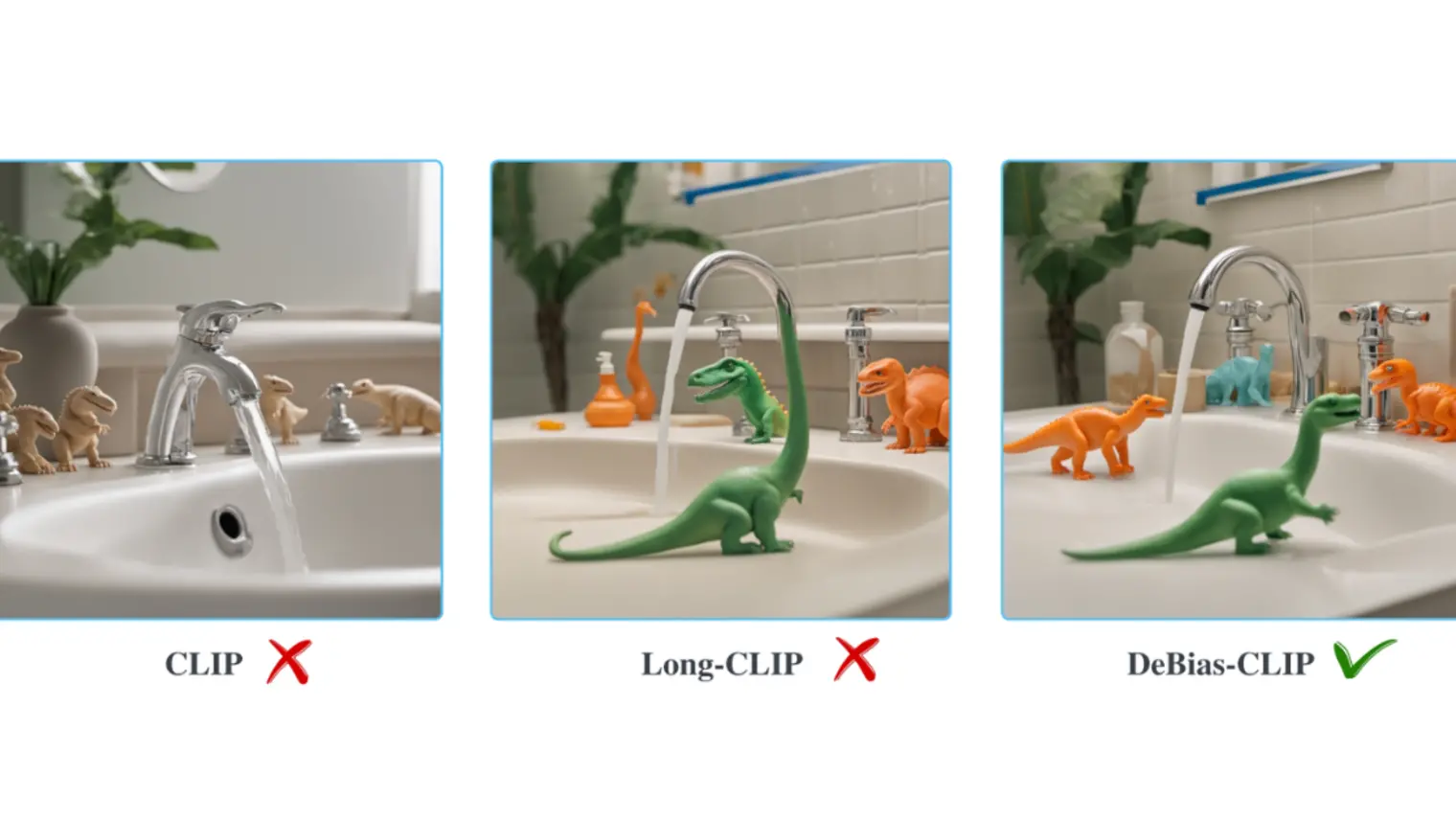
CLIP models learn transferable multi-modal features via image-text contrastive learning on internet-scale data. They are widely used in zero… (see more)-shot classification, multi-modal retrieval, text-to-image diffusion, and as image encoders in large vision-language models. However, CLIP’s pretraining is dominated by images paired with short captions, biasing the model toward encoding simple descriptions of salient objects and leading to coarse alignment on complex scenes and dense descriptions. While recent work mitigates this by fine-tuning on small-scale long-caption datasets, we identify an important common bias: both human- and LLM-generated long captions typically begin with a one-sentence summary followed by a detailed description. We show that this acts as a shortcut during training, concentrating attention on the opening sentence and early tokens and weakening alignment over the rest of the caption. To resolve this, we introduce DeBias-CLIP, which removes the summary sentence during training and applies sentence sub-sampling and text token padding to distribute supervision across all token positions. DeBias-CLIP achieves state-of-the-art long-text retrieval, improves short-text retrieval, and is less sensitive to sentence order permutations. It is a drop-in replacement for Long-CLIP with no additional trainable parameters.
CableInspect-AD: An Expert-Annotated Anomaly Detection Dataset
Akshatha Arodi
Margaux Luck
Jean-Luc Bedwani
Nicolas Pouliot
Julien Beaudry
Machine learning models are increasingly being deployed in real-world contexts. However, systematic studies on their transferability to spec… (see more)ific and critical applications are underrepresented in the research literature. An important example is visual anomaly detection (VAD) for robotic power line inspection. While existing VAD methods perform well in controlled environments, real-world scenarios present diverse and unexpected anomalies that current datasets fail to capture. To address this gap, we introduce CableInspect-AD, a high-quality, publicly available dataset created and annotated by domain experts from Hydro-Québec, a Canadian public utility. This dataset includes high-resolution images with challenging real-world anomalies, covering defects with varying severity levels. To address the challenges of collecting diverse anomalous and nominal examples for setting a detection threshold, we propose an enhancement to the celebrated PatchCore algorithm. This enhancement enables its use in scenarios with limited labeled data. We also present a comprehensive evaluation protocol based on cross-validation to assess models' performances. We evaluate our Enhanced-PatchCore for few-shot and many-shot detection, and Vision-Language Models for zero-shot detection. While promising, these models struggle to detect all anomalies, highlighting the dataset's value as a challenging benchmark for the broader research community. Project page: https://mila-iqia.github.io/cableinspect-ad/.