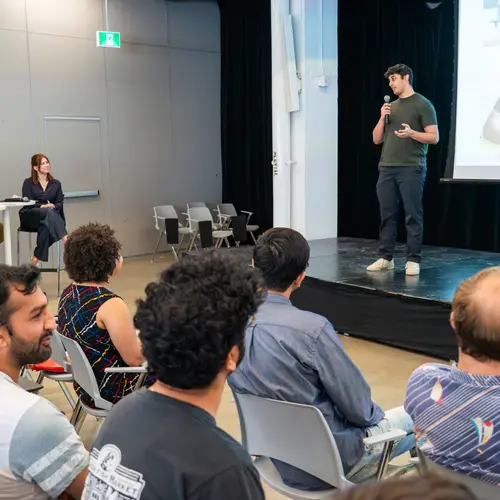
Join us on November 19 for the third edition of Mila’s science popularization contest, where students will present their complex research in just three minutes before a jury.
We use cookies to analyze the browsing and usage of our website and to personalize your experience. You can disable these technologies at any time, but this may limit certain functionalities of the site. Read our Privacy Policy for more information.
Setting cookies
You can enable and disable the types of cookies you wish to accept. However certain choices you make could affect the services offered on our sites (e.g. suggestions, personalised ads, etc.).
Essential cookies
These cookies are necessary for the operation of the site and cannot be deactivated. (Still active)
Analytics cookies
Do you accept the use of cookies to measure the audience of our sites?
Multimedia Player
Do you accept the use of cookies to display and allow you to watch the video content hosted by our partners (YouTube, etc.)?
Diffusion models have demonstrated strong generative capabilities across domains ranging from image synthesis to complex reasoning tasks. Ho… (see more)wever, most inference-time scaling methods rely on fixed denoising schedules, limiting their ability to allocate computation based on instance difficulty or task-specific demands adaptively. We introduce the challenge of adaptive inference-time scaling-dynamically adjusting computational effort during inference-and propose Adaptive Bi-directional Cyclic Diffusion (ABCD), a flexible, search-based inference framework. ABCD refines outputs through bi-directional diffusion cycles while adaptively controlling exploration depth and termination. It comprises three components: Cyclic Diffusion Search, Automatic Exploration-Exploitation Balancing, and Adaptive Thinking Time. Experiments show that ABCD improves performance across diverse tasks while maintaining computational efficiency.
We introduce a machine learning approach to determine the transition dynamics of silicon atoms on a single layer of carbon atoms, when stimu… (see more)lated by the electron beam of a scanning transmission electron microscope (STEM). Our method is data-centric, leveraging data collected on a STEM. The data samples are processed and filtered to produce symbolic representations, which we use to train a neural network to predict transition probabilities. These learned transition dynamics are then leveraged to guide a single silicon atom throughout the lattice to pre-determined target destinations. We present empirical analyses that demonstrate the efficacy and generality of our approach.