Portrait of Arna Ghosh

Arna Ghosh

Collaborating Alumni - McGill University
Supervisor
Research Topics
Computational Neuroscience
Computer Vision
Deep Learning
Dynamical Systems
Machine Learning Theory
Representation Learning

Publications

Why all roads don't lead to Rome: Representation geometry varies across the human visual cortical hierarchy
Zahraa Chorghay
Blake Aaron Richards
Tracing the Representation Geometry of Language Models from Pretraining to Post-training
Melody Zixuan Li
Adam Santoro
Blake A. Richards
Standard training metrics like loss fail to explain the emergence of complex capabilities in large language models. We take a spectral appro… (see more)ach to investigate the geometry of learned representations across pretraining and post-training, measuring effective rank (RankMe) and eigenspectrum decay (
Brain-like learning with exponentiated gradients
Kaiwen Sheng
Brendan A. Bicknell
Beverley A. Clark
Blake A. Richards
Computational neuroscience relies on gradient descent (GD) for training artificial neural network (ANN) models of the brain. The advantage o… (see more)f GD is that it is effective at learning difficult tasks. However, it produces ANNs that are a poor phenomenological fit to biology, making them less relevant as models of the brain. Specifically, it violates Dale’s law, by allowing synapses to change from excitatory to inhibitory, and leads to synaptic weights that are not log-normally distributed, contradicting experimental data. Here, starting from first principles of optimisation theory, we present an alternative learning algorithm, exponentiated gradient (EG), that respects Dale’s Law and produces log-normal weights, without losing the power of learning with gradients. We also show that in biologically relevant settings EG outperforms GD, including learning from sparsely relevant signals and dealing with synaptic pruning. Altogether, our results show that EG is a superior learning algorithm for modelling the brain with ANNs.
Stochastic Wiring of Cell Types Enhances Fitness by Generating Phenotypic Variability
Augustine N. Mavor-Parker
Anthony Zador
The development of neural connectivity is a crucial biological process that gives rise to diverse brain circuits and behaviors. Neural devel… (see more)opment is a stochastic process, but this stochasticity is often treated as a nuisance to overcome rather than as a functional advantage. Here we use a computational model, in which connection probabilities between discrete cell types are genetically specified, to investigate the benefits of stochasticity in the development of neural wiring. We show that this model can be viewed as a generalization of a powerful class of artificial neural networks—Bayesian neural networks—where each network parameter is a sample from a distribution. Our results reveal that stochasticity confers a greater benefit in large networks and variable environments, which may explain its role in organisms with larger brains. Surprisingly, we find that the average fitness over a population of agents is higher than a single agent defined by the average connection probability. Our model reveals how developmental stochasticity, by inducing a form of non-heritable phenotypic variability, can increase the probability that at least some individuals will survive in rapidly changing, unpredictable environments. Our results suggest how stochasticity may be an important feature rather than a bug in neural development.
Synaptic Weight Distributions Depend on the Geometry of Plasticity
A growing literature in computational neuroscience leverages gradient descent and learning algorithms that approximate it to study synaptic … (see more)plasticity in the brain. However, the vast majority of this work ignores a critical underlying assumption: the choice of distance for synaptic changes - i.e. the geometry of synaptic plasticity. Gradient descent assumes that the distance is Euclidean, but many other distances are possible, and there is no reason that biology necessarily uses Euclidean geometry. Here, using the theoretical tools provided by mirror descent, we show that the distribution of synaptic weights will depend on the geometry of synaptic plasticity. We use these results to show that experimentally-observed log-normal weight distributions found in several brain areas are not consistent with standard gradient descent (i.e. a Euclidean geometry), but rather with non-Euclidean distances. Finally, we show that it should be possible to experimentally test for different synaptic geometries by comparing synaptic weight distributions before and after learning. Overall, our work shows that the current paradigm in theoretical work on synaptic plasticity that assumes Euclidean synaptic geometry may be misguided and that it should be possible to experimentally determine the true geometry of synaptic plasticity in the brain.
Harnessing small projectors and multiple views for efficient vision pretraining
Recent progress in self-supervised (SSL) visual representation learning has led to the development of several different proposed frameworks … (see more)that rely on augmentations of images but use different loss functions. However, there are few theoretically grounded principles to guide practice, so practical implementation of each SSL framework requires several heuristics to achieve competitive performance. In this work, we build on recent analytical results to design practical recommendations for competitive and efficient SSL that are grounded in theory. Specifically, recent theory tells us that existing SSL frameworks are minimizing the same idealized loss, which is to learn features that best match the data similarity kernel defined by the augmentations used. We show how this idealized loss can be reformulated to a functionally equivalent loss that is more efficient to compute. We study the implicit bias of using gradient descent to minimize our reformulated loss function and find that using a stronger orthogonalization constraint with a reduced projector dimensionality should yield good representations. Furthermore, the theory tells us that approximating the reformulated loss should be improved by increasing the number of augmentations, and as such using multiple augmentations should lead to improved convergence. We empirically verify our findings on CIFAR, STL and Imagenet datasets, wherein we demonstrate an improved linear readout performance when training a ResNet-backbone using our theoretically grounded recommendations. Remarkably, we also demonstrate that by leveraging these insights, we can reduce the pretraining dataset size by up to 2
Learning Successor Features the Simple Way
Christos Kaplanis
Blake Aaron Richards
In Deep Reinforcement Learning (RL), it is a challenge to learn representations that do not exhibit catastrophic forgetting or interference … (see more)in non-stationary environments. Successor Features (SFs) offer a potential solution to this challenge. However, canonical techniques for learning SFs from pixel-level observations often lead to representation collapse, wherein representations degenerate and fail to capture meaningful variations in the data. More recent methods for learning SFs can avoid representation collapse, but they often involve complex losses and multiple learning phases, reducing their efficiency. We introduce a novel, simple method for learning SFs directly from pixels. Our approach uses a combination of a Temporal-difference (TD) loss and a reward prediction loss, which together capture the basic mathematical definition of SFs. We show that our approach matches or outperforms existing SF learning techniques in both 2D (Minigrid), 3D (Miniworld) mazes and Mujoco, for both single and continual learning scenarios. As well, our technique is efficient, and can reach higher levels of performance in less time than other approaches. Our work provides a new, streamlined technique for learning SFs directly from pixel observations, with no pretraining required.
On the Information Geometry of Vision Transformers
On the Varied Faces of Overparameterization in Supervised and Self-Supervised Learning
Matteo Gamba
Blake Aaron Richards
Agrawal
Hossein Azizpour
Mårten Björkman
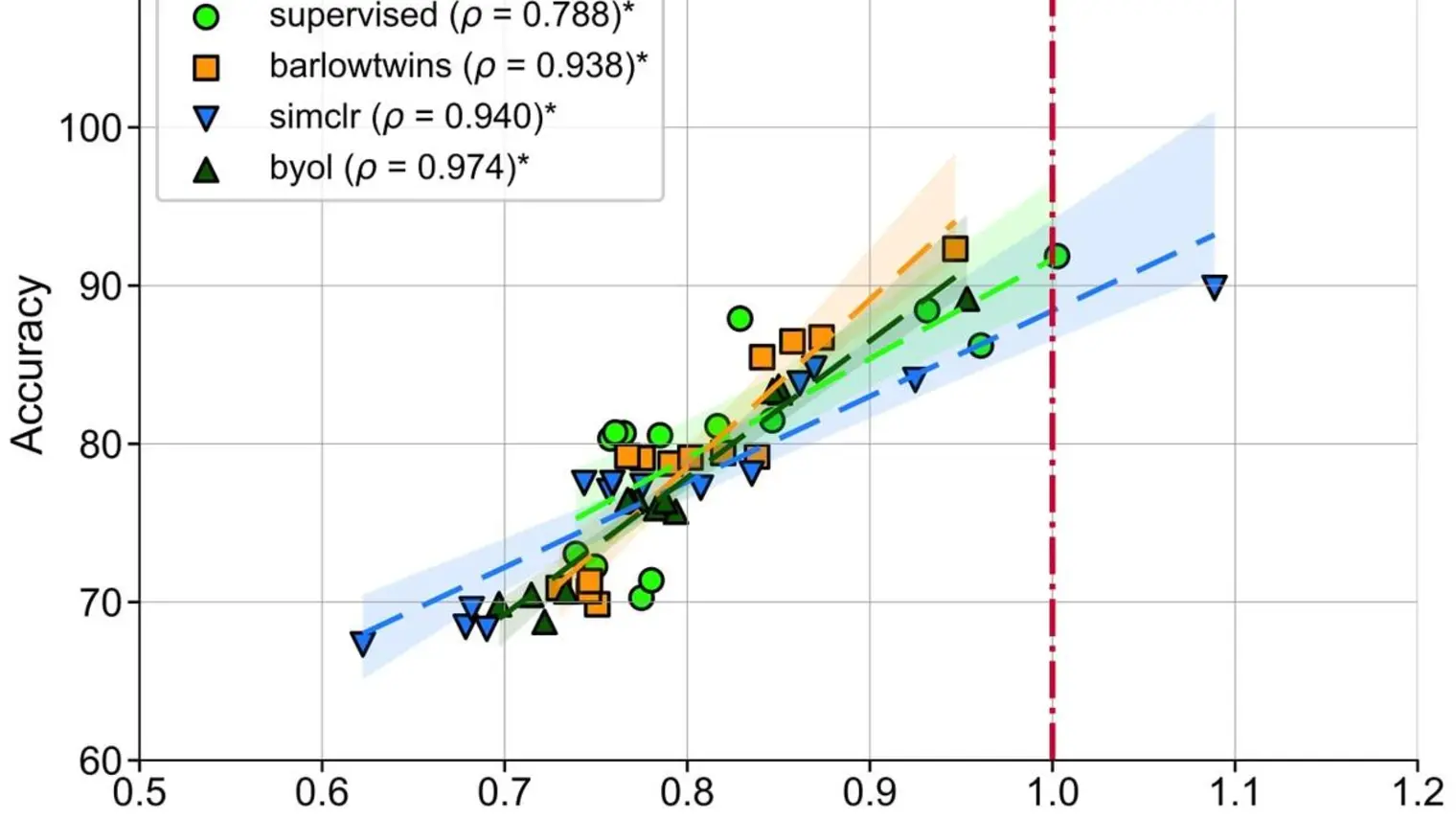
The quality of the representations learned by neural networks depends on several factors, including the loss function, learning algorithm, a… (see more)nd model architecture. In this work, we use information geometric measures to assess the representation quality in a principled manner. We demonstrate that the sensitivity of learned representations to input perturbations, measured by the spectral norm of the feature Jacobian, provides valuable information about downstream generalization. On the other hand, measuring the coefficient of spectral decay observed in the eigenspectrum of feature covariance provides insights into the global representation geometry. First, we empirically establish an equivalence between these notions of representation quality and show that they are inversely correlated. Second, our analysis reveals the varying roles that overparameterization plays in improving generalization. Unlike supervised learning, we observe that increasing model width leads to higher discriminability and less smoothness in the self-supervised regime. Furthermore, we report that there is no observable double descent phenomenon in SSL with non-contrastive objectives for commonly used parameterization regimes, which opens up new opportunities for tight asymptotic analysis. Taken together, our results provide a loss-aware characterization of the different role of overparameterization in supervised and self-supervised learning.


The feature landscape of visual cortex
Rudi Tong
Ronan da Silva
James Wilsenach
Stuart Trenholm
Understanding computations in the visual system requires a characterization of the distinct feature preferences of neurons in different visu… (see more)al cortical areas. However, we know little about how feature preferences of neurons within a given area relate to that area’s role within the global organization of visual cortex. To address this, we recorded from thousands of neurons across six visual cortical areas in mouse and leveraged generative AI methods combined with closed-loop neuronal recordings to identify each neuron’s visual feature preference. First, we discovered that the mouse’s visual system is globally organized to encode features in a manner invariant to the types of image transformations induced by self-motion. Second, we found differences in the visual feature preferences of each area and that these differences generalized across animals. Finally, we observed that a given area’s collection of preferred stimuli (‘own-stimuli’) drive neurons from the same area more effectively through their dynamic range compared to preferred stimuli from other areas (‘other-stimuli’). As a result, feature preferences of neurons within an area are organized to maximally encode differences among own-stimuli while remaining insensitive to differences among other-stimuli. These results reveal how visual areas work together to efficiently encode information about the external world.
Learning better with Dale's Law: A Spectral Perspective
Most recurrent neural networks (RNNs) do not include a fundamental constraint of real neural circuits: Dale’s Law, which implies that neur… (see more)ons must be excitatory (E) or inhibitory (I). Dale’s Law is generally absent from RNNs because simply partitioning a standard network’s units into E and I populations impairs learning. However, here we extend a recent feedforward bio-inspired EI network architecture, named Dale’s ANNs, to recurrent networks, and demonstrate that good performance is possible while respecting Dale’s Law. This begs the question: What makes some forms of EI network learn poorly and others learn well? And, why does the simple approach of incorporating Dale’s Law impair learning? Historically the answer was thought to be the sign constraints on EI network parameters, and this was a motivation behind Dale’s ANNs. However, here we show the spectral properties of the recurrent weight matrix at initialisation are more impactful on network performance than sign constraints. We find that simple EI partitioning results in a singular value distribution that is multimodal and dispersed, whereas standard RNNs have an unimodal, more clustered singular value distribution, as do recurrent Dale’s ANNs. We also show that the spectral properties and performance of partitioned EI networks are worse for small networks with fewer I units, and we present normalised SVD entropy as a measure of spectrum pathology that correlates with performance. Overall, this work sheds light on a long-standing mystery in neuroscience-inspired AI and computational neuroscience, paving the way for greater alignment between neural networks and biology.
How Gradient Estimator Variance and Bias Could Impact Learning in Neural Circuits
Yuhan Helena Liu
Konrad Kording
Blake A. Richards