Portrait of Max Schwarzer is unavailable

Max Schwarzer

Alumni

Publications

Learning and Controlling Silicon Dopant Transitions in Graphene using Scanning Transmission Electron Microscopy
Joshua Greaves
Ekin Dogus Cubuk
Bellemare Marc-Emmanuel
Sergei Kalinin
Igor Mordatch
Kevin M Roccapriore
We introduce a machine learning approach to determine the transition dynamics of silicon atoms on a single layer of carbon atoms, when stimu… (see more)lated by the electron beam of a scanning transmission electron microscope (STEM). Our method is data-centric, leveraging data collected on a STEM. The data samples are processed and filtered to produce symbolic representations, which we use to train a neural network to predict transition probabilities. These learned transition dynamics are then leveraged to guide a single silicon atom throughout the lattice to pre-determined target destinations. We present empirical analyses that demonstrate the efficacy and generality of our approach.
The Position Dependence of Electron Beam Induced Effects in 2D Materials with Deep Neural Networks
Kevin M. Roccapriore
Joshua Greaves
Riccardo Torsi
Colton Bishop
Igor Mordatch
Ekin D. Cubuk
Bellemare Marc-Emmanuel
Joshua Robinson
Sergei V Kalinin
Large Language Models as Generalizable Policies for Embodied Tasks
Andrew Szot
Harsh Agrawal
Walter Talbott
Rin Metcalf
Natalie Mackraz
R Devon Hjelm
Alexander T Toshev
Learning Silicon Dopant Transitions in Graphene using Scanning Transmission Electron Microscopy
Joshua Greaves
Kevin Roccapriore
Ekin Dogus Cubuk
Bellemare Marc-Emmanuel
Sergei Kalinin
Igor Mordatch
We introduce a machine learning approach to determine the transition rates of silicon atoms on a single layer of carbon atoms, when stimulat… (see more)ed by the electron beam of a scanning transmission electron microscope (STEM). Our method is data-centric, leveraging data collected on a STEM. The data samples are processed and filtered to produce symbolic representations, which we use to train a neural network to predict transition rates. These rates are then applied to guide a single silicon atom throughout the lattice to pre-determined target destinations. We present empirical analyses that demonstrate the efficacy and generality of our approach.
Discovering the Electron Beam Induced Transition Rates for Silicon Dopants in Graphene with Deep Neural Networks in the STEM
Kevin M Roccapriore
Joshua Greaves
Colton Bishop
Maxim Ziatdinov
Igor Mordatch
Ekin D Cubuk
Bellemare Marc-Emmanuel
Sergei V Kalinin
Journal Article Discovering the Electron Beam Induced Transition Rates for Silicon Dopants in Graphene with Deep Neural Networks in the STEM… (see more) Get access Kevin M Roccapriore, Kevin M Roccapriore Center for Nanophase Materials Sciences, Oak Ridge National Laboratory, Oak Ridge, TN, United States Search for other works by this author on: Oxford Academic Google Scholar Max Schwarzer, Max Schwarzer Mila - Québec AI Institute, Montréal, QC, CanadaDepartment of Computer Science and Operations Research, Université de Montréal, Montréal, QC, CanadaGoogle Research, Brain Team Search for other works by this author on: Oxford Academic Google Scholar Joshua Greaves, Joshua Greaves Google Research, Brain Team Search for other works by this author on: Oxford Academic Google Scholar Jesse Farebrother, Jesse Farebrother Mila - Québec AI Institute, Montréal, QC, CanadaGoogle Research, Brain TeamSchool of Computer Science, McGill University, Montréal, QC, Canada Search for other works by this author on: Oxford Academic Google Scholar Rishabh Agarwal, Rishabh Agarwal Mila - Québec AI Institute, Montréal, QC, CanadaDepartment of Computer Science and Operations Research, Université de Montréal, Montréal, QC, CanadaGoogle Research, Brain Team Search for other works by this author on: Oxford Academic Google Scholar Colton Bishop, Colton Bishop Google Research, Brain Team Search for other works by this author on: Oxford Academic Google Scholar Maxim Ziatdinov, Maxim Ziatdinov Center for Nanophase Materials Sciences, Oak Ridge National Laboratory, Oak Ridge, TN, United StatesComputational Sciences and Engineering Division, Oak Ridge National Laboratory, Oak Ridge, TN, United States Search for other works by this author on: Oxford Academic Google Scholar Igor Mordatch, Igor Mordatch Google Research, Brain Team Search for other works by this author on: Oxford Academic Google Scholar Ekin D Cubuk, Ekin D Cubuk Google Research, Brain Team Search for other works by this author on: Oxford Academic Google Scholar Aaron Courville, Aaron Courville Mila - Québec AI Institute, Montréal, QC, CanadaDepartment of Computer Science and Operations Research, Université de Montréal, Montréal, QC, Canada Search for other works by this author on: Oxford Academic Google Scholar ... Show more Pablo Samuel Castro, Pablo Samuel Castro Google Research, Brain Team Search for other works by this author on: Oxford Academic Google Scholar Marc G Bellemare, Marc G Bellemare Mila - Québec AI Institute, Montréal, QC, CanadaGoogle Research, Brain TeamSchool of Computer Science, McGill University, Montréal, QC, Canada Search for other works by this author on: Oxford Academic Google Scholar Sergei V Kalinin Sergei V Kalinin Department of Materials Science and Engineering, University of Tennessee, Knoxville TN, United States Corresponding author: sergei2@utk.edu Search for other works by this author on: Oxford Academic Google Scholar Microscopy and Microanalysis, Volume 29, Issue Supplement_1, 1 August 2023, Pages 1932–1933, https://doi.org/10.1093/micmic/ozad067.1000 Published: 22 July 2023
Bigger, Better, Faster: Human-level Atari with human-level efficiency
Johan Obando-Ceron
Bellemare Marc-Emmanuel
We introduce a value-based RL agent, which we call BBF, that achieves super-human performance in the Atari 100K benchmark. BBF relies on sca… (see more)ling the neural networks used for value estimation, as well as a number of other design choices that enable this scaling in a sample-efficient manner. We conduct extensive analyses of these design choices and provide insights for future work. We end with a discussion about updating the goalposts for sample-efficient RL research on the ALE. We make our code and data publicly available at https://github.com/google-research/google-research/tree/master/bigger_better_faster.
Sample-Efficient Reinforcement Learning by Breaking the Replay Ratio Barrier
Simplicial Embeddings in Self-Supervised Learning and Downstream Classification
Simplicial Embeddings (SEM) are representations learned through self-supervised learning (SSL), wherein a representation is projected into …
The Primacy Bias in Deep Reinforcement Learning
This work identifies a common flaw of deep reinforcement learning (RL) algorithms: a tendency to rely on early interactions and ignore usefu… (see more)l evidence encountered later. Because of training on progressively growing datasets, deep RL agents incur a risk of overfitting to earlier experiences, negatively affecting the rest of the learning process. Inspired by cognitive science, we refer to this effect as the primacy bias. Through a series of experiments, we dissect the algorithmic aspects of deep RL that exacerbate this bias. We then propose a simple yet generally-applicable mechanism that tackles the primacy bias by periodically resetting a part of the agent. We apply this mechanism to algorithms in both discrete (Atari 100k) and continuous action (DeepMind Control Suite) domains, consistently improving their performance.
Reincarnating Reinforcement Learning: Reusing Prior Computation to Accelerate Progress
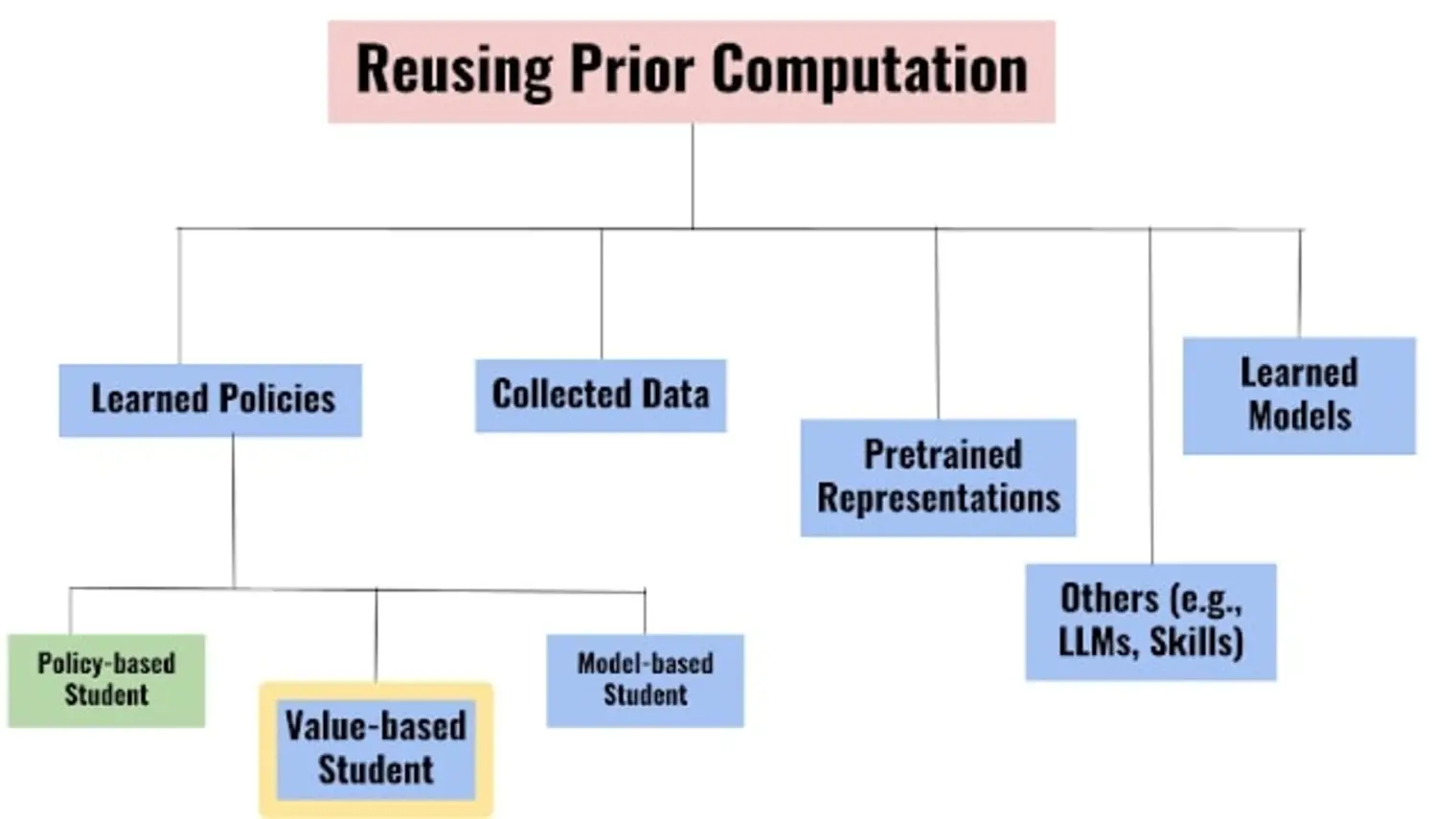
Learning tabula rasa, that is without any prior knowledge, is the prevalent workflow in reinforcement learning (RL) research. However, RL sy… (see more)stems, when applied to large-scale settings, rarely operate tabula rasa. Such large-scale systems undergo multiple design or algorithmic changes during their development cycle and use ad hoc approaches for incorporating these changes without re-training from scratch, which would have been prohibitively expensive. Additionally, the inefficiency of deep RL typically excludes researchers without access to industrial-scale resources from tackling computationally-demanding problems. To address these issues, we present reincarnating RL as an alternative workflow or class of problem settings, where prior computational work (e.g., learned policies) is reused or transferred between design iterations of an RL agent, or from one RL agent to another. As a step towards enabling reincarnating RL from any agent to any other agent, we focus on the specific setting of efficiently transferring an existing sub-optimal policy to a standalone value-based RL agent. We find that existing approaches fail in this setting and propose a simple algorithm to address their limitations. Equipped with this algorithm, we demonstrate reincarnating RL's gains over tabula rasa RL on Atari 2600 games, a challenging locomotion task, and the real-world problem of navigating stratospheric balloons. Overall, this work argues for an alternative approach to RL research, which we believe could significantly improve real-world RL adoption and help democratize it further. Open-sourced code and trained agents at https://agarwl.github.io/reincarnating_rl.


Pretraining Reward-Free Representations for Data-Efficient Reinforcement Learning
Iterated Learning for Emergent Systematicity in VQA
Yuchen Lu
Eeshan Dhekane
Although neural module networks have an architectural bias towards compositionality, they require gold standard layouts to generalize system… (see more)atically in practice. When instead learning layouts and modules jointly, compositionality does not arise automatically and an explicit pressure is necessary for the emergence of layouts exhibiting the right structure. We propose to address this problem using iterated learning, a cognitive science theory of the emergence of compositional languages in nature that has primarily been applied to simple referential games in machine learning. Considering the layouts of module networks as samples from an emergent language, we use iterated learning to encourage the development of structure within this language. We show that the resulting layouts support systematic generalization in neural agents solving the more complex task of visual question-answering. Our regularized iterated learning method can outperform baselines without iterated learning on SHAPES-SyGeT (SHAPES Systematic Generalization Test), a new split of the SHAPES dataset we introduce to evaluate systematic generalization, and on CLOSURE, an extension of CLEVR also designed to test systematic generalization. We demonstrate superior performance in recovering ground-truth compositional program structure with limited supervision on both SHAPES-SyGeT and CLEVR.