

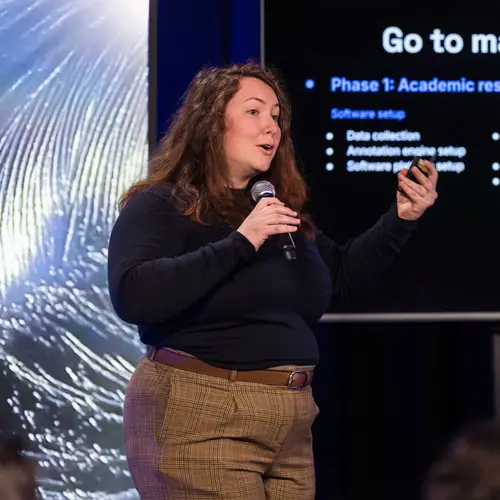


Maria Cutumisu
Biography
Maria Cutumisu is an associate professor in Learning Sciences at the Department of Educational and Counselling Psychology, Faculty of Education, McGill University. She is also an Adjunct Professor in the Department of Computing Science, Faculty of Science, University of Alberta as well as an Adjunct Professor in the Faculty of Education, University of Alberta. Previously, she was a tenured Associate Professor in the Department of Educational Psychology, Faculty of Education, at the University of Alberta, where she established her lab in 2015 in the area of Measurement, Evaluation, and Data Science affiliated with the Centre for Research in Applied Measurement and Evaluation (CRAME).
She graduated with an M.Sc. and a Ph.D. in Computing Science from the Department of Computing Science, University of Alberta and she trained as a postdoctoral scholar in Learning Sciences at the Stanford Graduate School of Education's AAA Lab. Her research draws on computing science and educational psychology and has been funded by tri-council grants and scholarships as a principal investigator (NSERC DGs, NSERC CGS-D, SSHRC IG, and SSHRC IDGs) and as a co-principal investigator (SSHRC IGs, SSHRC IDG, SSHRC PDG, NSERC CREATE, and CIHR). In 2025, she was included on the Elsevier and Stanford University list of the world's top 2% scientists based on citations from 2024.
Her research interests include feedback processing and memory (SSHRC IDGs), machine learning and educational data mining for automated feedback generation (NSERC DGs), game-based assessments that support learning and performance-based learning (SSHRC IGs), computational thinking and data literacy (CanCode Callysto grants, CCTt tests, and SSHRC IG), AI in games (reinforcement learning in computer role-playing games) and non-player character (NPC) behaviours (NSERC CGS-D), and serious games (the RETAIN game for neonatal resuscitation; FRQS). She employs learning analytics to investigate the impact of K-16 student choices (e.g., willingness to seek critical feedback and to revise) and mindset on learning outcomes in an online game-based assessment to understand how prepared students are to learn and innovate. She uses psychophysiological technology (eye-tracking and electrodermal activity wearables) to provide a comprehensive understanding of student learning and memory processes (SSHRC IDG, Killam).