


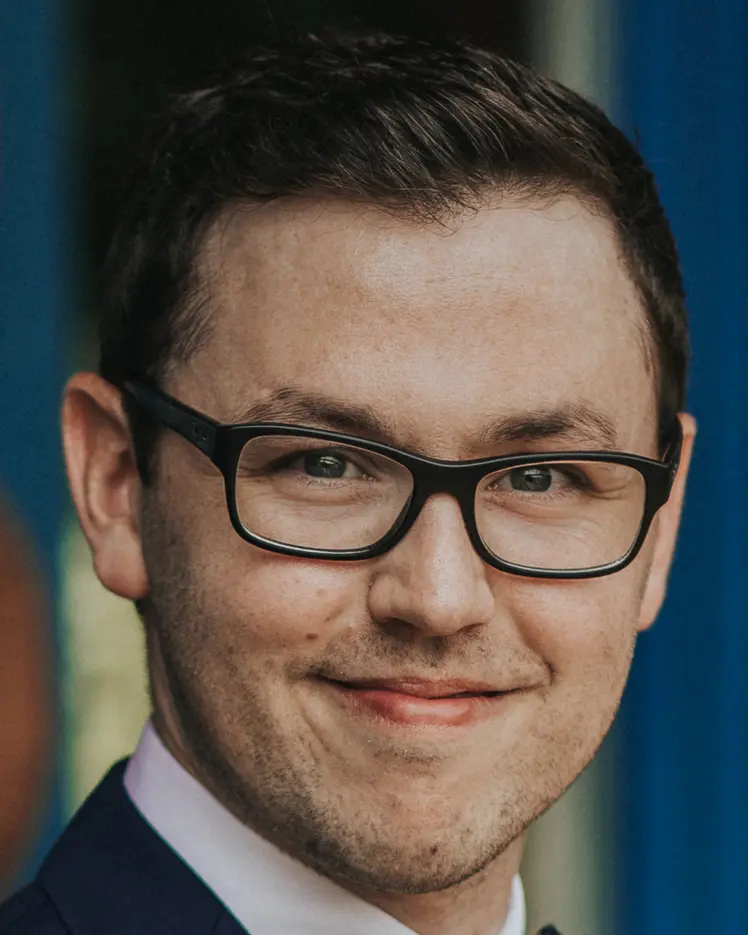
Portrait of Vincent Taschereau-Dumouchel

Vincent Taschereau-Dumouchel

Affiliate Member
Assistant Professor, Université de Montréal, Department of Psychology
Université de Montréal
Research Topics
Brain-computer Interfaces
Cognition
Cognitive Science
Computational Neuroscience
Consciousness
Language Model
NeuroAI
Neuroimaging (fMRI)
Phenomenological Consciousness

Biography

Vincent Taschereau-Dumouchel is a neuropsychologist working at the intersection of cognitive neuroscience, mental health, and artificial intelligence.

Based in the Department of Psychology at the Université de Montréal, his research combines AI and cognitive neuroscience to deepen our understanding of mental disorders and improve their treatment. His laboratory focuses particularly on conscious pathological experiences that underlie conditions such as fear and anxiety disorders.

His team specializes in developing closed-loop brain imaging systems that integrate real-time neuroimaging with machine learning. He currently leads projects funded by NSERC (Discovery Grant) to create co-adaptive systems using generative AI to modulate brain activity and subjective experience. He also leads projects to better study the subjective experience of delusion, fear and anxiety using large language models and intensive fMRI (notably funded by Beneva).

In parallel, Dr. Taschereau-Dumouchel serves as Director of the Data Valorisation axis of the Quebec Mental Health Alliance, an initiative uniting the three main FRQ-affiliated psychiatric research centers (CR-IUSMM, Douglas, and Cervo). They are currently leading efforts to federate clinical data across institutions and to develop accessible AI tools for researchers and clinicians.

Publications

A French Canadian adaptation and validation of the Vividness of Visual Imagery Questionnaire and Plymouth Sensory Imagery Questionnaire.
Catherine Landry
Laurence Lessard
Jeffrey Saint-Louis
Frédéric Gosselin
Guillaume T. Vallet
Mental imagery plays a central role in various cognitive processes and is increasingly investigated in cognitive science. Yet standardized t… (see more)ools for its assessment in French-speaking populations remain scarce. This study examined the psychometric properties of two widely used self-report instruments of mental imagery within the French Canadian population: the Vividness of Visual Imagery Questionnaire (VVIQ) and the Plymouth Sensory Imagery Questionnaire (Psi-Q)-here termed VVIQ-Québec (QC) and Psiq-QC. A total of 328 adults completed the VVIQ-QC and Psiq-QC, with a randomly selected subsample (n = 73) repeating the assessment 1 month later. Exploratory factor analysis of the VVIQ-QC (eyes-open) revealed, as in the original VVIQ, distinct factors corresponding to each prompt cluster (i.e., relative, sunrise, landscape, and storefront). The Psiq-QC yielded a six-factor solution after excluding the Body modality, diverging from the original seven-factor model. Both instruments showed strong internal consistency, temporal stability, and convergent validity. No significant effects of age, sex, or education were observed on imagery scores. These findings provide the first validated French Canadian versions of the VVIQ and Psi-Q, available via the Open Science Framework at https://osf.io/wuhja, offering reliable tools for both research and clinical applications. (PsycInfo Database Record (c) 2025 APA, all rights reserved).
What makes a theory of consciousness unscientific?
Derek H. Mark G. Tristan A. Yoshua James W. Jacob Dean D Arnold Baxter Bekinschtein Bengio Bisley Browning
Derek H. Arnold
Mark G. Baxter
Tristan A. Bekinschtein
James W. Bisley
Jacob Browning
Dean Buonomano
David Carmel
Marisa Carrasco
Peter Carruthers
Olivia Carter
Dorita H. F. Chang
Mouslim Cherkaoui
Axel Cleeremans
Michael A. Cohen
Philip R. Corlett
Kalina Christoff
Sam Cumming … (see 84 more)
Cody A. Cushing
Beatrice de Gelder
Felipe De Brigard
Daniel C. Dennett
Nadine Dijkstra
Adrien Doerig
Paul E. Dux
Stephen M. Fleming
Keith Frankish
Chris D. Frith
Sarah Garfinkel
Melvyn A. Goodale
Jacqueline Gottlieb
Jake R. Hanson
Ran R. Hassin
Michael H. Herzog
Cecilia Heyes
Po-Jang Hsieh
Shao-Min Hung
Robert Kentridge
Tomas Knapen
Nikos Konstantinou
Konrad Kording
Timo L. Kvamme
Sze Chai Kwok
Renzo C. Lanfranco
Hakwan Lau
Joseph LeDoux
Alan L. F. Lee
Camilo Libedinsky
Matthew D. Lieberman
Ying-Tung Lin
Ka-Yuet Liu
Maro G. Machizawa
Julio Martinez-Trujillo
Janet Metcalfe
Matthias Michel
Kenneth D. Miller
Partha P. Mitra
Dean Mobbs
Robert M. Mok
Jorge Morales
Myrto Mylopoulos
Brian Odegaard
Charles C.-F. Or
Adrian M. Owen
David Pereplyotchik
Franco Pestilli
Megan A. K. Peters
Ian Phillips
Rosanne L. Rademaker
Dobromir Rahnev
Geraint Rees
Dario L. Ringach
Adina Roskies
Daniela Schiller
Aaron Schurger
D. Samuel Schwarzkopf
Ryan B. Scott
Aaron R. Seitz
Joshua Shepherd
Juha Silvanto
Heleen A. Slagter
Barry C. Smith
Guillermo Solovey
David Soto
Hugo Spiers
Timo Stein
Frank Tong
Peter U. Tse
Jonas Vibell
Sebastian Watzl
Josh Weisberg
Thalia Wheatley
Michael H. Herzog
Martijn E. Wokke
Hakwan Lau
Michał Klincewicz
Tony Cheng
Michael Schmitz
Miguel Ángel Sebastián
Joel S. Snyder
Aftereffects following adaptation to face mental images
Mathias Salvas-Hébert
Frédéric Gosselin
Unveiling Mental Imagery: Enhanced Mental Images Reconstruction using EEG and the Bubbles Method
Audrey Lamy-Proulx
Laurence Leblond
Jasper van den Bosch
Catherine Landry
Peter Brotherwood
Frédéric Gosselin
Are vividness judgments in mental imagery correlated with perceptual thresholds?
Clémence Bertrand Pilon
Frédéric Gosselin
Reconstructing mental images using Bubbles and electroencephalography
Audrey Lamy-Proulx
Jasper van den Bosch
Catherine Landry
Peter Brotherwood
Frédéric Gosselin
Do visual mental imagery and exteroceptive perception rely on the same mechanisms?
Catherine Landry
Jasper JF van den Bosch
Frédéric Gosselin