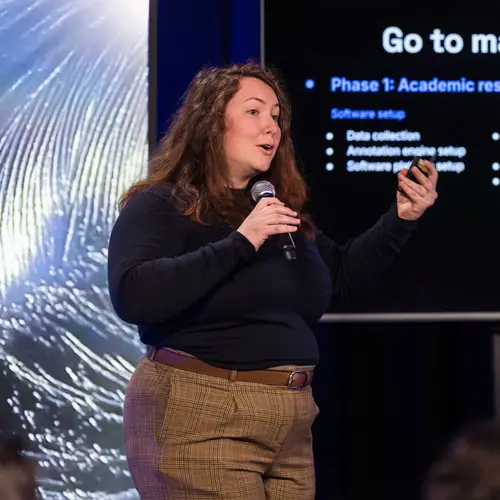
The upcoming meeting, taking place on November 10 at Mila, will explore how we can collectively develop, govern, and deploy high-performing, reliable, and secure agentic systems by connecting academic researchers, industry experts, and practitioners.
We use cookies to analyze the browsing and usage of our website and to personalize your experience. You can disable these technologies at any time, but this may limit certain functionalities of the site. Read our Privacy Policy for more information.
Setting cookies
You can enable and disable the types of cookies you wish to accept. However certain choices you make could affect the services offered on our sites (e.g. suggestions, personalised ads, etc.).
Essential cookies
These cookies are necessary for the operation of the site and cannot be deactivated. (Still active)
Analytics cookies
Do you accept the use of cookies to measure the audience of our sites?
Multimedia Player
Do you accept the use of cookies to display and allow you to watch the video content hosted by our partners (YouTube, etc.)?
Biomolecular interactions play a critical role in biological processes. While recent breakthroughs like AlphaFold 3 have enabled accurate mo… (see more)deling of biomolecular complex structures, predicting binding affinity remains challenging mainly due to limited high-quality data. Recent methods are often specialized for specific types of biomolecular interactions, limiting their generalizability. In this work, we repurpose AlphaFold 3 for representation learning to predict binding affinity, a non-trivial task that requires shifting from generative structure prediction to encoding observed geometry, simplifying the heavily conditioned trunk module, and designing a framework to jointly capture sequence and structural information. To address these challenges, we introduce the **Atom-level Diffusion Transformer (ADiT)**, which takes sequence and structure as inputs, employs a unified tokenization scheme, integrates diffusion transformers, and removes dependencies on multiple sequence alignments and templates. We pre-train three ADiT variants on the PDB dataset with a denoising objective and evaluate them across protein-ligand, drug-target, protein-protein, and antibody-antigen interactions. The model achieves state-of-the-art or competitive performance across benchmarks, scales effectively with model size, and successfully identifies wet-lab validated affinity-enhancing antibody mutations, establishing a generalizable framework for biomolecular interactions. We plan to release the code upon acceptance.
2025-12-31
International Conference on Learning Representations (Accept (Poster))
Owing to the ongoing mutation of SARS-CoV-2, the vast majority of therapeutic antibodies developed in the early stages have lost their neutr… (see more)alizing effects. Here, we have developed neutralizing antibodies, including 8G3 isolated from patients infected with the wild-type SARS-CoV-2 and its mutants from computational rational design. Following the mutations of 8G3 through computational technology, the neutralizing activity of the antibody was enhanced by approximately 1,500-fold. Our experimental results offer a case study for the optimization of neutralizing antibodies against SARS-CoV-2 guided by computational technology.
2025-02-04
Proceedings of the National Academy of Sciences (published)
The rapid evolution of the viral genome has led to the continual generation of new variants of SARS-CoV-2. Developing antibody drugs with br… (see more)oad-spectrum and high efficiency is a long-term task. It is promising but challenging to develop therapeutic neutralizing antibodies (nAbs) through in vitro evolution based on antigen–antibody binding interactions. From an early B cell antibody repertoire, we isolated antibody 8G3 that retains its nonregressive neutralizing activity against Omicron BA.1 and various other strains in vitro. 8G3 protected ACE2 transgenic mice from BA.1 and WA1/2020 virus infection without adverse clinical manifestations and completely cleared viral load in the lungs. Similar to most IGHV3–53 antibodies, the binding sites of 8G3 and ACE2 largely overlap, enabling competition with ACE2 for binding to RBD. By comprehensively considering the binding free energy changes of the antigen–antibody complexes, the biological environment of their interactions, and the evolutionary direction of the antibodies, we were able to select 50 mutants. Among them, 11 were validated by experiments showing better neutralizing activities. Further, a combination of four mutations were identified in 8G3 that increased its neutralization potency against JN.1, the latest Omicron mutant, by approximately 1,500-fold, and one of the mutations led to an improvement in activity against multiple variants to a certain extent. Together, we established a procedure of rapid selection of neutralizing antibodies with potent SARS-CoV-2 neutralization activity. Our results provide a reference for engineering neutralizing antibodies against future SARS-CoV-2 variants and even other pandemic viruses.
2025-02-04
Proceedings of the National Academy of Sciences (published)
Increasing the binding affinity of an antibody to its target antigen is a crucial task in antibody therapeutics development. This paper pres… (see more)ents a pretrainable geometric graph neural network, GearBind, and explores its potential inin silicoaffinity maturation. Leveraging multi-relational graph construction, multi-level geometric message passing and contrastive pretraining on mass-scale, unlabeled protein structural data, GearBind outperforms previous state-of-the-art approaches on SKEMPI and an independent test set. A powerful ensemble model based on GearBind is then derived and used to successfully enhance the binding of two antibodies with distinct formats and target antigens. ELISA EC50values of the designed antibody mutants are decreased by up to 17 fold, andKDvalues by up to 6.1 fold. These promising results underscore the utility of geometric deep learning and effective pretraining in macromolecule interaction modeling tasks.
In silico prediction of the ligand binding pose to a given protein target is a crucial but challenging task in drug discovery. This work foc… (see more)uses on blind flexible selfdocking, where we aim to predict the positions, orientations and conformations of docked molecules. Traditional physics-based methods usually suffer from inaccurate scoring functions and high inference cost. Recently, data-driven methods based on deep learning techniques are attracting growing interest thanks to their efficiency during inference and promising performance. These methods usually either adopt a two-stage approach by first predicting the distances between proteins and ligands and then generating the final coordinates based on the predicted distances, or directly predicting the global roto-translation of ligands. In this paper, we take a different route. Inspired by the resounding success of AlphaFold2 for protein structure prediction, we propose E3Bind, an end-to-end equivariant network that iteratively updates the ligand pose. E3Bind models the protein-ligand interaction through careful consideration of the geometric constraints in docking and the local context of the binding site. Experiments on standard benchmark datasets demonstrate the superior performance of our end-to-end trainable model compared to traditional and recently-proposed deep learning methods.
2023-04-30
International Conference on Learning Representations (Accept: poster)
Multi-task learning for molecular property prediction is becoming increasingly important in drug discovery. However, in contrast to other do… (see more)mains, the performance of multi-task learning in drug discovery is still not satisfying as the number of labeled data for each task is too limited, which calls for additional data to complement the data scarcity. In this paper, we study multi-task learning for molecular property prediction in a novel setting, where a relation graph between tasks is available. We first construct a dataset (ChEMBL-STRING) including around 400 tasks as well as a task relation graph. Then to better utilize such relation graph, we propose a method called SGNN-EBM to systematically investigate the structured task modeling from two perspectives. (1) In the \emph{latent} space, we model the task representations by applying a state graph neural network (SGNN) on the relation graph. (2) In the \emph{output} space, we employ structured prediction with the energy-based model (EBM), which can be efficiently trained through noise-contrastive estimation (NCE) approach. Empirical results justify the effectiveness of SGNN-EBM. Code is available on https://github.com/chao1224/SGNN-EBM.
2022-03-27
International Conference on Artificial Intelligence and Statistics (Accept (Poster))